
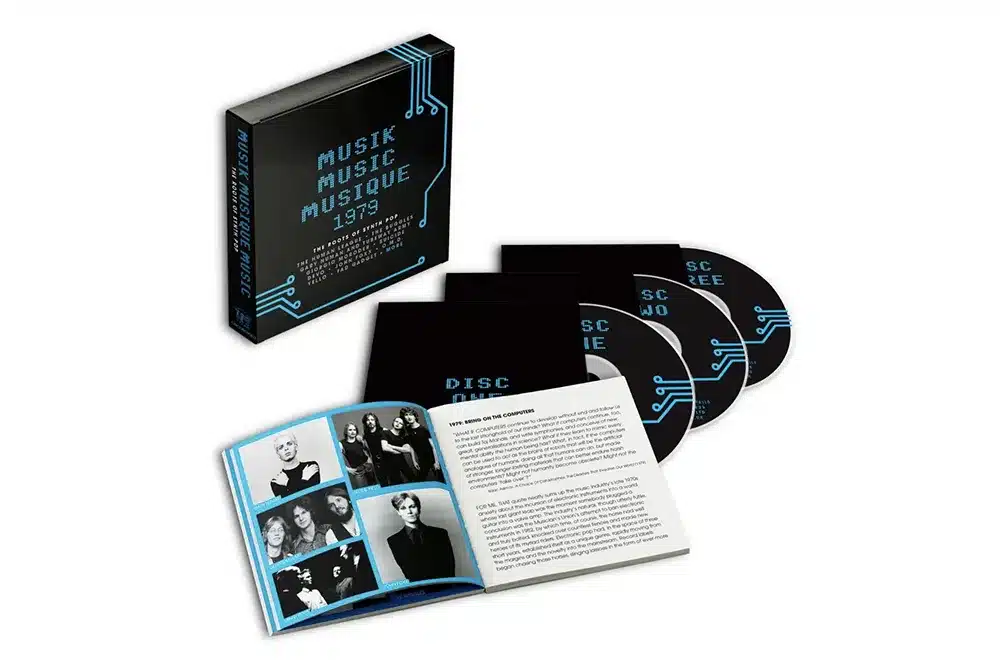
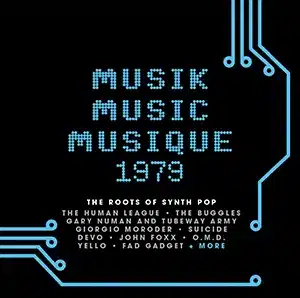
Not even music compilations are immune to the prequel treatment these days. Thus far, Cherry Red’s Musik Music Musique series has documented the rise of synth pop in chronological fashion, with one volume devoted to each of the crucial years from 1980 to 1982. This latest instalment, though, goes back to 1979 to trace sounds that, over the next year or so, would really begin to coalesce into a music all its own. There’s a problem, though, and it’s not a small one. The 1980 volume of the series is subtitled The Dawn of Synth Pop, and you know the saying: It’s always darkest before dawn.
“Synth pop” is a strange term because it is one of the only types of music to be named after an instrument. Of course, synthesisers and electronic instruments can and have been used to make all kinds of music. Furthermore, the music that came to be known as “synth pop” was not made exclusively with synthesisers. Some of it was, but a lot of it featured traditional guitar-bass-drums lineups, which were augmented by synthesisers in prominent ways.
This phenomenon can be illustrated by two early-1980s albums, both of which were massive hits and sold millions of copies. ZZ Top’s Eliminator, which was made by a guitar band that had no nominal synth player, can credibly be described as “synth pop”, while Vangelis’ Chariots of Fire soundtrack was made only with synths, yet is not “synth pop” at all.
Where all this fits in with Musik Music Musique 1979 is that in attempting to examine “The Roots of Synth Pop“, this latest compilation casts a relatively wide net for its 60 tracks. That net, while certainly capturing some gems, ensnares an awful lot of music that hasn’t aged well and, in all likelihood, wasn’t very good to begin with. The liner notes’ acknowledgement that “a few of [these] nuggets may require a little polishing before they begin to sparkle” is too generous by half.
First is the matter of where synth pop was coming from. There can be no doubt that disco was a major influence, helping usher in styles, production techniques, and instrumentation that led to a lot of great music. There can also be no doubt that the vast majority of disco itself amounted to corny, syrupy audio schlock. Disco certainly hadn’t worked its way far enough out of pop music by 1979, as evinced by the nearly-unlistenable likes of the Buggles’ “Technopop” (which, thankfully, turned out to be a red herring of a title), M’s “Made In Munich”, Hammer’s “Forever Tonight” (no, adding pedal steel guitar does not disco sins absolve), and others.
A similarly questionable pedigree also applies to the tracks that still bear too many vestiges of progressive rock. Fashion’s “Technofascist” looks, on paper, both more fashionable and edgier than they really are. After the Fire went on to have a hit covering Falco’s “Der Kommissar”, but on “One Rule For You”, they come off like Yes at their most lightweight and cloying. There is hope, though: “Don’t Dither Do It”, from ex-Gong progster Steve Hillage, actually manages to incorporate both disco and prog styles into something that sounds genuinely forward-thinking, even if, in 1979, that meant nothing more revolutionary than Pink Floyd.
Second is the matter of where synth pop was going. Musik Music Musique 1979 does include some genuinely experimental, electronic-focused music that at least flirts with pop sensibility. However, the material amounts more to abstract assemblages than actual pop songs. Yello’s “I.T. Splash” has a nice electro-pulse that became the band’s calling card; “In the Army”, from Blah Blah Blah, is more interesting than listenable; and Thomas Leer and Robert Rental’s “Attack Decay” is impressively disturbing. None of them, though, amounts to much more than roadside attractions on the way to something more substantial and satisfying.
What’s left, then, is the matter of where synth pop’s “now” was in 1979. Based on most of the best tracks on Musik Music Musique 1979, that was a place that drew equally from both traditionalist pop songcraft and new musical technology. It’s no coincidence that Orchestral Manoeuvres in the Dark‘s haunting, vulnerable “Almost”, Gary Numan‘s equal parts chilling and ass-kicking “Cars”, and Mi-Sex’s compelling, Duran Duran-anticipating “Computer Games” combine modernist sounds with rock dynamics and augment synths and sequencers with bass guitar and acoustic drums. Elsewhere, all-synth covers of “Memphis Tennessee” and “Rock Around the Clock” seem to lampoon and pay respect to their source material simultaneously.
None of these standout tracks is exactly rare, and that is another strike against Musik Music Musique 1979. As thoroughly researched and annotated as it is, the collection is nonetheless short on hidden gems or worthwhile rarities. Then, of course, are the matters of questionable inclusions (The Cars??) and omissions (Sparks, Simple Minds, and Throbbing Gristle all released synth-heavy albums in 1979). For hardcore synth enthusiasts, Musik Music Musique 1979 may be a useful historical document. Otherwise, it’s a backstory that didn’t need to be told in so much ear-assailing detail.