
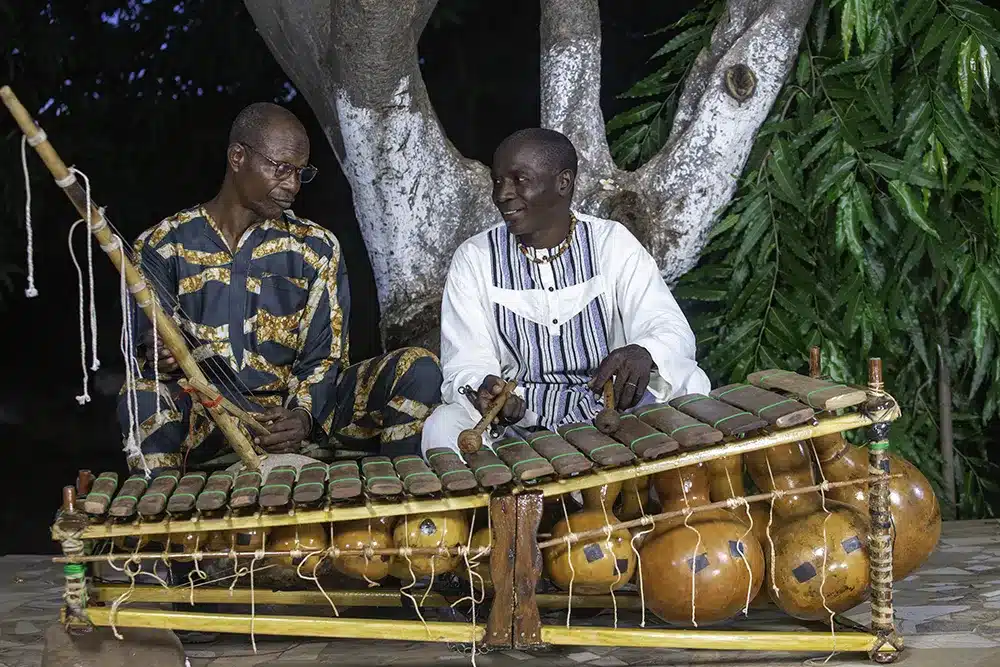
There’s a sincerely grounded quality to A Djinn and a Hunter Went Walking. The new album from balafonist Neba Solo and donsongoni (hunter’s harp) player Benego Diakité–their first as a duo–shines a light on two Malian musicians who are masters of their repertoires. Each performer hails from a different cultural background, with Solo trained in Senufo traditions and Diakité rooted in the Wassoulou region, and they come together here with an understated ease. It makes for a soothing work from start to finish, but with enough moving parts to reasonably grab and hold the attention of a range of audiences.
This is no ordinary celebration of genius. There is no bombast in this combination, at least not in the fully produced pieces. Solo’s and Diakité’s is instead a subtle leadership, and even so an effective one, guiding, as they do, almost a dozen other musicians who record synchronously and asynchronously with them, filling out ten gently intricate tracks with aural warmth.
Most of their comrades offer vocal support (Josephine Dembele, Fanta Dogomani Coulibaly, Bakoro Sidibe, Maimouna Soumounou). Souleymane Sidibe’s additional percussion is crucial in the overall texture of the album, and a string ensemble (arranger John Elliott, violinist Sophie Cameron, violist Alison D’Souza, and cellist Zosia Jagodzinska) and additional drummer (Seb Rochford) add a more dramatic flair to tracks “Djiné Mogo Tiki” and “Nania Ba”.” Each element contributes to the impressions of tradition and art that emerge from the work.
Behind the curtain of it all are producer Nick Gold and multi-instrumentalist Sonny Johns. It’s no surprise to learn of Gold’s involvement, globetrotter and painstaking arranger that he is. Perhaps best known as the organizer of the Buena Vista Social Club phenomenon, Gold is also known for his work with such West African superstars as Ali Farka Touré, Oumou Sangaré, and Orchestra Baobab, among many others worldwide. Johns, too, has an eclectic repertoire that includes engagements with various iterations of folk and pop. Here, he weaves a mesh of pop keys and strings between the voices and folk instruments, not overpowering the core ensemble but adding a vivid element to the atmosphere they create.
For all this collaborative energy, Solo and Diakité truly are the stars here, and they have more than earned that standing. They have been playing their respective instruments since childhood, both earning major local followings and then some; Diakité has spent decades touring with global star Oumou Sangaré. Together, they resonate, earthy and satisfying as they perform traditional tunes with messages of virtue, strength, and other life lessons. Solo usually sings lead, the energy in his voice an exciting complement to the round tones of his woody percussion. Diakité’s harp, meanwhile, has as nimble a voice as any to come from a human throat.
A Djinn and a Hunter Went Walking offers slices of long-held tradition with more globally widespread contemporary pop touches. It’s the kind of thing that requires a very careful approach, lest it fall headfirst into a dated worldbeat paradigm. Fortunately, there are many things to celebrate here: the context given in the liner notes (written by scholar Ingrid Monson), the cooperation clear in the ensemble production, and, most of all, the skill and warmth that exude from Neba Solo and Benego Diakité, two accomplished artists long known in their local and national scenes who now have the platform to speak and play to a wider world.