
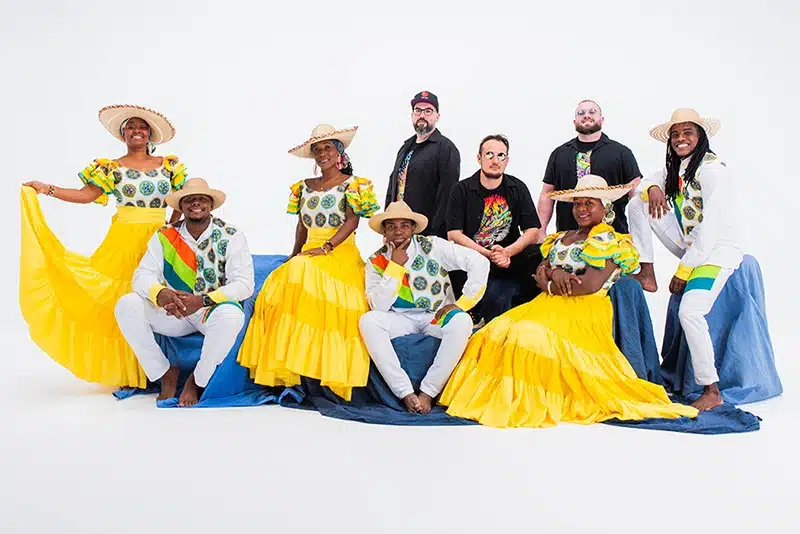

Less than a year after her luscious solo debut, Pacífico Maravilla, Nidia Góngora returns, this time as the frontwoman of Nuevos Ríos. Alongside her are members of her longtime group, Canalón de Timbiquí, and Toulouse-based Reco Reco, an ensemble that focuses on plugged-in renditions of South American styles. Together, the collective perform lively, electrified versions of music from Góngora and Canalón de Timbiquí’s finely honed repertoire, continuing to bear witness to the traditions and lifeways of the Pacific coast of Colombia for audiences worldwide.
Nuevos Ríos’ self-titled debut is nothing short of astonishing, a clear continuation of the work Góngora and her compatriots have long been doing, and yet something that feels wholly new. With only nine tracks, there’s not a moment to waste. The album opens with a quick grounding in a sense of place and time as birds, insects, children’s voices, and a vehicular buzzing kick off “Sumba Ale” before the familiar combination of Cristian Bonilla’s earthy marimba and Góngora’s voice.
It’s a celebration, rollicking percussion and antiphonal chorus indexing the rhythms of everyday life. A few verses and refrains into this, a swell of synths starts glowing in the middle of it all, a seamless, energetic match for Góngora’s calls. It becomes clear, all of a sudden, just how extraordinary this record is bound to be, how tightly it weaves together past and present for the sake of futurity.
Of course, Góngora is no stranger to work in the folktronica vein, having collaborated with producers like Quantic and the Bongo Hop and made two albums as a member of Ondatrópica. Nuevos Ríos is not so far afield from this body of work, but the textures are balanced differently, and exchanges between musicians feel more immediate. “La Vida es un Baile” exemplifies this, as it features acoustic and electric instruments bouncing off one another, aurally analogous to the titular dance.
In sharp tonal contrast, but closely aligned in approach, is “Si Yo Fuera”. Here, Góngora’s mournful vocals and the rattling of the guasá, a percussion instrument filled with seeds, echo keenly with the help of electronic amplification. The track is all the more poignant for it.
Perhaps the most triumphant demonstration of dense but still dynamic instrumentation comes in the form of “Malvada”. Urgently driving forward the track’s folkloric themes is a fantastic mix of marimba and electronic beats. Both elements have their time in the spotlight, but ultimately, the strongest moments are those in which they graciously work together. This is Nuevos Ríos in a philosophical nutshell.
There has been no shortage of European and North American producers trying to fuse Indigenous and African-derived musical styles from South America, especially Colombia, with something in the general area of EDM. Some have been fairly successful, while others have come across as something more akin to neo-worldbeat. Nuevos Ríos seems to have found a better way. The group’s first record emerges from organic processes of collaboration that treat local cultural expressions not as samples but as relevant contemporary music. This is exciting music, a vibrant new turn for Góngora, Canalón de Timbiquí, and Reco Reco. I sincerely hope to hear much more in the future.