
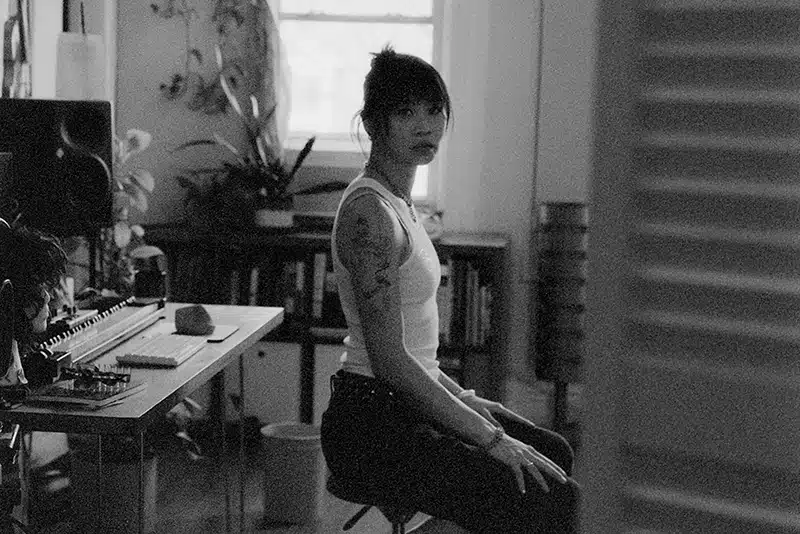

Composer and performer Ohyung (Lia Ouyang Rusli) takes an impressionist approach with real depth on the new experimental album Iowa. Created based on her 11-month stay in the album’s namesake state, Iowa, is an act of counter-cartography.
Against the grain of static pastoral heartland narratives, it portrays the state from an on-the-ground viewpoint as an ever-changing palimpsest. Spacious electronics and samples evoke vast and open landscapes, stories of life and loss, and social tensions and oppression ranging from European colonization to the acts of slow and fast violence that mark the contemporary stateside condition for so many, to specific policies that have recently been implemented in Iowa against, in particular, the state’s trans communities.
There’s a gothic quality to Iowa, an ominous ring to each filmy sound. At the same time, Ohyung frames her album with urgent realism. Its cover is a reference to Bruce Springsteen‘s Nebraska, but even more stark, with a black background and bright red letters: all caps, no serifs, no fuss. OHYUNG. IOWA. What appears to be a spray of blood in the center is, upon closer inspection, a figure gracefully reaching into the darkness. In combination with song titles like “all dolls go to heaven”, “stormchaser”, and “christofascism”, her perspective is unflinching. It’s not ambience for the sake of staying still, but for sparking thoughts and spurring on movements.
Sometimes, this sounds like wonder. Synthesized starbursts, almost metallic but still birdlike, ring out in “dancing parakeets”. Wordless vocal tones glow in “all dolls go to heaven”. Wings flutter amid scattered electronic tones in “driftless”. Often, it sounds like melancholy. This peaks on “nevada”, a piece that starts with a longing soon answered by rolling thunder. Distant voices (maybe; they seem too far away to tell) carry on a dry wind over flat land. The loneliness at its center is heartbreaking.
It’s always hard to tell the exact source of a given sound. Ohyung plays with field recordings and archival samples until they take totally new shapes, which then shift again in relation to new melodies and effects. In “christofascism”, choral voices sound as likely to be from human throats as from plugged-in processors, posing an uncanny paradox that perfectly suits the track’s name.
The same phenomenon plays out very differently at the end of the album, on the 12-minute final track “memorial”, a dirge dedicated to Iowa City music programmer Chris Wiersema. Here, the cyborg chorus sings with care and warmth, leading a kind of meditation on life and loss.
Iowa begins with “purgatory”, a twist of eerie voices and foreboding arpeggi occasionally cut through by cries and storm sounds: stretched-out chaos. By ending the record with “memorial”, Ohyung guides us out of the binding stillness and into a cold light. We mourn what we have lost. We reflect on the love and community we have and how we can continue to cultivate them in the face of dominant narratives that map out borders between us through policy and social categories. It hurts, but when we can, and as Ohyung does in Iowa, we create. Because of that, we move forward.