
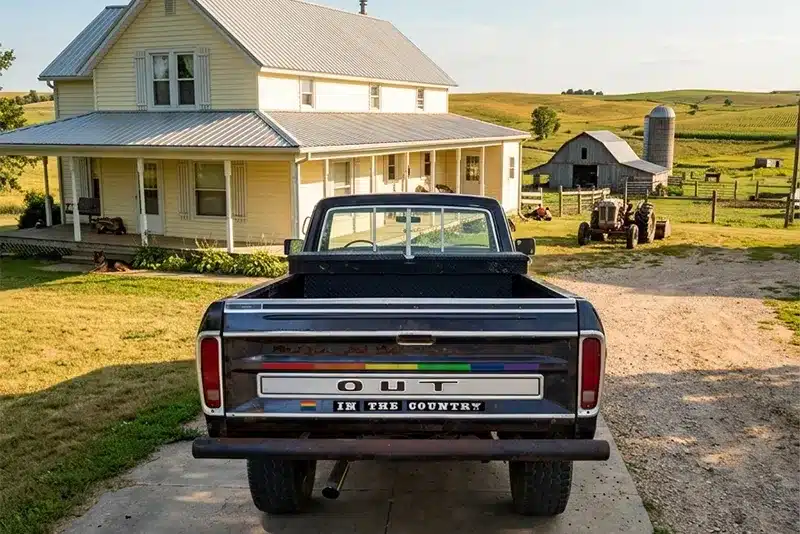

In 1967, newscaster Mike Wallace presented an hour-long investigation into gay life in America. “CBS Reports: The Homosexuals” is one of the earliest moments of queer visibility (for better or worse) in the American mass media. Even in 1967, Wallace reports that most homosexuals are drawn to large urban centers for the “anonymity” they bring, and the opportunity to form communities with the similarly afflicted. Mary L. Gray’s Out in the Country refutes that assumption.
By today’s standards, “CBS Reports: The Homosexuals” is a terrifying pastiche of misinformation and prejudice, a jumble of fearful protestant sexuality and pseudo-scientific reaching. What is interesting about Wallace’s report, in light of Gray’s fascinating ethnography of queer youth in rural America, is its focus on the urban in the earliest narratives of the GLBT (Gay, Lesbian, Bisexual, Transgender) experience.
Of course, it seems to make sense that many GLBT people want to live in a cosmopolitan center, which we deem to be more welcoming of sexual diversity and with more of an infrastructure to support the community. As Gray points out in her fascinating ethnography Out in the Country, not all young people can or want to forsake the country for the big cities. Kicked out of public meeting spaces or squeezed into library basement meeting rooms and chain restaurants, these organizations are often low on funding with no black-tie Human Rights Campaign fundraisers on the horizon. Rural GLBT groups rely on different means to build community far from enclaves like the Castro or Chelsea.
Gray’s observations might surprise you. Instead of long-suffering iconoclasts counting down the days until they can leave the family farm or trailer park, Gray introduces teenagers who are keenly aware of the social systems they inhabit and the means at hand to navigate a life that is both queer and rural. Central to this life is what Gray calls “never met a stranger.” The phrase suggests that people in rural communities know one another well. Whether these people have truly “never met a stranger” in their towns matters less than their belief in familiarity. It’s an ideology that bolsters the power of the family unit. Family, Gray argues, is an identity rural organizers have claimed to advance equality campaigns and consciousness-raising.
In what ways do young queer people get to form and enact their sexual identities if there is a real or perceived familiarity that may prevent any subversion? The answer, it seems, is in claiming or subverting traditional spaces. Gray follows a GLBT group as they meet up at the local Wal-Mart to sashay down the aisles in drag. This is one example of “queering” a traditional space. Drawing on Habermas theory of “the public sphere” and its critics, Gray calls sites like the Wal-Mart “boundary publics” or “iterative, ephemeral experiences of belonging that circulate across the outskirts and through the center(s) of a more recognized and validated public sphere”. Gray’s work helps us understand how it is possible to be truly “out” in the country.
Beyond reclaiming traditional spaces, the media provides other opportunities for visibility and “identity work”. Gray discusses everything from personal homepages to social web spaces like PlanetOut, and late-night documentaries on Discovery Health. The most interesting aspect of how GLBT youth use the media is how it assists in naming their sexual identities.
As Gray points out, youth-focused research poses sampling problems, especially when the research centers on sexuality. Many subjects had already self-identified and were members of one or more GLBT organizations. The small sample may make Gray’s results difficult to generalize, but her ethnography allows us an in-depth look at GLBT young people in the southeastern United States. Gray’s book should be read by anyone who works with rural GLBT youth, and those interested in learning about an under-represented, but not invisible, population.