

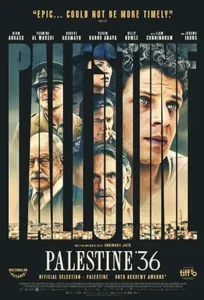
Palestine 36 begins by placing a historical rupture in front of ordinary life. It wants to stage a specific moment in the late 1930s, with Jewish migration to Palestine under British rule. It keeps close to the Palestinians, while the British and the Jewish immigrants, too, are mostly framed as a danger.
The film clearly takes a side, and that does not seem like a problem. What gives pause is how sure it is of that reading, considering how long and tangled this conflict is.
A film about Palestine does not need to claim neutrality. Palestinian suffering is real and still ongoing. There is also nothing wrong with a film like this coming from a clear political place. The trouble is how easily the script turns a long, tangled political problem into something much simpler, mostly split between oppressor and oppressed. That gives Palestine 36 force, but it also reduces the history too much.
Much of this holds because director Annemarie Jacir never lets this historical drama lock itself too quickly onto one person. It helps that the story does not rest on a single protagonist.
Yusuf, a young Palestinian caught between his village and Jerusalem, becomes a loose center, but the film keeps moving through other lives under the same pressure. It does not narrow too quickly around him. Other lives keep pressing in.
Karim Daoud Anaya makes Yusuf into a very restrained presence, almost entirely built through his eyes. They hold curiosity and hesitation, and Palestine 36 stays with that look. It is the look of people trying to understand what is arriving, while already sensing that it carries danger.
The actors help most when the writing leaves them little room. Robert Aramayo gives Captain Orde Wingate a cold, severe presence. He portrays him as someone cruel who uses authority to humiliate, getting joy from the oppression of vulnerable people. The part is written in broad strokes, leaving little room for ambiguity, but Aramayo keeps it from going flat.
Khuloud, the journalist played by Yasmine Al Massri, feels more fully there than many of the people around her because she is always deciding. Palestine 36 does not treat her as an ornament, and Al Massri never lets her drift in that direction either. She carries herself with a practical intelligence that keeps the character grounded.
Even when the film leans into nationalist fervor and military pressure, Khuloud changes the scene around her. She asks questions. She keeps some distance from the larger masculine displays around her. The younger actors are good, too. These children are pushed into a harder, more damaged kind of growing up, as war strips away the innocence they should still have.
Palestine 36‘s first act is patient, sometimes almost sluggish, because it has to build its world and let some of that pressure settle in. Then the story accelerates. As British pressure mounts, the plot moves faster. The script pushes harder once the pressure around these people starts closing in. Once the anti-British revolt takes hold, the film gains momentum. It pushes forward and does not linger in hesitation for long.
The British soldiers are drawn in stark terms, with little ambiguity about them. The Jews, meanwhile, scarcely exist as characters in their own right. They hover at the edges as a threatening presence, taking jobs, making deals with the British, moving in the background, pressing further onto the land. Palestine 36 treats them less as people than as an organized force already in motion. It also makes the history thinner than it should be. A much more tangled process becomes easier to read than it should.
The threat is often already there when a scene begins. It shows up before anyone says much or does anything outright, and it stays near the edge of the frame. You hear it in the rumors people carry. A familiar space starts to tighten around them.
The film keeps coming back to people crossing the land, or to armed men stepping into spaces that had felt ordinary a moment earlier. Even when the writing becomes blunt, the staging still does part of the work. Occupation is already there before it fully shows itself. It has begun to get into daily life. Even the ground beneath starts to feel different.
Much of the film’s storytelling depends on the light and on how long the camera stays with the land. The prairie is not rushed. The ground is given room to stretch outward, and the camera stays there long enough for this part of the Holy Land to feel like more than a backdrop. The land has to feel inhabited first.
There are moments when Palestine is held in a quiet light, then the frame starts to tighten. Armed men enter the frame, and that calm is broken. So when violence reaches the people moving through that space, the damage has already started.
Some of Palestine 36‘s strongest passages come when it moves across different lives and lets the pressure around them change the rhythm. It still has force as an act of national affirmation. We know, however, that the history around it is less settled than this film allows.