
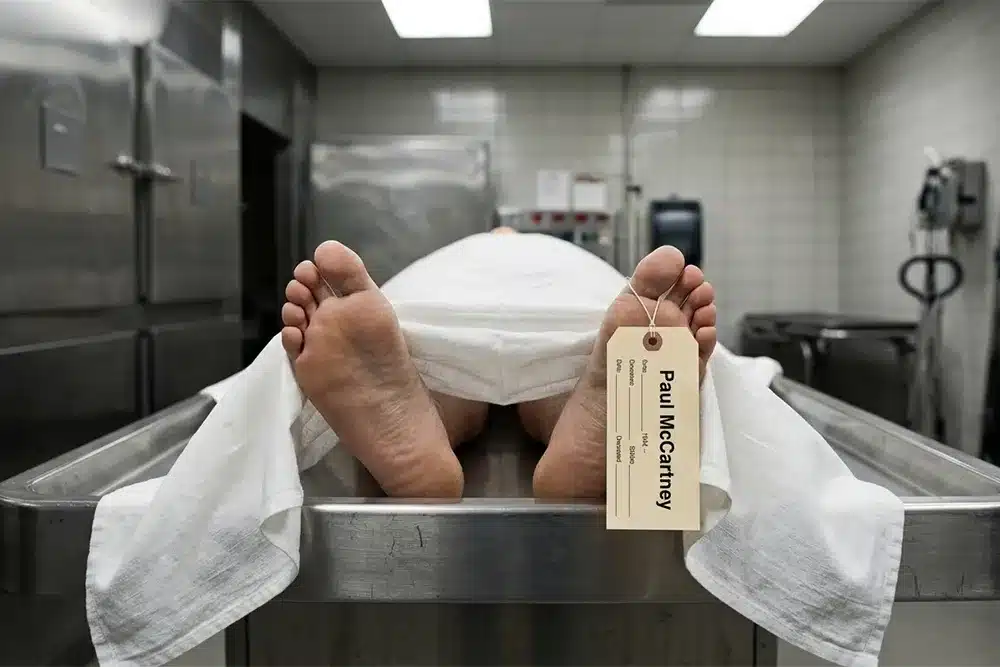
As Paul McCartney has been one of the world’s most famous pop-rock musicians for more than 60 years, it seems reasonable to assume the rumor that he died in 1966 and was replaced by a lookalike would have subsided by now. Absurdly, this is not the case. In November of 2025, for an interview with Parade magazine, McCartney, now 83, once again felt it necessary to debunk the preposterous hoax.
“Paul is Dead”, rock’s most preposterous hoax, has permeated our psyche for years, and it shows no signs of stopping. The hoax is so familiar to the public that it is taught today in undergraduate psychology courses to illustrate confirmation bias.
Though they only recorded together from 1963 to 1970, the Beatles, Paul McCartney’s first group, are still the biggest musical act of all time. With sensational popularity unheralded since that of Charles Lindbergh, it is little wonder the Fab Four became victims of multiple conspiracy theories.
These include whether John Lennon was assassinated by the CIA, whether the Fab Four subconsciously commanded the Manson Family, were involved in witchcraft, child sacrifice, or both, whether John Lennon played music with Che Guevara, and whether former President Joe Biden dropped acid with them. Most have slipped away from the public consciousness. The “Paul is Dead” rumor is the exception to the rule.
The story of how “Paul is Dead” became so pervasive is a fascinating, weird trip. That the Beatles “suddenly” decided not to hold concerts before tens of thousands of fans likely played into rumors that they were hiding something from the public. The Beatles ceased touring in 1966. Though it was never announced to the public, their last public performance was in August 1966, at Candlestick Park in San Francisco. They took a short hiatus from the band, each focusing on individual interests.
During a hiatus from recording sessions, Paul McCartney was involved in a car accident in 1967 that resulted in a scar on his lip. McCartney grew a mustache to cover the scar. A February 1967 edition of The Beatles Monthly Book ran a short article titled “FALSE RUMORS”. The article read, “The 7th January was very icy, with dangerous conditions on the M1 motorway, linking London with the Midlands, and towards the end of the day, a rumour swept London that Paul McCartney had been killed in a car crash on the M1. But, of course, there was absolutely no truth in it at all, as the Beatles’ Press Officer found out when he telephoned Paul’s St John’s Wood home and was answered by Paul himself.”
The article backfired, only exacerbating the rumor. By 1969, the “Paul is Dead” story was being rehashed on college campuses. The “story” was covered in a September 1969 edition of Drake University’s student newspaper, The Times-Delphic. The author, Tim Harper, facetiously questioned whether the Cute One was killed in a car crash while working on the group’s Sgt. Pepper’s Lonely Hearts Club Band album sometime in November 1966.

According to the theory, the Beatles dreaded disappointing fans and feared that, without him, their cash flow would discontinue. Having no other recourse, they replaced Paul McCartney with a look-alike named William “Billy” Shears, whose name dropped in the opening song of 1967’s Sgt. Pepper’s Lonely Hearts Club Band.
The following month, a Detroit deejay named Russ Gibb entertained a call from a true believer. The listener encouraged Gibb to play “Revolution #9”, the avant-garde sound collage from The Beatles (The White Album), and look for clues. Gibb did so and supposedly heard the words “turn me on, dead man.” Gibb’s off-the-cuff analysis exploded the hoax into the airwaves. Media speculation intensified, requiring Derek Taylor, the Beatles’ press officer, to declare the rumor was “…a load of old rubbish.”
More “clues” were found. Paul’s Sgt. Pepper’s Lonely Hearts Club Band uniform includes a patch with the letters “OPD”, purportedly meaning “officially pronounced dead”. The patch actually read “OPP”, as it was from the Ontario Provincial Police. The cover of Magical Mystery Tour features one of the Fab Four (John, in fact) black, while the others wear white. Some have insisted that John says “I buried Paul” at the end of “Strawberry Fields Forever”. He is actually saying “cranberry sauce”.

On the cover of 1969’s Abbey Road, Paul is carrying a cigarette in his right hand, whereas the “real” Paul was left-handed. A license plate in the background reads “28 IF”, interpreted as meaning McCartney would have been 28 if he had lived, even though McCartney was 27 when the photo was taken. John Lennon, dressed in all white, is supposedly the minister who oversaw Paul McCartney’s secret funeral. Ringo Starr, wearing a formal suit, is Paul’s mortician. George Harrison, dressed in dungarees, is said to have dug Paul’s grave. Paul McCartney, barefoot and out of step, is the corpse.
Ironically, the Beatles did hide messages in their songs. “You’ve Got to Hide Your Love Away” is about their manager Brian Epstein’s homosexuality, “Blackbird” is about race relations in the United States, and “Helter Skelter” references an amusement park slide. The fact that “clues” could really be found in the Beatles’ lyrics no doubt contributed to the “Paul is dead” paranoia.
The Beatles also wrote songs about their fondness for drugs. “Got to Get You Into My Life”. “Magical Mystery Tour”, “With a Little Help from My Friends”, and others are odes to marijuana. “Happiness is a Warm Gun” is about John’s heroin addiction, and “She Said She Said” and “Tomorrow Never Knows” are about LSD trips.
No Beatles songs were written to hide Paul’s death, though, because Paul McCartney was (and is, as of this writing) still alive. The rumor amused the Beatles, especially John Lennon. In his song “Glass Onion”, John famously noted, “…and here’s another clue for you all, the Walrus was Paul…” to tease his listeners.
Life magazine tried to put the conspiracy to rest with their November 1969 cover story titled “The Case of the Missing Beatle: Paul is Still With Us”. When the BBC phoned him, McCartney told them, “If the conclusion you reach is that I’m dead, then you’re wrong, because I’m alive and living in Scotland.”
After Paul McCartney sued his former bandmates in London’s High Court to legally dissolve their partnership in December 1970, the “Paul is Dead” rumor only grew. In 1971, the year after they went their separate ways, John Lennon addressed the rumor in his lyrics, singing, “…those freaks was right when they said you were dead” in “How Do You Sleep?”, a scathing attack on his former bandmate.
Two nods to the hoax occurred in 1993. In Nora Ephron’s romantic comedy Sleepless in Seattle, there is a scene in which a character excitedly holds a Beatles album and exclaims, “If you play this backwards, it says ‘Paul is dead!” That same year, McCartney parodied the rumor on the cover of his 1993 album Paul Is Live.
Authors have attempted to exploit the “Paul is Dead” rumor over the years. Book titles include The Walrus Was Paul: The Great Beatle Death Clues (R. Gary Patterson, 1998), Billy’s Back (Thomas E. Uharriet, 2020), Paul is Dead (Paolo Baron, 2020), and Turn Me On, Dead Man: The Beatles and the “Paul-is-Dead” Hoax (Andru J. Reeve, 2004). The hoax has been explored in two films: George Moore’s from 2018, and Wolfgang Becker and Henk Handloegten’s 2000 short, each titled Paul Is Dead.
Perhaps the most significant indicator that the “Paul is Dead” rumor is nowhere near ending was found when fans located “clues” on the cover of Anthology 3, expanded and reissued in 2025. According to “Paul is Dead” conspiracy theorists, the collage placing an earlier picture of Paul’s head over 1970’s Let It Be album cover and the word “remains” shows, once and for all, that the rumor mongers had been right all along.
Works Cited
“The Anthology 3 cover has a Paul is dead easter egg (and yes, I know, it’s a bs conspiracy ) : r/beatles.” Reddit. 18 November 2023.
APA Member Services. “Teaching confirmation bias using The Beatles.” American Psychological Association. 24 October 2016.
Baron, Paolo. Paul is Dead. Image Comics, 2020.
“The Beatles live: Candlestick Park, San Francisco: their final concert.” The Beatles Bible.com
Evon, Dan. “Did Biden Drop Acid With the Beatles?” Snopes.com. 26 May 2021.
Evon, Dan. “FACT CHECK: John Lennon Played Guitar with Che Guevara?” Snopes. 27 July 2017.
Harbron, Lucy. “Why did Paul McCartney sue The Beatles?” Far Out Magazine. 12 January 2025.
T“Beatle Spokesman Calls Rumor Of McCartney’s Death ‘Rubbish’”. The New York Times. 22 October 1969.
Paton, Callum. “How the Beatles’ Music Influenced Charles Manson to Commit His 1969 Murders.” Newsweek,. 20 November 2017.
Patterson, R. Gary. The Walrus was Paul: the great Beatle death clues. Simon & Schuster.1998.
“Paul Is Dead: The Truth Behind The Conspiracy Theory.” All That’s Interesting. 9 May 2021.
Reeve, Andru. Turn Me On, Dead Man: The Beatles and the Paul-Is-Dead Hoax. Genius Book Publishing. 2004.
Torregiani, Isabella. “Paul McCartney Confesses ‘Paul Is Dead’ Theory Had Truth Behind It After 50 Years”. Parade. 3 November 2025.
Uharriet, Thomas E. Billy’s Back! Peppers Press. 2020.
Whatley, Jack. “The Beatles and the ‘Paul is dead’ conspiracy myth explained.” Far Out Magazine. 12 July 2025.