
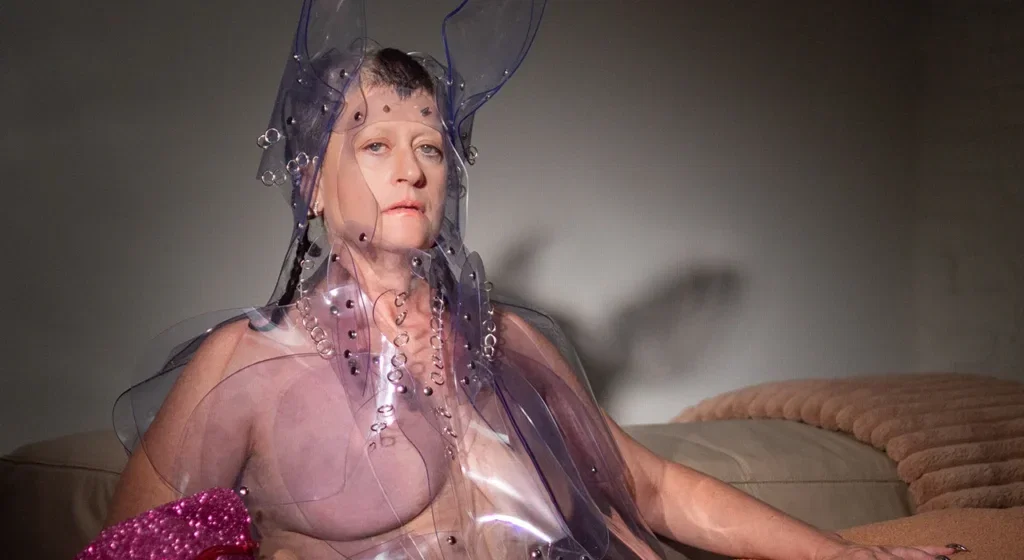

Music’s Mother Superior of Smut, Peaches, is back with a new album for the first time in more than a decade. Titled No Lube So Rude, the Canadian artist has called her latest album’s title a call for a socio-political smoothing rather than a direct reference to the kind of sticky substance that appears on the record’s cover art.
Launching her career in the 1990s Toronto underground scene, Peaches‘ particular brand of frenetic, cacophonous electropop came to typify the musical subgenre known as “electroclash“. It’s an offshoot of techno galvanized by female-fronted, gender-subversive acts like Peaches herself, Le Tigre, and Ladytron. Though the Canadian artist has stated in the past that the “electroclash” classification might be something of a misnomer today, its gender-subversive ethos still falls in line with the kind of uninhibited, queer performance Peaches has become synonymous with.
When the Canadian musician was promoting her last album Rub back in 2016, she agreed with journalist Zachary Small that music seemed to be “getting straighter.” When asked if she’d still felt the same way, she told us, “No, music is not getting straighter,” she tells PopMatters. “In 2024, you know, the top pop stars were not only super queer but female-identifying like Chappell Roan, Billie Eilish, and Doechii, which was really exciting. It wasn’t hidden [their queerness]. It was like ‘We’re queer, and we’re on the top.’ That was pretty exciting. Queer music is always here to stay.”
Like Roan and Doechii, Peaches has spent her career performing through a persona, pulling the “Peaches” moniker from a 1966 Nina Simone song called “Four Women”. When asked if she felt the “Peaches” persona allowed her a greater degree of creative liberation, she stated, “I think it’s more about you’re not being a normal person standing up there talking to one person. There’s an audience, and you have to create something that’s going to be in front of 1,000, 2,000, 5,000 people, whatever it is. It’s not a normal situation, so you have to create something that stems from your soul, you can emulate for more than a discussion with two people.”
After recording her signature track “Fuck the Pain Away” for her album The Teaches of Peaches during a 1999 live performance in Toronto, Peaches found herself thrust into the periphery of the mainstream, garnering broader recognition and even finding her hit track popping up in movies like Sofia Coppola’s Academy Award-winning Lost in Translation and television shows ranging from South Park to The Handmaid’s Tale. More recently, she even helped create the soundtrack for actor Dan Levy’s crime comedy series Big Mistakes on Netflix. Levy, like many a Peaches devotee, described the artist’s music as the genre-defying soundtrack of their youth.
Throughout her decades-spanning career, the Canadian artist has collaborated with everybody from Joan Jett to Yoko Ono on music, films, and performances that resist tidy categorization. On taking on Ono’s polarizing work Cut Piece in 2013 and again in 2025, Peaches told us, “Yoko always makes room for us to inhabit whatever the work is. That’s why a lot of her work is instructional or giving a sort of container for you to experience it inside of.”
Ono’s Cut Piece is an evocative performance art piece first staged by the Japanese artist in Kyoto during the 1960s. The premise of the work is fairly simple: Ono, fully clothed, sits onstage and invites audience members to cut pieces of her clothing using a provided pair of scissors. An avant-garde commentary on feminism, consumerism, and class, Cut Piece was staged by Ono on six occasions between 1964 and 2003 before the proverbial torch was passed to Peaches in 2013.
Inherently abstract and evoking an array of reactions, when asked what kind of differences she noticed between the 2013 and 2025 performances, Peaches explained, “I mean, on a very human level, they were very similar in the way that people got very protective and very focused on what they wanted to get out of it. People want to protect you.
“In the first one, there were a lot of people wanting to talk to me. They wanted me to know what I was to them, but on the other hand, they wanted to cut my hair, steal my shoes, just grasping at and trying to get away with things in a weird way.”
Of the 2025 performance, Peaches admitted the audience might have lost the plot a bit, turning it into a quasi-sit-in and seeing the performance’s intrinsically necessary scissors stolen on more than one occasion. The Canadian artist reported everything from audience members cutting her hair, to donning a stranger’s baseball cap, to being draped in the Palestinian flag.
For all her avant-garde activity, Peaches has maintained a lifelong devotion to a more “traditional” avenue of creative expression: musical theatre. Despite dropping out of an oppressive university program centered on theatre direction, Peaches made her journey back to musical theatre in 2010 for a one-woman production of Andrew Lloyd Webber’s Jesus Christ Superstar, aptly renamed Peaches Christ Superstar.
Less musical and more rock opera, Peaches’ take on Webber’s beloved show was a critical sensation, quickly solidifying itself as one of the most ambitious works to date in the Peaches pantheon. Far from the religious skewering many expected it to be, Peaches handled the work of Peaches Christ Superstar with the same reverence many a musical theatre kid familiar with Webber inevitably finds themselves beset with.
When asked about stepping into Webber’s musical, she said, “It lends itself to its own story, but I’m playing every character. For me, it’s about queerizing the story. It’s bringing female-identifying to the front. It’s also about how any new ideas or humanitarian ideas can get lost, misconstrued or turned into a mob. It’s a good vehicle when it’s not my music to express myself.”
Peaches also reported that the reaction to the musical has varied wildly based on the performance’s locale. In Germany, she says, audiences adopted a monastic silence and gave raucous standing ovations afterwards. In Australia, audiences devolved into giggles at Peaches’ mere mention of God. In England, the musical became a sort of sing-along, while in the United States, it took on a Rocky Horror Picture Show quality. Much like Peaches herself, the onlookers’ reactions to her performances tend to reveal more about the audience than about her.

Alongside a proclivity for provocation, hair has remained a defining piece of Peaches’s artistic and political language since her early career. Whether it be through her asymmetrically bleached quasi-mohawk or flesh-toned nipple pasties with streams of scraggly brunette locks, hair always seems to become a crucial player in a Peaches performance.
When we asked the Canadian performer how hair came to have such a constant place in her art, she told us, “I started to notice when I wore my little shorts [a staple in her early performances], people would be pointing at little hairs coming out of my shorts and they were really shocked by it … or I’d lift my armpit and people would be pointing at it. It made me realize that I had to go harder. This is absurd. It made me think a lot about how it’s beautiful when it’s on your eyelashes or your head, but not in other places.
“So I started to play with that and in a way, that’s what I do, sort of play with what a standard is, and that’s the way I question it.” She goes on to explain that she applies the same framework of contortion to lyrics, “twisting them up and around” to shift our understanding. It’s within this kind of confusion or dissonance that the artist’s work feels its most vibrant and alive.
This kind of play is evident nowhere more than in her work with longtime collaborator, Charlie Le Mindu. Le Mindu, a hairstylist turned conceptual artist, shared a similar fascination with the politics of hair, lending himself to the creation of countless hirsute looks for the electroclash icon. After tracking Peaches down at a Berlin bar in the early 2000s, Le Mindu proffered his services as Peaches’ personal costume designer and stylist, marking the beginning of the pair’s very specific kind of artistic symbiosis.
A Peaches performance defies uncomplicated description in a way only the most exciting and engaging can. Teeming with delightfully outlandish costumes depicting the most intimate parts of our anatomy, Peaches’ performance ethos is perhaps best exemplified by the approach she’s taken in performing her song “I Mean Something” on this latest tour. Donning a scarlet bodysuit fashioned from a contorted ski puffer designed to resemble a knot of small intestine, Peaches steps into the crowd, literally walking on the clamoring hands of her audience and into a sea of fans where she rides the waves of their adoration for the entire track.
Peaches sees her performances as something to be given to her fans, telling us, “I just try to be in the moment as much as possible. I just want to give it everything, you know? I want you to have the best experience. I want you to love. I want you to cry. I want you to feel a little nervous. I want you to be different after it.”
Uninhibited, aesthetically exciting, fully engaged, and never boring, for all the boundless energy of Peaches’ live performances, the Berlin-based musician said that music has always remained her template. “I like to focus on the music. I think about the music first and what I want to say and then how to say it, and then move to how it should be performed,” she tells us.
Much of Peaches’ work has been about what our bodies reveal when they collapse, deteriorate, or distort; her latest project is no exception. Pushing her body politic to a new frontier, Peaches has proudly declared “prolapse” a uniting theme of No Lube So Rude and its corresponding tour.
Beyond the campy provocation such a body mishap might provide, Peaches has insisted the idea has taken on a deeper meaning, explaining, “It’s another part of our body showing us that things are not perfect, and this is where it comes out. It’s also very visual and sticks out like a boob or nipples but in a way that’s more horrifying than normalized. This time I wasn’t just doing body parts, but things that’re going wrong or things that are under the surface that’re still part of us.”
A meta commentary on aging and degeneration, Peaches’ particular strain of absurdity takes the business of being funny seriously. Pairing humor with political edge in a way as bighearted as it is bold, No Lube So Rude represents a welcome return to form for one of music’s most stalwart and enduring queer voices.