
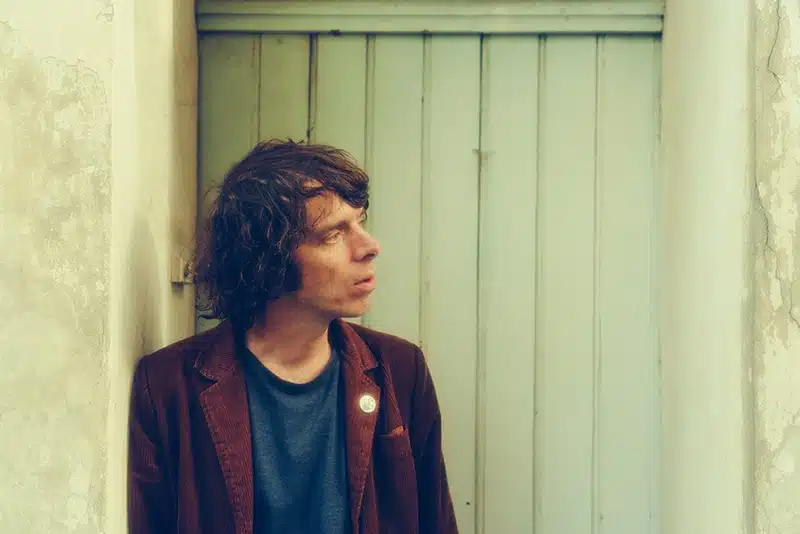

Penny Arcade’s debut album, Backwater Collage, was one of the highlights of 2024. However, it was easily overlooked, a winsomely quiet and melancholy little raft of songs whose runtime didn’t reach 30 minutes. It succeeded mostly through its addictively aqueous mood, its roots in Beatles-bred melodicism, and a compelling musical marriage of slightness and concision. You could put it on auto-repeat and pay as much or as little attention as you liked, with equally satisfying results.
In the fadeout of Backwater Collage‘s closing track, “One More”, an unwonted flame of hot solo guitar shot up out of the chill vibe, suggesting that James Hoare—the man behind the Penny Arcade moniker—might be preparing to come at us next time with something like rock music. Sure enough, the first song on the follow-up, Double Exposure, is an old-school if muted classic rock jam outfitted with duelling-guitar solos. “Regrets” isn’t exactly a foot-stomper, but it’s the kind of song Nick Drake could plausibly have come up with after listening to “Jumpin’ Jack Flash” all day, or that Kurt Vile might fall into during a campfire hootenanny.
Not so fast, literally. “Regrets” is followed by “Memory Lane”, a morose midtempo shuffle set to a drum machine track so primitive it might have been one of those old Casio presets. The guitar is low in mood and so low in the mix as to be a near cypher until a mournful solo toward the end. The signature instrument is a sad-clown violin that slides around the song. What connects “Memory Lane” to “Regrets” is Hoare’s lyrics, which likewise gravitate toward loss, nostalgia, and abulia, lamenting that “I’m stuck in the doldrums, there’s nowhere to go”.
The kiddie drum machine returns for the third track, “Worst Trip”, which is essentially an emo-indie update on Phil Collins’ “In the Air Tonight”. Who’d have thought that awful beast from the heart of 1980s musical darkness could ever be redeemed? The simple minor-key chord changes support lyrics about being on the worst trip ever in the dark of the night, with some echoey underground noises adding to the bleakness during the last few seconds. The Penny Arcade we knew from Backwater Collage are back, after all: low spirits on lo-fi grooves, wistfully charming, rudimentary as demos. By Hoare’s own accounting, they recorded it quickly and spontaneously to 16-track just before he moved to the South of France, as if following the expat example of fellow English eccentric Kevin Ayers.
Hoare pivots again, though. “You’ve Got the Key” is a sweet and simple waltz with sweet and simple lyrics: pleasure may turn to pain, people may come and go and fall by the wayside, but “you’ve got the key, turn it and see”. This encouraging refrain is such a wonderful surprise; it’s like the sun popping out through the spring rain that falls in the song’s first verse. Properly excerpted, “You’ve Got the Key” could provide the soundtrack for an ad for any number of anxiety-reducing products with minimalist designs (noise-cancelling headphones, pregnancy tests). That’s meant as a compliment. The song’s sentiment is so simple, limpid, and sanguine that it’s almost universal, and its practical counsel belongs in the material world, where what you hold in your hand opens the door to every solution.
“You’ve Got the Key” is reinforced by “Everything’s Easy”, which recalls Neil Young when he’s in one of his mellow folkish moods, and puts a useful update on today’s IYKYK watchword: “Everything’s easy / Everything’s easy / If you know.” Don’t get too excited about this tagline of self-help, though, not even after the acoustic guitar and bright organ instrumental “Early Morning” delivers another ray of “Here Comes the Sun”-like optimism.
The ensuing “Rear View Mirror” brings back the befogged when-you-were-young moodiness, albeit with a slinky T. Rex vibe. Then the really gloomy “Time” warns us, over more organ and drum machine and via Hoare’s breathy vocal delivery, “Time’s on your side / But there’s only so long”. In other words, time’s not on your side at all; it’s “running through your hand, dropping like a grain of sand”, and the gentle spring rain has time-lapsed into a chilling autumn breeze.
Two more instrumentals follow, sandwiched around “We Used to Be Good Friends”, which has a vocal track that sounds like it was recorded underwater and bobs plaintively along until Hoare hits it with another two-guitar-solos outro. Hoare’s inclusion of undeveloped instrumental tracks (there were a couple on Backwater Collage, too) lends a somewhat diffuse character to Double Exposure. It doesn’t have the compellingly compact proportions of its predecessor, despite clocking in at under 30 minutes. Hoare used to have a band called Ultimate Painting, and he seems a little more interested here in adding a few extra daubs and drips, as though leaving some possessions behind—trinkets, souvenirs—to lighten the load for his relocation to France.
Double Exposure’s last song, the mellow “Riverside Drive”, doesn’t seem like an homage to New York City’s Upper West Side but a wistful late-night look across the water—yet another breeze blows, this one “clear[ing] the mind”—to the opposite bank where “you can hide away for days”. Life spent in retreat and remembrance, darkness invited and dwelled in, despair soothed by melody, simple musical gestures that carry equally simple sentiments: that’s the Penny Arcade way.