

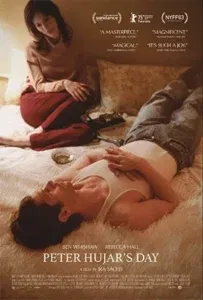
Photographer Peter Hujar spent 19 December 1974 telling his friend, author Linda Rosenkrantz, what he had done the day prior; she recorded him, and the result became Peter Hujar’s Day. Originally intended to be one of several such recollections in a book by Rosenkrantz, the idea was abandoned until the transcript resurfaced, leading to its publication in 2021 by Magic Hour Press. It’s now a film, which, to some, might raise the question: why?
The new picture from filmmaker Ira Sachs (of 2014’s Love Is Strange and 2016’s Little Men) works on multiple levels. It’s a tribute to a great but still underrated artist; it’s a paean to the bohemian scene of 1970s New York; it’s a meditation on monotony and an ode to the ordinary; it’s a tone poem about art’s relationship to life, death, and time.
Peter Hujar’s Day is also a rare opportunity for Hollywood talent to have some fun with a genuine art film, a conceptual project that somehow slipped past the mainstream gatekeepers. Even if it weren’t such a beautiful and unforgettable film, its uniqueness alone warrants a gander from curious cinephiles.
The prolific Ben Whishaw previously starred in Sachs’ romantic drama Passages (2023). Sachs discovered the published text of Peter Hujar’s Day while making that film, and found a fellow fan of Hujar’s in Whishaw. The two worked together to bring the transcript to life, with Rebecca Hall joining the project as the only other actor in the adaptation, starring as Hujar’s friend and questioner, Linda Rosenkrantz.
Peter Hujar’s Day opens with a bit of situating text before plopping audiences into Rosenkrantz’s inviting, cozy apartment, where she presses “record” on a reel-to-reel and listens to Hujar recount in fastidious detail what he did the day prior. The film joins an established smart cinema of conversations, a pantheon of films devoted to dialogue, including Éric Rohmer’s My Night at Maud’s (1969), Louis Malle’s My Dinner with Andre (1981), Richard Linklater’s Tape (2001), for example. Sachs breaks the fourth wall throughout the film, suggesting that this conversation isn’t only between Hujar and Rosenkrantz but also between the audience and the film.
In practice, the result is actually closer to the somewhat experimental work of Jean Rouch and Edgar Morin (1961’s Chronicle of a Summer), Andy Warhol (1965’s Poor Little Rich Girl), Paul Morrissey (1968’s Trash), and Jim McBride (1969’s My Girlfriend’s Wedding). That’s likely thanks to the synthesized contrast of form and content throughout Peter Hujar’s Day. What Hujar has to say is not particularly interesting, yet he is a compelling figure; the events of the film are not dramatic or especially significant, but they’re filmed as if they are (even incorporating Mozart’s Requiem to make the everyday seem epic – Sisyphus as Hercules).
Whishaw achieves something close to dialectical mesmerism in his equally paradoxical performance, one that is simultaneously monumental (his dialogue comprises 55 of the script’s 58 pages, according to the film’s press notes) and mundane. It’s a tightrope walk of contradictions that is managed masterfully. There are no flashy emotional pirouettes or dramatic revelations, no manipulation or Oscar-bait. Instead, Whishaw embodies the artist at his most quotidian.
Hujar discusses a day that comprises multiple phone calls, attempted naps, a photo shoot, a trip to pick up Chinese food, time spent in his dark room processing photographs, and not much else. His day involves ordinary interactions with various figures of the New York intelligentsia at the time, including Susan Sontag, Max Kozloff, Alan Lloyd, Ed Baynard, William S. Burroughs, John Gruen, Allen Ginsberg, Tuli Kupferberg, and Fran Lebowitz.
As such, Peter Hujar’s Day is a bit of a soft panegyric for the downtown scene that would be decimated by AIDS (which Hujar died of in 1987), sanitized by Disney, and economically dissected by gentrification. With subtle but excellent period-specific production design, era-appropriate 16mm film, and performances and references that reflect the ‘70s, Peter Hujar’s Day, feels like an intentional relic, a lost artifact from the time that could be slotted into a double feature with Shirley Clarke’s Portrait of Jason (1967) or McBride’s similarly titled David Holzman’s Diary (1967).
As Don DeLillo wrote in his story Hammer and Sickle (2010), “People say great art is immortal. I say there’s something mortal in it. It carries a glimpse of death.” The passage comes to mind when watching Peter Hujar’s Day, itself suggesting how multiple artistic mediums – photography and film, mainly, but also audio recording and the written word – immortalize moments differently. At the same time, with its constant references to people, places, and scenes that have either died or been forgotten, Ira Sachs’ period drama feels like a haunted wake.
The great writer Susan Sontag ruminated about this exact thing in her introduction to the sole book Hujar published in his lifetime, 1976’s Portraits in Life and Death. “Photographs turn the present into the past, make contingency into destiny,” Sontag wrote. “Photography also converts the whole world into a cemetery. Photographers, connoisseurs of beauty are also – wittingly or unwittingly -– the recording-angels of death […] Peter Hujar knows that portraits in life are always, also, portraits in death. I am moved by the purity and delicacy of his intentions.”
That purity and delicacy are on display in Whishaw’s performance, one of the best of the year. The way he speaks is almost Warholian, but with more authenticity and undercurrents of melancholy. The way Whishaw carries himself in general is also hypnotic, beautifully manifesting something Hujar’s longtime friend, the novelist Stephen Koch, once mused to Art Basel: “Nobody, but nobody, could sit still like Peter.”
Despite having much less to do, Hall is phenomenal as well, making it clear why Hujar feels comfortable stepping into the vulnerable position Rosenkrantz has created for him. Her admiration of Hujar is palpable, and we’re more entertained by him because she is. More than merely a vicarious audience surrogate, though, Rosenkrantz transforms the film from a monologue into a hangout. Together, Whishaw and Hall create a lived-in friendship with a contagious intimacy.
“The day is gone, and all its sweets are gone”, lamented Keats – but he didn’t have a tape recorder. By immortalizing one day thanks to reels of different kinds, Peter Hujar’s Day captures so much more. It is one of the most succinct examples of how the specific can become the universal, how details can tell the whole story, and how meaning can be created from scraps.
- ‘Strange’ Magic: An Interview with ‘Love Is Strange’ Director Ira Sachs
- ‘Love Is Strange’: Complicated Lives in Tight Spaces
- Love Will Tear Us Apart in Ira Sachs 'Keep the Lights On’
- Linda Simpson’s Photo History of NYC Drag Beguiles
- ‘Shape of Light’ Shines in the Space Where Photographic Art Bleeds into Wider Art
- The Big-City Drama of ‘Little Men’: An Interview with Director Ira Sachs