
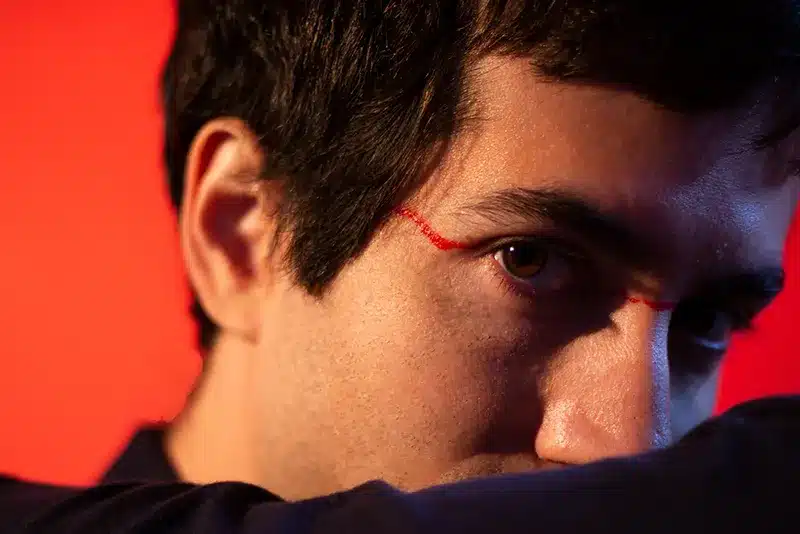

Until recently, my personal familiarity with the music of Phillip Golub was limited to two brilliant, unique records he made on Joseph Branciforte’s forward-thinking label, greyfade. Filters (2022) is a hypnotic collection of loops for solo piano, while Loop 7 (2025) is an extended piece created with midi-controlled Disklavier pianos. A move from those concepts to the full-band microtonal fusion madness of his new record, Partisan Ship, is a jarring yet highly welcome shift that showcases Golub’s far-reaching approach to the keyboard and his own ensemble arrangements.
While other releases in Golub’s discography – the intimate post-bop delights of Abiding Memory (2024) and dream brigade, his 2025 project with drummer Lesley Mok – have him exploring different avenues of jazz, Partisan Ship is a conceptually deep and satisfying journey through full-band microtonal music, perhaps his most sonically rich project yet. Part of this is because each track in the record is written in its own tuning system.
“I wrote all of the music first and then created demo tracks using MIDI instruments,” Golub explains in the album’s press materials. The resulting score, 157 pages long, is performed by Amir ElSaffar on trumpet, Anna Webber on tenor saxophone and flute, Layale Chaker on violin, David Leon on alto saxophone, Yuma Uesaka on tenor sax and clarinets, Jon Starks on drums, Sam Minaie on bass, and Elias Stemeseder on synthesizers. Golub plays a variety of keyboards here, including a semi-modular synthesizer called a Behringer Neutron, as well as an instrument of his own design called a flexichord (a microtonal MIDI keyboard in which the tuning changes with every song).
The album’s title derives from Golub’s narrative about a group of “partisans” and their journey to a utopian micronation. “Microtonal utopian micronational anthems for the Internet age,” he calls it in the record’s liner notes. With all of that conceptual and technical backstory in mind, it’s no surprise that Partisan Ship is an absolutely insane, thrilling ride.
The constant dependence on microtonality—pitches outside the 12-tone system commonly used in jazz and classical music—gives the entire record an otherworldly feel. It’s a sideways approach to the music. The opening track, “loyalty oath”, combines these pitches with a slightly chaotic arrangement, as the arsenal of players vie for space within the composition, yet remain engaged and not at all disorganized.
Several of the tracks are interludes that effectively bridge the songs. “interlude (aboard)” is a clatter of static and noise, leading into the title track, which employs swift tempi, generous soloing, and a gleeful sense of urgency reminiscent of Frank Zappa‘s best 1970s jazz trips. The carefree shuffle that guides “mutiny meeting” is similarly playful, with Golub providing wild but tuneful jaunts across the keyboard that give the song an odd consistency. Meanwhile, there’s a kitchen-sink approach to “utopian micronation,” as the lovingly overstuffed arrangement evokes Miles Davis‘ best fusion moments, highlighted by ElSaffar’s trumpet bursts.
The brief cacophony that closes the record takes the form of “afterword: partisan session”, which is overpowering in its absurdity and ends things on a decidedly chaotic note, fitting for a record that is so deeply musical yet beautifully nonsensical. “I feel that all music reflects the experiences one has in the world,” Golub says. “And to some extent, the world itself. Our world is profoundly complex and often not very comprehensible. I think my music reflects that, not intentionally, but simply because that’s how it turns out.”