
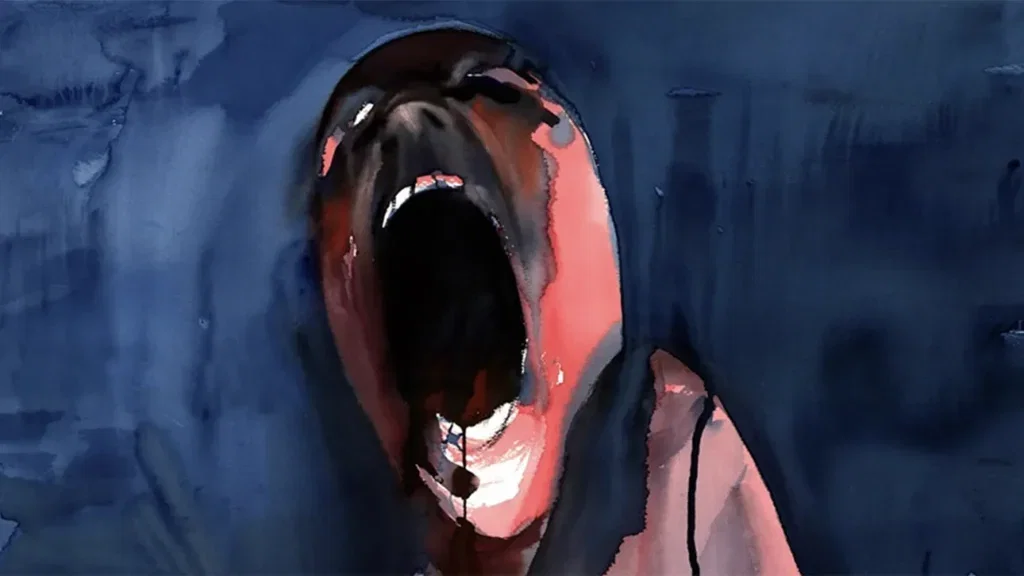


If art is, as Salvador Dalí said, “the persistence of memory”, then it is fundamentally about haunting: an apparitional remnant lingering into the present. Among works that confront their own obliteration – The Marble Index by Nico (1968), Closer by Joy Division (1979), The Holy Bible by the Manic Street Preachers (1994), and Nirvana Unplugged (1994) – few are as choked with ghosts as The Wall by Pink Floyd.
Whether encountered as the 1979 album, Roger Waters and Gerald Scarfe‘s immersive stage show during Pink Floyd’s 1980-81 tour, or Alan Parker’s 1982 film, Pink Floyd‘s The Wall shows that haunting lies not in wailing and chain-rattling but in trauma, alienation, and absence. Over the course of 90 minutes, the film Pink Floyd: The Wall – the band’s name obtruding like a brick – is perhaps the ultimate rock opera telling a larger story through song and image.
On a deeper level – which many critics often miss because they stopped discussing rock music as art sometime in the 1980s – The Wall is a haunting from three particular ghosts, rather like the ghosts that haunt Charles Dickens’ A Christmas Carol. Pink Floyd’s particular ghosts, however, are the three theorists who haunt the modern individual: Sigmund Freud, the ghost of Christmas Past; Karl Marx, the ghost of Christmas Present; and Jacques Derrida, the ghost of Christmas Future.
Bob Geldof’s Pink, the gestalt protagonist of the film, like Dickens’ Scrooge, is haunted by his past, present, and future, and finally escapes following a judgment to an indeterminate future. The album says, “Isn’t this where we came in?”, taking us back to the beginning, but the film suggests, through a brightened version of the song “Outside the Wall”, some kind of closure, when the “bleeding hearts and artists” have made their stand.
Waters himself couldn’t decide: was The Wall a cycle or redemption? Perhaps both. Or perhaps, as with all hauntings, the only certainty is recurrence.
Sigmund Freud: The Ghost of Christmas Past
The Wall is a film deeply haunted by the past in its form and its theory, but also in its most literal sense: by Roger Waters’ own biography. His writing steadily became more personal from The Dark Side of the Moon (1973) to Wish You Were Here (1975) to Animals (1977) to The Wall (1979). In the latter, he directly addresses his absent father (killed in action in 1944), overbearing mother, sadistic schoolteachers, and marriage breakup. All of these animate individual songs outlining their traumatic effect on Pink, and appear in “The Trial” as literal apparitions denying their own guilt.
Each leaves their mark: the son denied a father, oppressed by a mother (who “might let you sing but won’t let you fly”), bullied by teachers who would “hurt the children any way they could”, and let down by a cheating wife (the international phone operator noticing, “See? It’s a man answering.”). The Oedipal narrative isn’t hard to locate. Each is a Freudian primal scene, leaving its mark as trauma in the adult Pink. Their ghosts live on in his mind, spectres of the past affecting his present.
Like Freudian ghosts, they insist on repetition. Abuse begets abuse. Teachers who bully children are themselves thrashed “within inches of their lives” by “their fat and psychopathic wives”. Self-loathing leads to violence, like spousal abuse; as Pink says, “I need you / To beat to a pulp on a Saturday night” to his wife. While hotel room destruction had, by the 1970s, become part of the rock n’ roll legendarium, in “One of My Turns”, it sounds utterly grim, an auto da fe of self-hatred.
Pink’s relationships are shattered, and fame is sought in recompense. Women cannot be trusted; there is no home but an unmade hotel room, and colleagues abuse Pink for their own ends. “The show must go on.”
Freud suggests, in Beyond the Pleasure Principle (1920), that we seek to repeat the most painful experiences in our lives to gain mastery over them. (Thus, for example, the survivor of sexual assault who unconsciously restages their trauma in an attempt at psychic control). For the musician, repetition is both method and metaphor: practising chord shapes or passages until technique replaces spontaneity.
Repetition becomes mastery — but also alienation. The beautiful yet affectless classical guitar solo that concludes “Is There Anybody Out There?” enacts this very idea. And so, in the end, Pink becomes entombed in his own wall.
Karl Marx: The Ghost of Christmas Present
You don’t have to have read Derrida to see spectres of Marx in the modern world. Alienation, commodification, spectacle, and estrangement are practically synonymous with modern life. These ghosts particularly haunt The Wall.
Waters’ parents weren’t just socialists but Trotskyite activists, and that socialist worldview remained in him. He might have lusted after material signs of success like owning a Bentley, but he mocked bandmate Rick Wright for buying a country pile, until he got round to buying one himself.
Reconciling the two worldviews would prove impossible. In The Dark Side of the Moon, he offers understanding to all those damaged by the stresses of capitalism, but in the three great albums after that, his mood turns from condemnatory to vituperative.
Animals is class hatred turned into allegory – pigs, dogs, sheep – and by the time of The Wall two years later, that fury is turned inward, toward the commodification of the self. Pink, the character, is both product and producer: packaged, marketed, and chewed up by the machine he fuels. He becomes both commodity and labourer, utterly estranged from his work and from himself.
Pink Floyd’s The Wall concerts were stunning dramatizations of this: the band playing behind a wall of bricks, hidden from their audience, spectacle replacing presence. Guy Debord’s Society of the Spectacle was published in 1967, but Waters didn’t need to have read it. He had experienced it firsthand (most famously when provoked into spitting on a fan in Montreal in 1977) and, with great artistry, delivered a startling theatrical rendition. Fans could buy not connection but alienation, paying for absence. The commodity they received was the band’s very disappearance.
Marx describes alienation as the worker becoming estranged from their own labour. He wrote (in the Economic and Philosophic Manuscripts of 1844), “The object that labour produces, its product, stands opposed to it as something alien, as a power independent of the producer.” The worker becomes impoverished through his own creation: “the more wealth he produces, the poorer he becomes in his inner life.”
The Wall dramatises this aspect of Pink’s present relentlessly. He is a musician, but his music no longer belongs to him. His life is a staged performance of endless repetition, enforced by managers and promoters, estranged from any meaning he might once have intended. The show must go on, but the show does not belong to Pink. He is consumed, and his alienation is packaged and sold back to the crowd.
This is why the fascist rally sequence in the film is so unnerving. It is not merely a critique of authoritarianism but of mass spectacle. The audience does not want Pink’s presence; they want his image, his role, his commodity form. When Pink barks grotesque orders from the stage, the crowd roars in delight, as though their subjection were the product they’d paid for. Here, the ghost of Marx is unmistakable: the concert arena is transformed into a factory of alienation, every cheer greeting labour estranged from the self.
Jacques Derrida: The Ghost of Christmas Future
If Freud haunts The Wall with the weight of the past (the wounds of childhood and the persistence of trauma), and Marx shadows its present with alienation and commodification, then Derrida’s ghost reveals that identity, language, and even time are never whole.
As Derrida wrote in Specters of Marx (1993), “the future is always to come; it is that which is not yet and that which must remain unforeseeable, the coming of the other itself.” The future is not what comes next, but what can never fully arrive. Just as Pink’s future is never settled. We never learn what lies outside the wall.
Like The Dark Side of the Moon six years earlier, The Wall has a poetic vocabulary based on binary oppositions. In The Dark Side of the Moon, they include dark/light, us/them, with/without, sanity/lunacy, and presence/absence. Whereas The Wall is more focused: inside/outside, and again sanity/lunacy and presence/absence. These oppositions invite a deconstructionist reading. The interiority of Pink becomes a prison. The outside is hell, and then escape.
Similarly, Pink’s presence is always in doubt. Pink is not really here; he’s part of a “surrogate band”. As Derrida notes in Of Grammatology (1967), presence is never self-identical; it is always deferred as part of a chain of signifiers pointing to an absent centre. “Hello? Is there anyone there?” asks his wife, though we can see Warhol-style portraits in the background as proof of having arrived. Yet, if you have arrived, where did you leave?)
“Hello? Is there anybody in there?” echoes the corrupt doctor. Is there an essence of Pink lurking inside? During the fascist rally sequence, even Pink disavows his presence: “Pink isn’t well, he’s back at the hotel,” he says, as though he himself wasn’t Pink. “This is not how I am.”
Similarly, The Wall could be viewed as Pink’s search for solidity: a father, a wife, a self. Yet throughout, he finds only absences. Young Pink dresses in his father’s military uniform and sees him, but only through a mirror. The reflection shows his own face. Fame is no replacement for the self; the film satirises the vulgar ostentation of aftershow parties (the tour manager spitting out champagne), the loveless mutual exploitation of groupies (“Wanna take a baaaath?”), and the numbing fugue of the TV (with “thirteen channels of shit”) always on in the soulless hotel room.
Pink’s wife offers no succour either: their flower-power wedding is washed away in the rain; she betrays him, and when he telephones, seeking connection, there’s “nobody home.” Everywhere he looks, there are only ghosts.
The Wall’s Protective Isolation
While Waters admits that his rock opera is largely autobiographical, another figure looms over The Wall. The ghost of Syd Barrett also haunts the album and film. Though he was still alive, Barrett’s absence looms larger than any presence. He is there and not there, simultaneously alive and erased, his breakdown written into every song Waters wrote from “Shine On You Crazy Diamond” onwards. Barrett becomes the ultimate Derridean signifier in The Wall: a man whose absence enables and structures the band’s very presence.
The wall itself is what Derrida called différance: the structure by which meaning is both produced and postponed. It promises protection while ensuring isolation. Every brick signifies the gap between presence and absence. Pink finally tears it down, but the question remains: was there ever anything behind it? Or was the wall the only reality all along?