

Growing up, I was a good generation removed from Pink Floyd’s worldwide rise to fame. Heck, my parents barely climbed onto the bandwagon in the 1970s. However, I was such a fan that my room was papered with cutouts from Pink Floyd live shows, which my family affectionately called “The Wall”. It got to the point where jealousy would course through my veins whenever my friend sported a worn Division Bell Tour T-shirt (likely a hand-me-down but possibly the souvenir of a wide-eyed 11-year-old). Hey, wasn’t I one of their biggest fans, too?
Pink Floyd had that effect in my hometown, as a multi-generational band that captivated both parents and kids alike. Worn LPs got the needle drop when shooting pool in a friend’s basement, or a live disc might be plucked from a CD wallet for a road bake. In any given bedroom, Pulse (1995) would beckon a clique of teenagers to slide both discs into the five-CD changer and daydream the afternoon away. The soundtrack to our parents’ barbeques, bonfires, and pool parties contained plenty of Pink Floyd‘s hits, as was undoubtedly the case in similar burgs throughout the country.
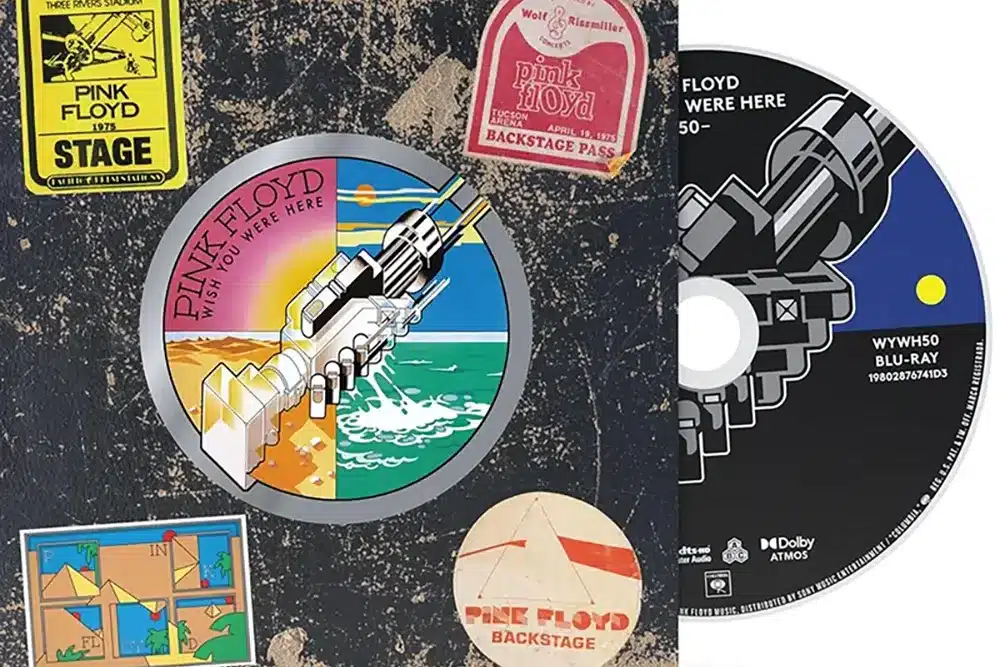
Considering Pink Floyd‘s colossal influence, Wish You Were Here (1975) has not received the same attention as their other blockbusters, with Dark Side of the Moon being a top-selling album of all time and Roger Waters making The Wall (1979) his legacy. After 50 years (isn’t that hard to believe?), it was due for the royal treatment, including a new Dolby Atmos mix by James Guthrie, whose work with Pink Floyd dates back decades, nine studio rarities, and a restored version of the 26 April 1975 concert at the Los Angeles Sports Arena, remastered by Steven Wilson. It’s a fitting recognition of the classic and, depending on one’s budget, is available in a variety of packages.
In Pink Floyd‘s diverse and sometimes confounding discography, Wish You Were Here (1975) remains slotted in the centre. Depending upon how one classifies things, at least from Waters’ standpoint, the record stands smack dab in the middle chronologically, eight years removed from The Piper at the Gates of Dawn (1967) and eight years prior to The Final Cut (1983). It also serves as the natural midpoint to their excellent string of 1970s biennial releases, which effectively began with Meddle (1971) and culminated with The Wall. Conceptually, the record serves as the axis point between the band they once were and the band they would eventually become.
Most people already know the main story surrounding the Wish You Were Here recording sessions. Syd Barrett appeared, almost as an apparition, in Abbey Road Studios. The band barely recognised him, as he had shaved his head (and eyebrows) and gained considerable weight. His appearance had an unsettling effect on the artists and significantly altered the mood of the sessions.
The bookend tracks, “Shine on You Crazy Diamond”, were clearly inspired by Barrett, who had steeply declined in terms of mental health; however, the record dealt with other heavy themes, such as condemnation of the record industry and overall disillusionment with fame. Paradoxically, Wish You Were Here is, by many accounts, their most accessible record, featuring only five songs, three of which are bona fide hits.
Fans will approach Wish You Were Here 50 knowing the quality of the songs and the album in its entirety was never in question, but the Dolby Atmos mix sounds phenomenal. The new stereo mix of “Shine on You Crazy Diamond (Pts. 1-9)” is quite the treat, even if a simple reshuffling of MP3s would have a similar effect. The unified version was long overdue, and parts one through nine should now receive more attention as standalone tracks now that they exist as a cohesive whole. It is the one bonus feature that deserves more attention during the larger release.
The additional tracks from the writing and recording process prove illuminating, as they shed light on the process and reinforce why the band landed where they did. The decision to include demos, a first take, and an alternate take of particular songs was prudent, as releasing all demos and outtakes could have caused controversy, especially when assessed alongside the original masterpiece.
The “Welcome to the Machine” demos exhibit Waters’ genius and provide insight into the minor decisions made along the way. These tracks are insightful, but in a different way than “Have a Cigar (Alternate Version)”. That version isn’t bad, but it lacks the immediacy of the record release, not to mention a longer outro without Gilmour’s rip-roaring solo. Setting aside minor vocal differences, Waters’ bass sounds muffled, and the synths just aren’t as prominent. It certainly makes listeners appreciate the version they’ve heard a thousand times.
Much the same can be said for “Wish You Were Here (Take 1)”, but the differences between this recording and the official version are much more discernible. For so many out there, “Wish You Were Here” is sacrosanct, and one must appreciate the label’s decision to release a first take as opposed to an alternate version (you just can’t mess with perfection). From the adjusted intro solo to Gilmour’s different vocal intonations to the lack of the vocal reprise at the end, we now know the recording is missing key parts that made the song definitive. The first take sheds light on the complexities of a relatively simple song.

Most of the other bonus tracks are non-essential, even “Wine Glasses”, part of the Household Objects record that never came to be. This piece eventually became part of the “Shine on You Crazy Diamond” opening, an interesting piece of rock and roll history, but not worth standalone consideration.
The Los Angeles Sports Arena live recording from that era is a nice addition, even if the show is not album-specific. The concert reflects the band’s transitional state, as they play “Raving and Drooling” and “You’ve Got to Be Crazy” (early versions of “Sheep” and “Dogs”, respectively), cuts from Wish You Were Here, Dark Side of the Moon in its entirety, and the unparalleled “Echoes”. Unfortunately, the Wish You Were Here 50 two-CD set doesn’t include the live show (you have to purchase the Blu-ray version that can only be played on that type of device). If you want it all, you’ll have to pay handsomely, with the Deluxe Box Set running around $250.
Half a century later, Wish You Were Here has staying power. The album showcased a wide range of elements in Pink Floyd’s sound, including the unmatched title track. Not only does it capture a pivotal moment for the band, but it has also become a major release, now celebrated as an all-time classic. In fact, the LP officially became the UK’s Christmas Number 1 album for 2025, returning to the spot it held after its initial release.
Back in 1975, Pink Floyd—those pioneers of progressive rock—railed against the music industry and, in the process, became more radio-friendly to the point of being refined. No way could they have known the impact they would have across Europe and in the United States, influencing generations to come. While the album was recorded amid personal turmoil, it helped the band achieve equilibrium. If the legacy of Pink Floyd lives on in their works from the 1970s, Wish You Were Here will forever be regarded as the perfect centre.