
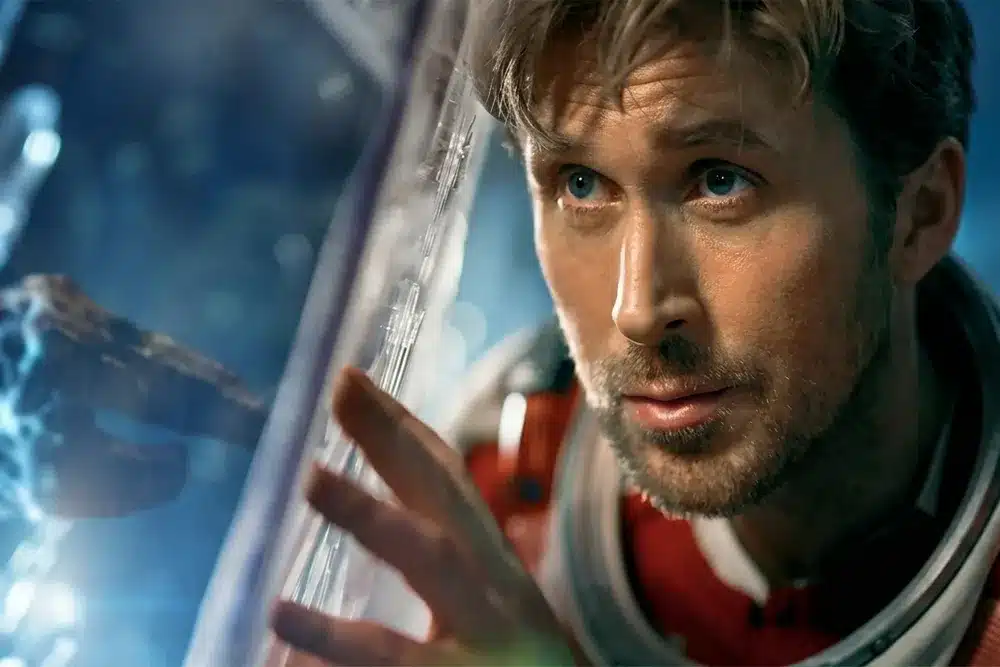

Some may walk out of Phil Lord and Christopher Miller’s goofy and pop-operatic adaptation of Andy Weir’s novel Project Hail Mary trying to string together all the shards of hard science fiction-speak that just burst from the screen at them. They may be able to math all the astrophysics which the film’s scientist hero, Ryland (Ryan Gosling), has to wrangle to save Earth from microscopic alien organisms that are rapidly eating the Sun.
While that would be an admirable accomplishment—Drew Goddard’s script does not stint on the science—it would also be beside the point. Ultimately, Project Hail Mary is not so much about rescuing the human race as it is about ensuring that Ryland keeps his friendship with an adorably chatty and plucky alien (voiced by James Ortiz), whom he meets while on a similar planet-saving mission.
Big-hearted, sentimental, overripe, and under-edited, Project Hail Mary is both a near-perfect star vehicle for Gosling and an example of how his appeal can be misplaced. His Ryland is a one-time renegade researcher whose controversial paper cost him his career and left him teaching grade-school science, where it just so happens that his brash playfulness is just the right fit for communicating with kids.
After being reluctantly recruited to Project Hail Mary, a secret global effort to hurl a spaceship light-years away to a distant star in hopes of discovering how to stop the “astrophage” (a kind of interstellar parasite) from destroying life on Earth, Ryland not only rises to the challenge but rediscovers his humanity in the dead of space. After waking up from his induced coma on the project’s ship to find the rest of the crew dead, Ryland realizes the fate of the world rests on him. Similarly, the entire film depends on a mostly solo Gosling, charming viewers with self-deprecating wink-wink.
This is good as far as it goes. In Ridley Scott’s The Martian (2015), based on another of Weir’s interstellar sci-fi engineering puzzlers, Matt Damon as Mark Watney showed that a likable star doing some very dedicated green-screen work can get a film mostly across the finish line. One difference is that in Project Hail Mary, Ryland is not recording video messages back home or joshing around with a capable cast of humans, unlike Damon’s Mars-marooned astronaut.
Instead, Ryland is interacting primarily with an alien he nicknames Rocky, who looks like a dog-sized spider made of stone and has the humor of a precociously impatient and very emo 14-year-old. Rocky arrives in a gorgeously delicate ship. Its unusual beauty – composed mostly of long, needle-like gold structures – is a sign of just how predictable most design has become in science fiction filmmaking.
Flashbacks to Ryland’s pre-launch time on Earth are frequently more compelling, for the simple fact that they contain humans. Key in those scenes is Eva Stratt (Sandra Hüller), the frosty Eastern European organizer of Project Hail Mary. Hüller’s stern yet empathetic performance provides a welcome contrast to Gosling’s wry and self-effacing bonhomie. Their clashing worldviews, hers laser-focused and mission-oriented while his is all “who me?” disbelief and responsibility-shirking, somehow give the film more grit and frisson than even the most dramatic near-death moments in outer space.
In those moments where, between nearly dying, Ryland and Rocky move from standoffish curiosity to trading lighthearted banter to shamelessly tearjerking declarations of cross-species friendship, Goddard’s script hits the emotion button effectively but somewhat relentlessly. Their joint efforts to jury-rig a way to return home with an astrophage-stopping solution have an Apollo 13-style feel, missing only Tom Hanks.
For dramatic purposes, though, these sections can often miss the mark. The filmmakers’ biggest miscalculation was how much time is expended on Ryland and Rocky learning how to communicate and work together. Even once they have constructed a crude translation device, that relationship is largely one-sided, with Ryland problem-solving out loud in a way that is both overly complex and overly easy to solve.
Lord and Miller have a good sense of how to match genial comedy with interstellar drama. However, they pack in too much poorly-delivered engineering-speak and a cascade of climaxes, which make Project Hail Mary feel even longer than its bloated two-and-a-half-hour runtime. This is not a brainy sci-fi like
Denis Villeneuve’s Arrival, after all, but a heartwarming and affirming spectacle, and the filmmakers don’t do themselves any favors by pretending otherwise.