
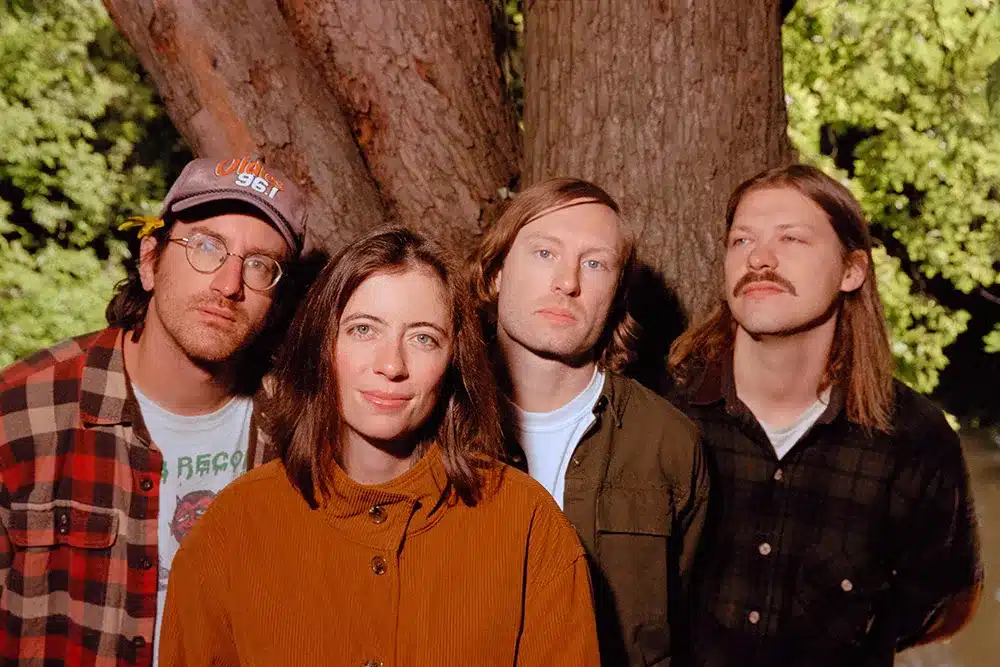

Ratboys have spent more than a decade growing from a dorm-room songwriting duo into one of indie rock’s most consistently compelling bands. Formed in 2010 by Julia Steiner and Dave Sagan while the pair were students at the University of Notre Dame, the project has steadily expanded in both membership and ambition, eventually settling into a fully realized four-piece group after relocating to Chicago in 2015.
With Sean Neumann anchoring the band on bass with steady, melodic lines and Marcus Nuccio driving the band forward on drums, Ratboys have evolved from lo-fi, acoustic beginnings into a confident, collaborative unit whose chemistry has become central to their sound, which is most apparent in their newest album, Singin’ to an Open Chair.
Ratboys’ music weaves together strands of indie rock, post-country, and folk, creating a sound that sits comfortably at the crossroads of several guitar-driven traditions. Their evolution toward fuller arrangements and higher-fidelity production has allowed them to stretch across these genres with increasing confidence, even coming close to creating fun, easily digestible pop-rock songs (their newest single, “Anywhere”, even has hand claps). However, no matter the evolution or what music genre they are toying with, there are some specific Ratboys moves that they keep returning to that push against genre and into something distinctly their own.
Specifically, they don’t know when to end a song. Or, more to the point, they seem incapable of ending their songs where they logically should. That is not a criticism but an admiration. Their indecisiveness does not lead to masturbatory guitar solos or post-Radiohead loops meant to underline the meaninglessness of language. Instead, the songs circle their ideas because words do matter—so much so that, despite their best efforts, they never quite manage to pin down the words they’re chasing. As a result, the songs meander and shift, often doubling back before following some small dead-end thread. It can create a touch of sonic frustration, but more often it feels like a kind of persistence. Ratboys’ music is content to keep reaching, even if it never arrives.
This tight yet incomplete instrumentation perfectly fits a typical Ratboys lyric, which often seems more comfortable circling an idea than confronting it squarely. In two of their strongest previous records, GN and The Window, this tendency is most apparent as the lyrical worlds lean into impressionistic, sometimes opaque imagery. The songs convey emotion through mood and suggestion rather than straightforward narrative clarity, a quality that closely echoes Tanya Donelly’s lyrical approach during her magical era with Belly in the 1990s.
Like Donelly, Ratboys use symbolic fragments and dreamlike scenes not to obscure meaning, but to give voice to the impossibility of fully articulating the feelings their songs evoke. While each album has offered a bit more clarity, it feels significant that they titled their last album The Window—the songs may be more visible now, but the pane is still smudged, and the view remains blurred.
Which brings us to the last foundational piece of a Ratboys record that explains their opaqueness: the songs keep returning, almost compulsively, back to childhood traumas. Some images seem significant, others seem like they would be significant only to a child, but the songs are haunted by home, a space where things were off, and the world tilted to a point that nothing could ever be straight again.
Singin’ to an Open Chair builds upon these foundational principles but, interestingly, moves closer to clarity. Steiner, using her unique and beautifully lilting voice in the first song, asks repeatedly, “What’s it gonna take to open up tonight?” The record seems to reach for an answer—hesitatingly at first, before committing to revealing itself. While the album still has beautiful, poetic lyrics that offer sleight-of-hand misdirection (“The bugs are writing books with their eyes” is one of many great lines from the song “Penny in the Lake”), Steiner often places herself in her home as a young child trying to make sense of the world.
That is most apparent in the standout song “Just Want You to Know the Truth”. The track opens with a few seconds of sonic uncertainty, as if it isn’t quite sure when to begin, before it commits to a slow burn whose tight melodic and rhythmic lines bring Steiner’s voice forward in all its fragility. She sketches a Christmas Eve scene that initially feels warm and content, though its edges begin to fray quietly. The song is addressed to the empty chair of the album’s title, a place where she sings “the truth” into absence.
However, despite her best efforts, that truth remains impossible to articulate, and the music eventually unravels into chaotic guitars that scratch at the frame and tear the moment open. In true Ratboys fashion, the band refuse to simply end the song; their tight rhythm keeps pressing forward as if willing the truth closer, even if it never quite arrives. It’s a beautiful song that is one of their best.
The track, while never quite arriving at a truth, distinctly points to an anger that runs throughout the album. Anger isn’t an emotion Ratboys have often given voice to on previous records—it’s too clear, too hot, too direct for a group that typically gesture toward feelings rather than embraces them outright. Across much of the new album, Steiner’s voice hardens—much like Adrianne Lenker of Big Thief does so brilliantly in songs like “Vampire Empire”—as though singing to an empty chair has finally made her willing to shout instead of speak.
The band, fully committed, back her with a muscular confidence that matches the intensity. Nowhere is this more apparent than in “Burn It Down”, a caustic track that demands, “hands off our fucking mouths”. Steiner refuses to be quiet, and while she’s still working through the shadows of her childhood, she keeps singing to get closer to the truth.
In their song “Wandered“ from GN, Steiner sings, “Mother now, I promise / I’m going home some day / But I got news for you / Rock ‘n’ roll is my escape.” Over more than a decade and a half of shaping the band into what it is today, Ratboys still aren’t ready to go home, but they can’t turn their backs on it either. Their distinct take on rock ‘n’ roll keeps sending them down new roads, each one looping back to offer a different vantage point on where they came from. The result is a wonderful album that shows the band revving their engine once again, ready to take another long, curious lap around the block.