

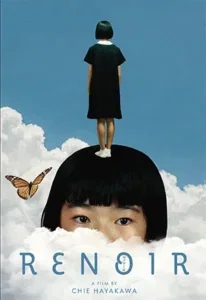
Renoir is a courageous film. Courageous because it is deeply personal. It is not a film that tries to seem radical all the time, nor one that calls attention to its own form as if that were enough. The courage seems to come from facing a memory that is too intimate, almost uncomfortable in its closeness.
Chie Hayakawa draws from her own childhood, when she went through her father’s illness and death from cancer, and turns this into the story of a girl who is still trying to understand the world and, suddenly, also needs to understand that someone can disappear from it. Even when she fictionalizes, Hayakawa seems to touch on very personal emotions: fear, guilt, imagination, and a childish, somewhat strange fascination with death.
At the center of Renoir is Fuki Okita, 11 years old, played by Yui Suzuki in her first major role in cinema. She is on summer vacation in Tokyo in 1987. Her father, Keiji Okita, played by Lily Franky, is hospitalized again, in a terminal state. Her mother, Utako Okita, played by Hikari Ishida, tries to deal with the inevitability of death by burying herself up to her neck in work.
There does not seem to be room inside that house for a clear conversation, for emotional preparation. Fuki is a lonely and adrift child, with her terminally ill father in the hospital and her mother, who has little time for her daughter.
The film is challenging because it refuses to place heartache where we expect to find it. It does not give us the painful breakdown we expect. The catharsis does not come. Fuki’s mother suffers in an opaque way, sometimes irritating, almost dry. Her father is dying, but the story does not turn this death into a melodramatic center. Fuki observes, wanders, asks, imagines, gets distracted, and grows curious. At times, she seems more interested in the occult, hypnotism, and the idea of death than in the concrete gravity of what is happening.
That is where the film’s cruelty comes from, not from an absence of affection, but from the direct way in which it leaves certain feelings in the frame. Loss appears without much preparation. Guilt too. Irritation, loneliness, that kind of ugly regret that no one likes to admit. Renoir lets all of this circulate without explaining too much. Hayakawa speaks of fear and desolation within the family, and of the uncomfortable idea that the family does not always offer the support someone needs. Sometimes, family also isolates and, many times, hurts.
Hayakawa’s most important choice for telling her story lies in perspective. The director portrays the events through the limits of Fuki’s understanding. There is no omniscient narrator stitching together the meaning of things. We know what she knows, we follow what she follows, and the rest we fill in ourselves. We also stay somewhat in the dark with her. The signs are there, but they still do not come together properly. The illness is there, the absences too, the tired adults, the house slowly falling apart from neglect, but Fuki does not have the repertoire to turn all of this into a mature understanding.
The adults’ emotional distance pushes Fuki aside. Her mother seems to trust that she will be well enough, or maybe she simply needs to believe this to keep herself functioning. Fuki moves through Renoir wearing the same clothes – the somewhat tomboy-ish polo shirt, the shorts, the ordinary shoes – almost as if the costume insists on a stability that her life has already lost. She ends up delegated to the sense of community: friends, neighbors, acquaintances who change her socks, feed her, welcome her, give her some shelter while the mother works.
Almost always, Fuki’s mother is working. When she returns, there is dinner, but even dinner together seems less like a family moment than a small pause in the collapse.
The house, in some way, reveals what no one says out loud. The ignored domestic chores that accumulate are not just set details. They are signs of a family structure that can no longer hold itself together. There is neglect, yes, and there is also overload. The strength, perhaps, lies in not separating these two things comfortably. Her mother fails Fuki, but she is also trying to cope with grief even before death happens. Her father is present as a sick body, as a source of affection, and as a weight. Fuki perceives pieces of him, never the whole picture of his suffering. How does one blame another who is so deeply wounded?
After her father’s death, the first image of the hospital room being cleared with the light coming in is significant. Calling that visual metaphor a type of “liberation” from grief would be too simple. It is also more than an image of sadness. There is exhaustion there. It seems like the end of a wait that has gone on for too long. Something that had been dragging itself through the house, through the hospital, through the bodies.
Death is hard to endure, but the suffering that comes before it in Renoir had also already occupied the house, the bodies, the routine. When the light comes in through the empty hospital room’s window, it seems as if a weight leaves, even though the pain continues. It is uncomfortable to admit this, but grief can also come with a guilty relief.
Fuki is not filmed as a pure child, made to move us. She is distracted, sometimes strange, sometimes selfish, as any child can be. Hayakawa approaches these fluctuations without trying to make them beautiful: the neediness, the hunger for physical warmth or affection, the fascination with life after death. There is a sad trace of guilt in her storytelling.
Even the title enters the film without making much noise. The connection with the painter Pierre-Auguste Renoir stems from a personal memory: as a child, Fuki was enchanted by a reproduction of Little Irène that her father bought for her; in the film, Fuki insists that her father buy the replica. Hayakawa says that the connection with the painter does not extend much beyond that, and that this simplicity may be part of the interest. The painting does not explain the film. It stays there in a simpler way: something Fuki wants, a memory connected to her father, a small beauty that resolves nothing.
In such a hard portrait of a child’s loss of her parent, a wife’s loss of her husband, one must not assign simple judgments of right or wrong. Renoir is not interested in that. The film stays close to this girl, who does not know what to do with death. Fuki is forced to learn what it means to lose someone without anyone teaching her how to feel or how to act. Renoir follows Fuki’s unguided process without making things easier for her, the adults, or the viewers.
By not transforming grief into a spectacle of overcoming, or childhood into shelter, Hayakawa pushes viewers to accept that there are bad, crooked, ugly feelings, and that they are also part of the experience of loving someone who is dying. Perhaps this is what makes Renoir so uncomfortable: pain does not form into a clear shape. Sometimes it comes mixed with boredom, anger, relief, guilt, and the desire to be seen. A child, faced with this, keeps walking through the house, through the street, through the summer, trying to understand something that no adult can explain.