
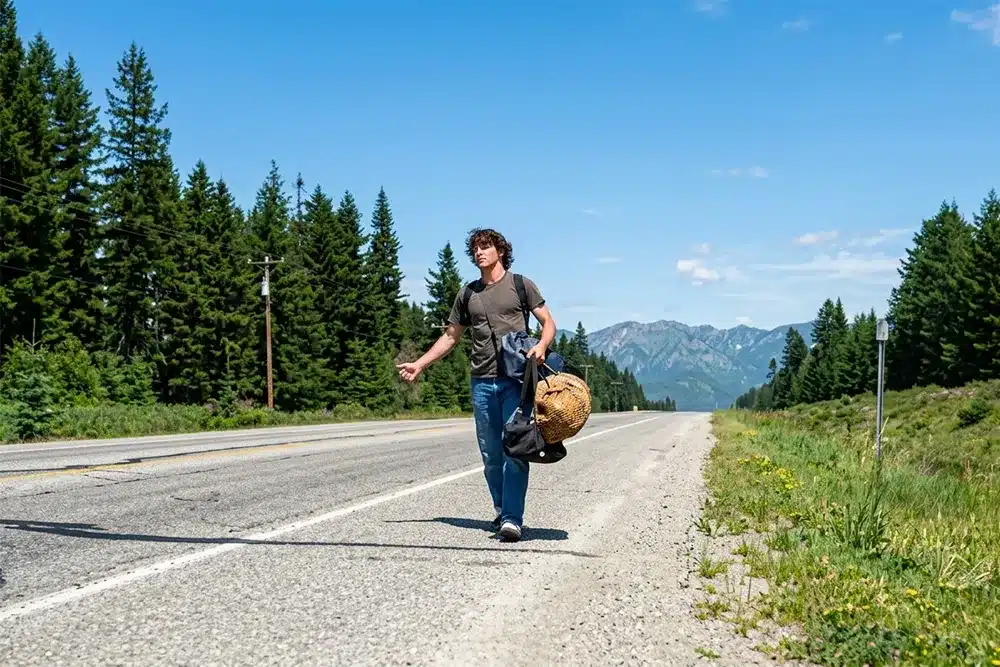

There’s a documentary by directors Michael Dunaway and Tara Wood called 21 Years: Richard Linklater. The title comes from “the notion that an artist’s career can be summarized within its first 21 years.” If we go back in time from its release year of 2014, the 21 years of the title takes us back 1993; thus, this film should be called 26 Years: Richard Linklater because, if we are considering the whole of this American icon’s work, you cannot ignore his first film, It’s Impossible to Learn to Plow by Reading Books (hereafter, It’s Impossible.)
Passed over, even neglected in most articles and scholarly discussions of Richard Linklater’s oeuvre, is this curious and unavoidably independent film. Even film scholar Mary P. Erickson has written that “Linklater’s first feature film… is rather obscure unless one has closely tracked Linklater’s career.” While two scholars, Rob Stone and David Johnson, have briefly written about the film, little mainstream attention is paid to It’s Impossible, as is to Linklater’s more well-known and “significant” work, like Slacker, Boyhood, or Dazed and Confused, or his two most recent films from 2025, Nouvelle Vague and Blue Moon. However, It’s Impossible set the template for Linklater’s entire career.
To wit: 2025’s Nouvelle Vague is a recreation of the making of French New Wave icon Jean-Luc Godard’s first film, 1960’s Breathless. The connecting threads between Godard’s Breathless and It’s Impossible are impossible to ignore. They are both filmmakers’ first films; both directors flirted with chaos and randomness in script and direction, defiantly playing with the idea of narrative structure. Godard felt he needed to make a film (“I should have made my first movie by 25,” he says in Nouvelle Vague), while Linklater released It’s Impossible when he was 28.
Richard Linklater: Big Dreams, Small Camera
In the 1980s, before he became a director and when he was watching every possible movie he could, Richard Linklater became aware of Cahiers du Cinéma, the film magazine and movement that took root in France and helped spawn the New Wave of French cinema, a highly influential movement that radically shifted how films were created. One of their major precepts was that “you could make movies as cheaply as possible.” It’s Impossible was made for $3,000.
I first came across the film around 2015. I was curious, after watching Slacker, his 2019 breakthrough, for maybe the fourth time, if Linklater had done anything previous. I found It’s Impossible innocuously uploaded to a YouTube page, for free no less, and was entranced.
With no real narrative thrust, It’s Impossible focuses on idleness and travel. The film was directed, filmed, and edited by Richard Linklater, who stars as a drifter meandering through Texas, taking trains and cars to other destinations in the US. One reviewer on the IMDB message board called it “intentionally alienating yet undeniably fascinating and innovative.” What brought Linklater to make this anti-narrative feature film?
Richard Linklater Becomes a Hitchhiking Filmmaker
Richard Linklater was born in Houston, Texas, and later moved to Huntsville, Texas, with his mother after his parents divorced. He spent a lot of time in high school playing baseball and, later, football. He stopped playing baseball due to a heart arrhythmia.
By all accounts, he was an avid reader, and in his teen years, he aspired to be a writer. “Rick was an incessant notetaker. He was always writing stuff down… He was always a good observer, because he was a bit of an outsider,” his high school friend Lydia Headley says. Even at this early age – the middle teens – Linklater was aware of some filmmakers. Linklater admired François Truffaut, the French New Wave filmmaker, of whom he says, “anything’s fodder” for a screenplay.
In his senior year, Linklater moved back to Houston to live with his father. After high school, he enrolled at Sam Houston State University in Huntsville but dropped out after two years. Instead, he worked the summer after his sophomore year on oil rigs in the Gulf of Mexico and then stayed on rather than returning for his junior year of college. The pay was good.
This was also when he saw Martin Scorsese’s 1980 film Raging Bull for the first time: “the film he now credits with changing his life and inspiring him to be a filmmaker.”
“That just got me thinking, ‘Oh, wow, film can do that?’ That’s when the film bug totally let loose on me,” Linklater says.
When not working on the oil rig, he watched films in Houston at the River Oaks Cinema and a three-plex art house at the Greenway Plaza, as well as at the Rice Media Center and the Museum of Fine Arts. He developed a hunger for films.
“I might be offshore for 12 straight days, but the second I hit land… most of the guys out there started going to bars, I just wanted to get home and go to the movies… I was just sort of falling in love with cinema.” And not too long after this, a lightbulb went off: “I was like, ‘I just need to get a camera. I’m realizing I’m a filmmaker. I’ve found my medium. Once I knew it, I never looked back.”
He was laid off from his oil rig job, had $18k in savings, and collected unemployment. He moved to Austin in 1983, a time Linklater recalled: “When I moved to Austin, everybody I met was an artist. Nobody talked about what they did for their day job. They were painters. They were musicians… everybody had ideas. Everybody was writing something.”
His friend Tony Olm recalled that Linklater “…saw 500 movies a year. That was his full-time job.” Linklater says the number was closer to 600. He pared down his expenses, and about the only major purchases were film stock and equipment. “I was buying freedom to live in the kind of world I wanted to live in.”
He applied to film schools in Austin and UCLA but was rejected. On not going to film school, he told journalist Robert Horton: “I think film school’s real overrated,” he says. “You spend all year and make maybe one little five-minute movie with three people. Why not just go and make movies?” He did take a few film classes at Austin Community College.
He lived in an apartment where his main roommate for five years was Lee Daniels, who later became the cinematographer on many of Linklater’s films. With his film gear and the freedom of a life without needing to earn money, at least for a while, Linklater began making short films. Linklater and Daniels met in the mid-1980s when Daniels, a University of Texas at Austin film student, encountered Linklater at a meeting of the Heart of Texas Filmmakers club, a group particularly enthusiastic about the Super 8 format.
“Rick told me that he made Super 8 films with sound, which I’d never done before, so I asked to see them,” recalls Daniels. “We went to his apartment, and he showed me these films that he’d never shown to anybody. They were really well-done. He’d learned how to splice with Super 8 sound, which was very meticulous work. I would never have had the patience for it! I really developed some respect for him after that day.”
He bought editing, sound, and camera equipment and watched Late Era, Lee Daniels’ first short film. He and Daniels made a short documentary called Woodshock in 1985. Slowly, in his new hometown of Austin, Linklater was finding a community he not only wanted to be a part of but also contribute to.
Around this time, other filmmakers around the US were gaining renown for making small, independent films about their cities: Spike Lee, John Sayles, Susan Seidelman, and Jim Jarmusch in New York; Wayne Wang in San Francisco; and John Waters in Baltimore. This had an impact on Linklater because Austin became his kind of ground zero for filmmaking. This was the nascent beginnings of what is referred to as “indie” culture, short for independent culture, free of corporate or institutional involvement. Austin, Texas, was at the vanguard of this movement.
Independent culture was in ascendance at this time. One example of this is the music festival South by Southwest, which started in 1987. At first, it was meant as a regional festival centered on independent culture, which organizers hoped would attract 150 people; 700 showed up at the first iteration.
“It was meant to be a regional event for five or six states,” he says. “But it was national almost immediately,” proving there was keen interest in the vibrant creative community in Austin. Films were introduced later, in 1994, and in 1995 Linklater gave a keynote address as a standard-bearer for Austin film. “The fact that Rick stays in Texas is really important. He makes the films he wants to make,” says Louis Black, South by Southwest co-founder.
It’s a good idea to pause here and recap where the story of Richard Linklater’s life is around 1986. He has moved to Austin after discovering he wants to make films; he starts making short films with a Super 8 camera and meets people in Austin’s cultural community, where a nascent independent cultural scene is taking shape. Over the next few years, two parallel yet interconnected parts of Linklater’s life coalesce, propelling him further into a career as a filmmaker. One is a film; the other is a film society.
The Indies’ Oasis: The Austin Film Society
Once Richard Linklater moved to Austin, he lived not far from the University of Texas campus in a part of town called “New Oasis”, also known as West Campus, and realized he could see films on campus. To satisfy his voracious appetite for film, he also watched what he called “off programming” at the Dobie Theater, and the notion came to him that he might be able to program films.
“How do you do that?” he asked the theater manager. “Can we rent the theater? Can we split box office if I brought some films in?” Linklater says in a discussion with Criterion Collection president Peter Becker in 2021. He adds:
“You still yearned for what wasn’t there, you realized they were kind of showing the greatest hits. And this is what led me to get a little more active in the programming thing. There is this canon, there are all these classics, but there’s so much more.”
So, starting in 1985, Richard Linklater and Lee Daniels launched a midnight screening series that sold out the theater’s 200 seats on opening night.
“The spirit longs to be a part of a community. It’s an important thing in people’s lives. I found satisfaction in showing a film to an appreciative audience—one hundred people, or even forty people, watching a movie and hanging out after, talking,” he says.
They started by programming avant-garde shorts, then moved on to directors’ retrospectives. One of the first was Rainer Werner Fassbinder‘s films. A community of like-minded film people began to coalesce. “We’re kinda like the Calais de Cinema guys in the ‘50s. Like, we’re future directors. I’m a future director doing this.”
Linklater has mentioned many times his affinity for the French New Wave, and another of the first retrospectives was of Robert Bresson, one of the most influential of the New Wave filmmakers:
“One that I really put everything I had into was a Robert Bresson retrospective in the fall of 1987. I even wrote him a letter when it was over. He wrote me this wonderful letter back about the power of cinema and how here is this little town in Texas showing all his films and what a powerful medium we live in to communicate around the world like that. It was just kind of special.”
The film scene in Austin was vibrant:
“Everything was cheap. People were just hanging out, and that community was also a filmmaking community. A lot of these people wanted to make their own films or were working on films, so our production community was growing parallel to our cultural community. The people who ran The Austin Chronicle were film freaks, and there’s a big film school right there at the University of Texas, so there was a lot of film energy around—it just needed some destination. I was programming films before I was making them.”
In a video interview in 2020, Linklater describes the work he and Daniels put into what was later named the Austin Film Society (AFS.) “Showing films at the Dobie, splitting the door, hustling up an audience, taking care of advertising… That’s what kind of helped the film society be successful, is we treated it like a punk band. The week of the show, we’d put up flyers everywhere as if it was some punk show at the Dobie.”
“It was a grassroots organization,” says film critic Alison Macor. “Its methods of marketing were very grassroots, the way a lot of bands were promoting themselves at the time.”
The AFS slowly became a cultural institution in Austin over the years. It has now lasted 40 years and is an embedded part of Texas – and international – film culture. After a few years, it became a nonprofit organization and began receiving grants. In 2025, Linklater talked about the film society:
“I’m so proud of the Film Society. Out here in L.A., we’re part of this American-French Film Festival, and all these French people I’m meeting, they speak of the Film Society in such reverent tones… When they think of American film and film culture, it’s amazing. They jump to Austin as the indie success – that we support our filmmakers, that we show films around the world.”
In my research for this article, I discovered hints at the two sides of Richard Linklater’s personality. There is the film society side, the one building a filmmaking and film-watching community. Then there is the other, more isolated, solo-filmmaker side of Linklater.
“My own filmmaking at that point was so private and singular. But the film society was public; there was part of my personality that I was gonna be a warrior for cinema… I was a lone operator, making films completely on my own, so of course you want to build a community.”
If It’s Not Impossible…
Brett Davis, an alum from his high school, says of Richard Linklater’s It’s Impossible, “what I see is a guy caught in that limboland a lot of us are in our 20s, when you’re on the borderline between greatness and homelessness, and you’re not sure which way it’s going to go.”
Over two years, around 1985 and 1986, Linklater worked on the film. It’s Impossible consists of dozens of shots where Linklater would set up the camera in a variety of locations – a train station, a bathroom, the top of a hill, on the street, in his kitchen – and then he would press record and jump in front of the camera. Sometimes he would record the audio with a Sony Walkman stuck in his pocket. Linklater was the film’s director, writer, actor, cinematographer, and editor.
A much-shared book published around this time by Rick Schmidt called How to Make a Feature Film at Used Car Prices, almost at the same time as Linklater was spending $3k to make It’s Impossible. Microbudget filmmaking was in the air; Robert Rodriguez, Quentin Tarantino, Steven Soderbergh, and others were making ultra-low budget movies in the late 1980s and early 1990s.
“That’s where I was at that time, and that’s what I could do at that moment. I could do a film alone for $3,000 with a Super 8 camera. I did every element of the film myself and didn’t collaborate with anyone. I was really testing myself to see if I was a filmmaker.”
Linklater’s friend Clark Walker says, “That’s when I met you, Rick, you were doing the thing where you do the little Super 8 camera on the tripod, turn it on, and run in front of it and act, and I thought, this guy’s really crazy, or he’s really determined to make a film.” Another friend of his, Frank, gave him the film title by translating a Russian t-shirt he was wearing.
Linklater filmed outside train windows. Trains became almost another character in the film, partially because he bought the Amtrak “all aboard excursion fare” for $200 with unlimited US travel for 45 days. He took two trips to Montana, among other places, filming where he felt like it.
“It was really my own private little film school. Staring out the window with my Super 8 camera. It was that test, could I conceptualize, do, and then finish.”

As for the film’s theme: “I was obsessed with banality at the time, anything, a trip to the grocery store or a train trip around the country. Any element of my life I could find something to fit into this film. That’s the ultimate rejection of Hollywood structure, showing someone brushing their teeth, or shaving,” he said.
Once he had captured all the footage, and while he was still not working a regular job, and continuing to program the AFS at the Dobie Theater, he began to edit It’s Impossible. He did this in an editing suite at a cable-access TV station, ACTV, where he transferred Super 8 footage to video and then edited it over the course of a year. It’s Impossible eventually aired on ACTV.
An apt description of the film comes from film scholar Jeroen Boom:
“In a series of long takes, trains, buses, and automobiles move him in his desire to travel, voyaging through a wasteland of neon-lit roadsides and gas stations.
The film is not eager to arrive at a destination, but finds its solace in transitions and movement, in the infinite possibilities and endless encounters on the road.”
Once the final edit was done, It’s Impossible screened on the cable access channel, but nothing much else happened. Linklater, even though a dedicated “slacker” – or at least a dedicated observer and visual historian of the slacker lifestyle – had ambitions. He sent a letter to Monte Hellman, a well-known cult director and producer, and asked him to watch his film. A
lthough Hellman didn’t keep a copy of the letter, he recalls that “I watched Rick’s movie from start to finish, and I answered his letter with enthusiastic encouragement… Rick told me he used it to help raise money for his first 35mm feature, Slacker. To whatever extent this may be true, it makes me proud.”
Richard Linklater’s next film, Slacker, filmed entirely in Austin with local actors and a budget of only $23k, was released in 1990. Eventually, Slacker caught nationwide attention. The film follows a series of distinct characters as they go about their day in Austin. The non-narrative thrust of Slacker is connected to It’s Impossible: both are semi-experimental works of a young filmmaker. The film lacks the usual dramatic beats and character arcs found in typical Hollywood films.
Slacker‘s success would enable Linklater to maintain a career that is still strong today, with Blue Moon and Nouvelle Vague released in 2025. His forthcoming work on a film or TV series about the transcendentalists of the 19th century is still gestating, and he has been working for over 20 years now on an adaptation of Stephen Sondheim’s 1981 musical Merrily We Roll Along.
There’s a shot about halfway through It’s Impossible where we see Linklater, the actor, hitchhiking, presumably somewhere in Montana. He walks down the road carrying three bags, and cars pass him by. Not present in the scene are the camera and the tripod used to film it. Once he finishes filming the scene, Linklater, the director, must walk back, pack up the camera, tripod, and film stock, and actually hitchhike. At this point in his life, as a filmmaker, he’s entirely alone.
The scene’s poignancy stems from the metaphor that Linklater is trying to hitch a ride into the next stage of his life, camera gear and backpack in hand, to edit his new project, continue to program at the Austin Film Society, direct an unexpected indie hit, then direct niche films, experimental animated features, and studio films. As of 2025, Richard Linklater has 25 feature directorial credits to his name.
It all starts with Linklater, the actor, director, cinematographer, and editor, sticking his thumb out, trusting a driver to help take him to his next adventure. In 1991, as Slacker’s rise was beginning, Linklater told the New York Times: “My ideal world is making movies.” For a so-called godfather of Slacker-dom, his ambitious, driven, disciplined dream came true.
Works Cited
[Editor’s note: Citations are incomplete at the time of publishing. This will be rectified shortly.]
Editor’s note: Images from It’s Impossible to Learn to Plow by Reading Books adjusted for clarity using Google Gemini.
Black, Louis, and Bernstein, Karen. Richard Linklater: Dream is Destiny. PBS, American Masters. September 2016.
Macor, Alison. Chainsaws, Slackers, and Spy Kids: Thirty Years of Filmmaking in Austin, Texas. University of Texas Press. March 2010.
Schmidt, Richard. How to Make a Feature Film at Used Car Prices. Viking. 1988.
Weston, Hillary. “Thirty Years of the Austin Film Society: An Interview with Richard Linklater”. The Criterion Collection. 4 November 2015.
Wilkins, Kim and Moss-Wellington, Wyatt. “On Drifts and Swerves: Linklater’s Love for Lacunae”. ReFocus: The Films of Richard Linklater. Oxford Academic. December 2022.