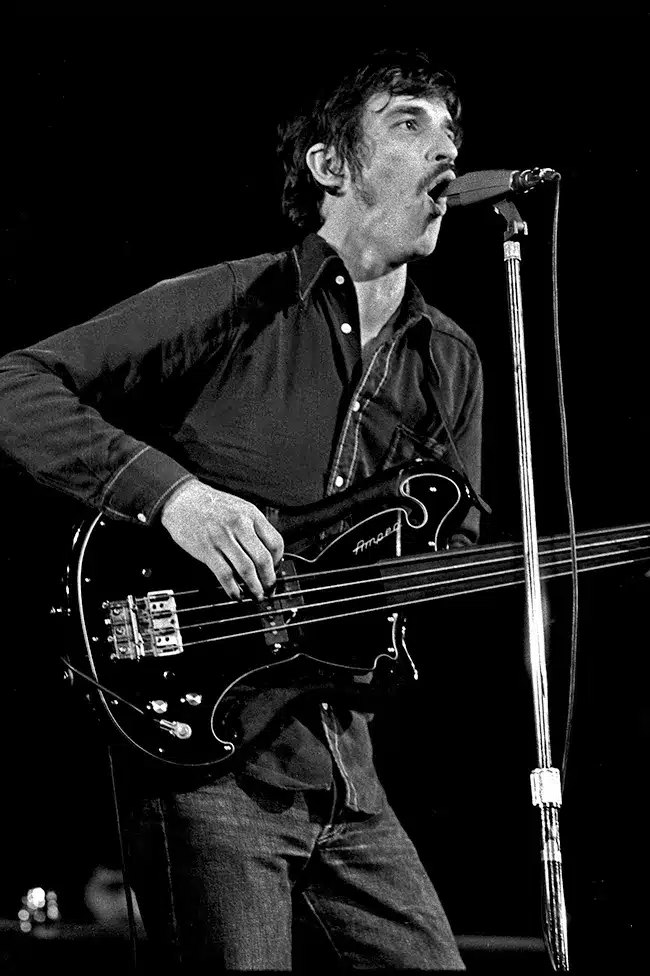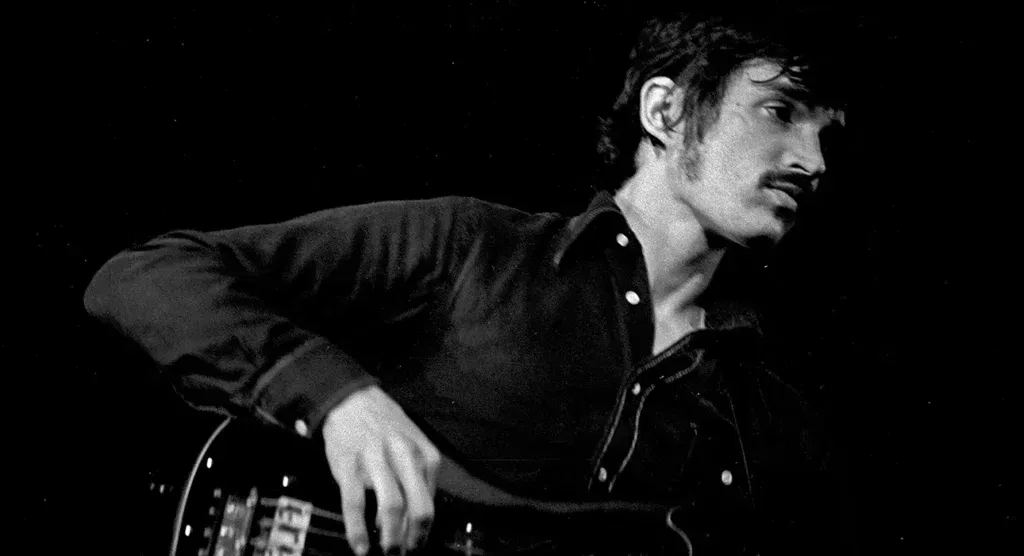
Rick Danko, the bassist and co-lead vocalist of the Band, sang with his soul. In fact, Danko not so much sang as wailed about what the world can do to you, and, if you are not prudent, the damage you can do to yourself. Therein lies the irony: Danko died of heart failure at the age of 55—overweight, a heroin addict, road-weary, lost. Yet Danko’s achingly soulful voice possessed a sensitivity that embodied and transcended the void.
Over his relatively short life, Danko demonstrated that the strength of his songs, if not always, came from his keening voice. In his early days, he’d sung in a higher key, which gave the impression that he had reached up to the stars and dragged them down before besmirching them with soil. Conversely, Danko could sink like an anchor to plumb the depths of existence.
In his most profound moments, Rick Danko felt as if he were singing from the perspective of a betrayed United States. He sang of hurt and perfidy, alienation and strife. Moreover, he seemingly expressed a post-Protestant gnosis, coined by the professor and literary critic Harold Bloom and posited in his 1992 book, The American Religion: The Emergence of the Post-Christian Nation. In other words, Danko expressed spiritual loneliness and sadness that reflected Gnosticism rather than Christianity.
Like the country singer he grew up listening to, Hank Williams, Danko could conjure a world of emotion with a word. Danko was five years old when he first heard the country singer-songwriter Lefty Frizzell‘s version of “Long Black Veil”. In Danko’s version, he sings “e-ter-niii-tttyyyy”, elongating the last syllable as if taking a long drag on a cigarette. It is not unlike Bob Dylan‘s phrasing of “eternity” in his 2000 song, “Things Have Changed”. Yet Danko didn’t win an Oscar.
Rick Danko was also influenced by soul artists, such as Tony Williams of the Platters, Sam Cooke, and Lee Dorsey. Like them, Danko would let a song direct him, which is why he sang with such conviction and freedom: his presence felt reduced within the carapace of the music. Put differently, he was a voice in a crowded room, not trying to be overheard. Thus, you would be hearing more than drunken wisdom at midnight, though, on the right occasion, that can be good too.
Danko could knock you down with a quiver or a sigh. In “This Wheel’s on Fire”, a track he co-wrote with Bob Dylan, his mournful vocals echo the narrator’s baffled state. Danko stretches the words “Rooaad” and “exploooode”, helping the listener to envision the narrator rolling down the road with his fiery wheel, or Ezekiel’s chariot. It’s fun, sad, and, above all, suggests he knows something that you don’t know, which we’re better off for.
In “Stage Fright”, Rick Danko forces you to feel the narrator’s intensity, temerity, and vulnerability. He is a lonely kid turned man with a mask like a face. Vocally, at one point, he warbles like the bird referenced in the lyrics. Furthermore, Danko’s phrasing on “all his might” tells you all you need to know about defeat.
Other highlights include “Long Black Veil”, “The Unfaithful Servant”, “Time to Kill”, “Christmas Must Be Tonight” (especially the alternate version), “Twilight”, and “A Book Faded Brown”. However, there is one song that eclipses all the rest: “It Makes No Difference”, one of the greatest songs ever written about lost love. The version on the Band’s sixth studio album, Northern Lights – Southern Cross, released in 1975, is a warm-up, a rehearsal for the live versions Danko performed in the following decade. Then he was close to the void to the point that he wore it like a cloak, which you hear in the performances.
For the cultural critic Greil Marcus, the version of “It Makes No Difference” from Danko’s concert with Levon Helm in Portland, Oregon, on 28 January 1983, is perhaps Rick Danko’s greatest recorded performance. In his 1975 book, Mystery Train, Marcus writes, “[it] is almost too deep to listen to.” Indeed, it is a performance that seems to withdraw rather than project: each wail a confession; each moan a secret; a love wounded and defeated, broken and dying.
On 12 December 1985, Danko and Richard Manuel performed at O’Toole’s Bar in Scranton, Pennsylvania. The second concert of the evening was released as an album in 2009 entitled Live at O’Toole’s Tavern. It features a version of “It Makes No Difference” which is devastating: Danko crumbles into his woe; his world is turned upside down. Paradoxically, the only thing that keeps him going is the ghost of her, moving through him, through his lonely days, through his words; otherwise, he would have nothing, not even a phantom to cling to.
“It Makes No Difference”, or at least this version, is the sound of a person at the end of his rope, like Dick Diver, the main character of F. Scott Fitzgerald’s Tender Is the Night (1934). Nicole, Diver’s wife, espies him in his room: lost, emasculated, and defeated. As a result, she feels sorry for her unfaithful husband, a once-talented and revered psychiatrist turned alcoholic. Although the narrator of “It Makes No Difference” is in no way as cruel as Diver, they both experience a fall, a postlapsarian existence, in which they endure a fate worse than death. “It Makes No Difference” showcases life lived within the prison walls of lost love; shadows for company, like Plato’s Cave without illusions.
Turning lost love into a threnody, the veracity of Rick Danko’s pain, real or acted, cannot be denied. Danko falls deeper and deeper into an abyss with no signs of a way out, no hope, no joy, nothing. Accompanied by Manuel on piano, Danko delivers the lines as if the loneliness has suddenly crept up on him, as if surprised by the fact that another day has turned him further away from her, that is to say, himself.
Danko’s life had its own sadness, a slow descent precipitated by drug use, including being arrested for smuggling heroin in Japan in 1997. Shortly after the release of his third solo album, Live on Breeze Hill, Danko died in his sleep on 10 December, 1999. Perhaps that is the price for greatness: one must understand the soul on abstract terms, for better or worse. Perhaps that is a self-indulgent reading of artists; it does not matter in the end. With his old-timey, soul-inflected voice, Rick Danko went places that others could only imagine—a voice that makes a difference.