

A well-known idiom says, “In this world, nothing can be said to be certain, except death and taxes.” The habitual tendency for horror movies to disappoint, stoking strong feelings of frustration and despair, creates the illusion of a third certainty. This is not unique to horror in general, but the genre is as specific as it is broad, which means it is subject to more intense scrutiny than other genres. Sadly, what unfolds in Rock Springs (2026) is an experience that tests horror fans’ patience and goodwill.
The rhythmic disappointments in the genre grow tiresome, especially with Blumhouse, which once offered hope for horror movie fans but has since cannibalized the indie side of the genre, taking more than it has put back in. It begs the question: are horror fans a glutton for punishment, are they masochists, or are they actually eternal optimists?
The painfully disjointed indie ghost story Rock Springs might answer that we are all three. It’s a pity, because there was a personal desire to see the best in it, given that its story has the appeal of the familiar, but with a twist of Chinese spiritual beliefs. Also, it is writer and director Vera Miao’s feature debut, who was a writer and supervising producer on the miniseries Expats (2024) and the creator of the anthology series Two Sentence Horror Stories (2017-2022).

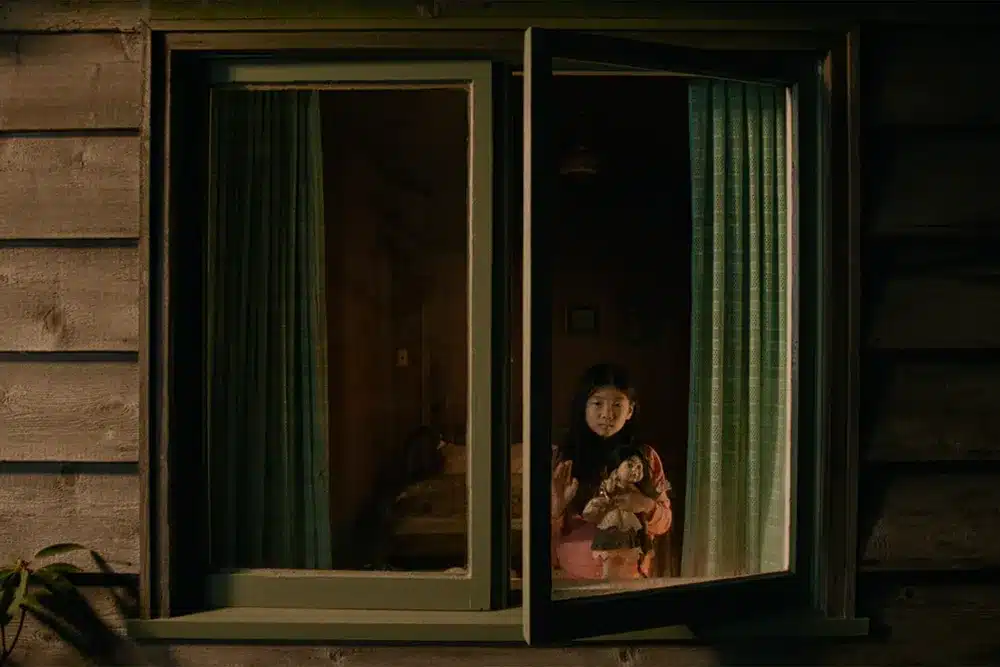
After the death of her husband, Emily (Kelly Marie Tran) relocates to an isolated home in Rock Springs, Wyoming, with her young daughter Gracie (Aria Kim) and elderly mother-in-law Nai Nai (Fiona Fu), who is a first-generation Chinese immigrant. There’s an inherent tension between the two women. Nai Nai frowns upon Emily for being unable to communicate with her in Mandarin. She also makes snarky comments to Gracie about Emily’s ignorance toward certain traditions and beliefs. So, Nai Nai teaches Gracie about Chinese customs, especially the “hungry ghosts” and the connection between the living and the dead.
As it so happens, the town has a dark history that is attached to a creepy doll that Gracie finds at a second-hand market stall. There are also the creepy woods behind the house Emily has chosen, from which Gracie hears mysterious voices. Soon after moving in, the little girl disappears.
Whatever sliver of a film you’ve formed in your imagination from this brief outline will likely be better than the film itself. Ideas can be more fulfilling than those ideas turned into a story.
Rummaging through my thoughts, I’m at a loss to remember much about the film, other than it is a directionless mess. In its current guise, Rock Springs is an early draft, and its director and producers are the proverbial deer caught in the headlights.
To start at the beginning, overhead shots or a God’s-eye view are effective ways to create a feeling of unease and isolation, which Miao uses to show the family’s car approaching their secluded new home. Look down from high enough, and human beings will be reduced to insect-like dots. Emily, Gracie, and Nai Nai are framed as being small and insignificant in the grand scheme of things, which is a nice touch, given that the three of them will be forced to confront a history dating back to the late 19th Century.
There is, however, an unintended irony here, because all three characters are underdeveloped. They are reduced to props because narratively and thematically, Rock Springs may rev its engines, but it never gets out of first gear. Meanwhile, the cinematography and music, which are overdone in an attempt to summon an atmosphere and suspense that’s largely missing, become like an engine’s high-pitched whine or roar as Miao tries to accelerate.
“Gracie”, the film’s first chapter, serves as a set-up, introducing the characters and the mysterious sounds Gracie hears in the forest. Then Miao makes the inexplicable and detrimental decision to abandon the trio of characters that form Rock Springs‘ emotional throughline. She runs off for a 30-minute trip down memory lane, albeit not a particularly pleasant one.
Chapter two, “Uncle Brother Nameless”, chronicles the Rock Springs Massacre of 1885, where Chinese miners were set upon by a mob of white miners and townsfolk. As important as these events are, breaking that all-important emotional through-line cannot be justified. It’s here, 23 minutes into the film, that Miao loses control because chapter two asserts itself as a self-contained short film, with an effective set-up and payoff.
The movement from comedy to tragedy in this part of Rock Springs shows Miao’s skill at shifting and evolving tones, which she struggles to achieve in the long form. Even the first chapter, “Gracie”, is close to being its own self-contained short story, and so, the second chapter becomes the proverbial double-edged blade. It showcases Miao’s storytelling acumen while also exposing her shortcomings.
Then, by the time Rock Springs‘ third chapter, “Emily Emily Emily” begins, fatigue sets in. Our interest is on its last legs and is seen off by Miao’s struggles to emotionally reconnect us with Emily, who is haunted by her husband’s ghost.
Either side of chapter two, Miao wants Rock Springs to be a creepy ghost story, especially in the third chapter, with the creaking floorboards and her dead husband’s voice. She takes a fatal, even arrogant, misstep. She demands rather than orchestrates. It’s as if she expects to click her fingers and the audience will emotionally jump.
Despite James Wan’s overuse of jump scares, he at least took the time in his films to put the audience on the edge of their seat, and when he was at his best, he either created sustained tension or moved to scare the shit out of you. It’s the difference between orchestrating and demanding, a distinction that eludes Miao.
Rock Springs’ gravest failing is exploiting horror fans’ optimism by assuming that we will accept anything. We will not, and in this age of film versus content, Rock Springs is an agent of the latter, even if that was not its filmmakers’ intention.
It’s also a missed opportunity. There’s little use in talking about what could have been, but Miao had the opportunity to feed the American/Canadian horror film with multiculturalism and also create a serious meeting point between East and West. Rock Springs could also have been a fun popcorn horror with a sense of history that connects the past and present on a thematic level by exploring the hypocrisy and entitlement around race and immigration.
Indeed, compelling cultural and political themes await discovery, but the filmmakers preferred to offer rudimentary observations rather than elevate the film. These, along with any other nice ideas and moments of dialogue, are lost in the shadows of Rock Springs‘ broader failings. They are like those spontaneous noises in the dark, which, in the light of day, are blamed on our overactive imaginations.
Rock Springs premiered at the 2026 Sundance Film Festival in the Midnight strand.