
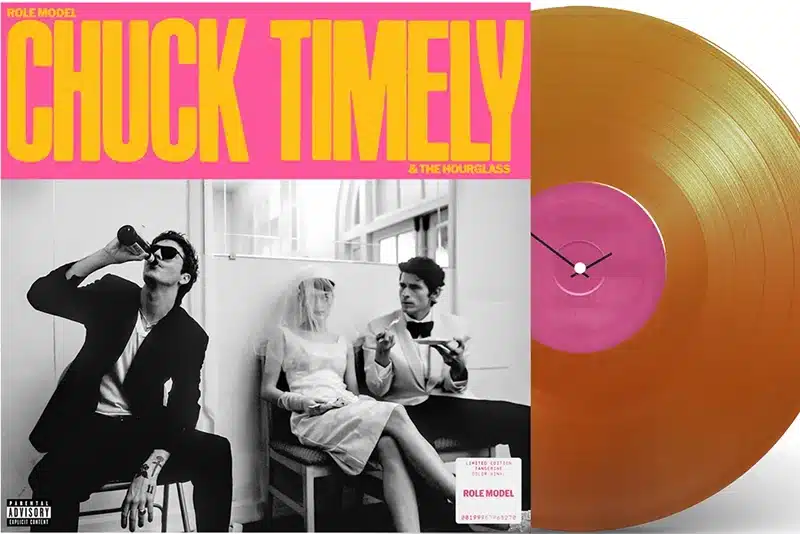

Pop music is about persona, whether or not a given star has a moniker. The country-pop singer Role Model, whose given name is Tucker Pillsbury, flirts with a new alter ego on his third studio album, Chuck Timely and the Hourglass. On the cover, Pillsbury, as Chuck, drinks a beer, wearing a T-shirt beneath a blazer. Sitting next to a dressed-up bride and groom, he embodies an unkempt, rowdy wedding guest, sustaining judgmental glances.
Despite its wariness of domestic bliss, Chuck Timely and the Hourglass is an optimistic album that charts the romantic misadventures of its titular character, a thinly veiled autobiographical representation of Pillsbury. Discovered by the rapper Mac Miller in 2017, Pillsbury adopted the name Role Model, moved to Los Angeles, signed a deal with Interscope Records, and, by 2023, was “hard launching” his relationship with YouTuber Emma Chamberlain via a GQ cover story.
Although the two are no longer a couple, Pillsbury’s savvy relationship to celebrity itself sharpens his songwriting. By implicitly acknowledging that his old-school country-rock exists in a soundbite-dominated media landscape, he renders his own attachment to persona all the more authentic.
Consistent with this self-effacing approach to fame, on Chuck Timely, “Love I You” features a spoken-word cameo from actor Dakota Johnson, another of Pillsbury’s Hollywood exes. (Although the pair were reportedly still dating when the album was released.) The song is a laconic, rollicking bar anthem with a lyrical conceit that epitomizes drunken word-slurring. In the spoken-word bridge, Johnson is coy but self-assured when dismissing Pillsbury’s flirtation. “You say that to everyone,” she says.
Elsewhere, the record includes country-rock’s obligatory celebration of autonomy. In “Service Receipt”, Pillsbury leaves his phone number on a scrap of paper for a waitress, but never hears back. The chorus of “Joy” leaves room for guitars but doesn’t rely on rock theatrics to convey jubilance. Instead, an acoustic riff complements a succinct lyrical hook, and, in the song’s music video, Pillsbury and a friend spray each other with gas pumps.
The appeal of the singer known as Role Model relies on his ability to espouse straightforward Americana tropes without vanishing beneath their layers of history. In a 2026 interview with Rolling Stone, he explained the sonic mission statement of Chuck Timely: “do whatever [Madonna’s] doing on synth- doing that with piano or guitar.”
The album’s penultimate track, “The Wedding”, serves as its emotional thesis. In a 2026 interview with Nylon, Pillsbury described the song’s inspiration as integral to the record as a whole: he recently attended the nuptials of a bandmate, then his sister, which prompted him to picture himself standing at the altar one day. “The Wedding” describes the unexpected well of emotion he experienced at these ceremonies: “How sweet to realize at a wedding / that all hope ain’t lost on me?”
By humbling the irreverent Chuck Timely character, Pillsbury proves that the institution of marriage, like pop music, is accompanied by pomp and circumstance, but contains something real at its core. In the aforementioned interview with Nylon, Pillsbury talked about visiting his home state of Maine, away from Hollywood’s bustle. “When I don’t have success, I’m trying to set myself up to be happy,” he said.
Although the pop genre lends itself to froth, its creators demonstrate the benefits of being married to your career. For example, the Swedish band ABBA penned “The Winner Takes It All” about the separation of the two couples that comprised the group. Despite his apprehension about the passage of time, Chuck Timely seems content to get drunk at other people’s weddings, as he does on the album cover. “Time is no friend of mine,” he says on “Chuck’s Mantra”.
As a free-wheeling, flirtatious millennial, Chuck Timely (i.e. Role Model, Tucker Pillsbury) is a familiar archetype, but his ambivalence to the dismissal of his perspective provides him enough cynicism to navigate fame while maintaining a buoyant demeanor. In “Honeydew”, a beleaguered love song, Pillsbury turns a cliché—”We’ll be alright”—into a worthwhile chant. Pop music gives artists a strict lyrical and sonic framework, and to succeed, they must offer something new while repackaging the old. In name alone, Chuck Timely accomplishes this task, plotting his escape as he writes his vows.