
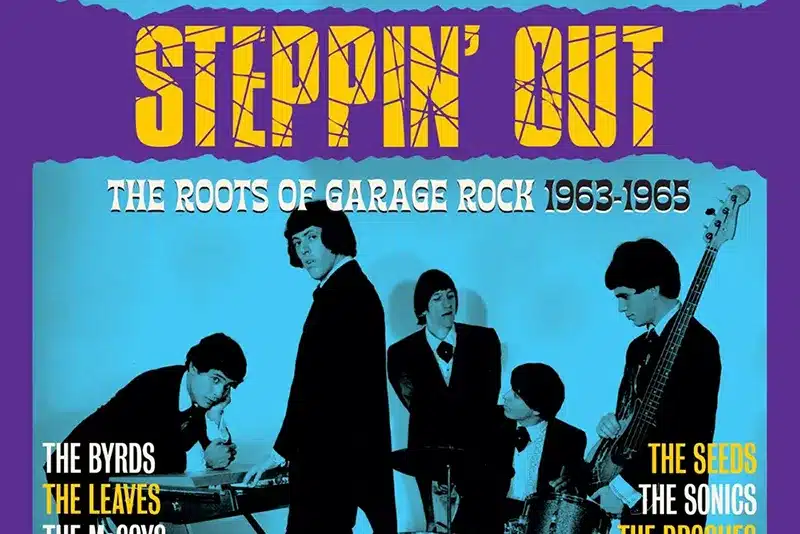

Today, the term “garage rock” is practically synonymous with the rough, ragged, proto-psychedelic music featured on Lenny Kaye’s landmark Nuggets compilation. First released in 1972, Nuggets was almost entirely comprised of songs originally released between 1966 and 1969. Therefore, Cherry Red’s Steppin’ Out: The Roots of Garage Rock 1963-1965 features a lot of material that predates Nuggets. That’s important to remember when considering your expectations for this collection.
Steppin’ Out continues Cherry Red’s traditional “exhaustive overview” approach. There are 94 (!) tracks squeezed onto three CDs, and only a handful of artists are represented more than once. With track-by-track liner notes that give plenty of historical context and lineup information, Steppin’ Out immediately becomes an efficient, economical alternative to all kinds of crate-digging and online scouring. As far as big-picture significance, there is some irony at work. Garage rock was primarily an American and Canadian phenomenon, and nearly all the artists here hail from those countries. Yet the primary cultural lesson from Steppin’ Out concerns two British giants—the Beatles and the Rolling Stones.
Steppin’ Out does indeed feature a handful of artists who appear on Nuggets. The Sonics, the Seeds, and the 13th Floor Elevators all deliver that classic, frazzled garage sound. The likes of the Uniques’ “You Ain’t Tough” and the 13th Floor Elevators’ landmark “You’re Gonna Miss Me” introduce the lazily menacing, drug-addled drone that would be so successfully revived 20 years later by the likes of the Brian Jonestown Massacre and Spiritualized. But that is not the only sound that is presaged on Steppin’ Out.
The Leaves’ take on “Hey Joe” has the frantic tempo, unbridled aggression, and energy that would fuel the UK punk movement (Kaye used the term “garage punk” in his Nuggets liner notes years before the Damned or the Sex Pistols existed). The Dovers’ “I Could Be Happy” and the Lovin’ Spoonful’s “You Didn’t Have to Be So Nice” wallow in the melancholy jangle that came to be indie rock, and the swaggering, organ-driven blues of the Standells’ “Dirty Water” sounds like a template for the Stone Roses. That is the “garage rock” part of Steppin’ Out, and it doesn’t really get going until the third CD, which covers late 1965 through 1966.
For anyone who might be wondering what the Beach Boys‘ “I Get Around” is doing on a compilation called The Roots of Garage Rock, though, here is the answer. The “roots of garage rock” seem to consist of popular American rock ‘n’ roll that preceded and overlapped with it in the mid-1960s, mainly surf rock and British Invasion-inspired music. Those two styles actually make up the majority of Steppin’ Out.
Since the compilation runs roughly chronologically, most of the first CD consists of 1963-1964 vintage surf rock. That includes both instrumentals and “hot rod rock”—songs about cars: Chevys, Cobras, and Jaguar XKEs. By 1965, the British Invasion was in full swing, all but wiping out the surf trend. The second disc, then, is heavy on the Merseybeat sound of the early Beatles. There are also a couple of nods to the looser, bluesier sound of the Rolling Stones, with the Passions’ swaggering “Lively One” being a prime example.
Many of the songs on these first two CDs were Top 10 hits. Some are still well-known, and for good reason. The Chantays’ “Pipeline”, the Lively Ones’ “Surf Rider” and Link Wray’s “The Shadow Knight” remain sublime, foreboding classics of the surf instrumental style. In addition to “I Get Around”, Brian Wilson co-wrote Jan & Dean’s irresistible “Dead Man’s Curve” and appears under the alias the Survivors for the exuberant “Pamela Jean”.
The Gene Clark-era Byrds progress from the half-baked Beatles pastiche of “You Movin'” to the fully-formed 12-string jangle of “I’ll Feel A Whole Lot Better”. Throughout, there are true proto-garage gems like the Kingsmen’s reverb-soaked “Louie Louie”, actually a cover version, and the Wailers’ fuzzed-out “Hang Up”, which has nothing to do with Bob Marley.
Thus, while the Beatles still cast a shadow on the Disc Three material, the sounds of the Stones and R&B loom larger. Also, this is the point where the big-picture lesson becomes strikingly apparent. In 1965, the Beatles’ singles included “Day Tripper” and “Nowhere Man”. The Stones released “(I Can’t Get No) Satisfaction” and “As Tears Go By”. Just the next year would see the likes of “Rain”, “Paint It Black”, Revolver, and Aftermath.
Maybe 75% of the material on Steppin’ Out was almost instantly rendered obsolete. You could argue that none of those 94 tracks matches any of those shortlisted above. The Beatles, the Stones, and, to a lesser extent, their British Invasion cohorts had left most of the Americans behind. The result is that most of Steppin’ Out sounds even older than it actually is. In an interesting twist, in the 1980s British bands like the Jesus and Mary Chain and Swervedriver would rediscover American surf music, planting the roots of garage rock once more.