
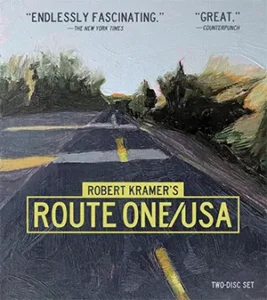
US Route 1 is a highway traveling up and down the Eastern USA from the Canadian border to Florida, making it the longest north-south route in the US. Robert Kramer structures his quiet, expansive, digressive four-hour-and-15-minute film, Route One/USA (1989), around this highway. If America is perceived as a land of the traveler, Kramer’s film is one of its ultimate road movies, and it’s now on a two-part Blu-ray from Icarus Films.
To label Route One/USA a documentary is both true and false. Although Kramer has made documentaries, he’s interested in the documentary nature of fiction and the fictive nature of reality, and he’s used documentary techniques for fictions.
In the opening scenes here, Kramer’s voice tells us that he’s recently returned to the US after ten years abroad (true) and that he’s gotten the idea to explore the country from north to south with his old friend Doc. That’s fiction, for Doc (played by Paul McIsaac) is a character from two previous Kramer films, Ice (1970) and Doc’s Kingdom (1987).
In Ice, Doc is a frustrated revolutionary in a sort of alternate-world scenario of a fascist America. In Doc’s Kingdom, the doctor has spent time in Africa and settled in Portugal, where his unknown son tracks him down.
In Route One/USA, Doc is more clearly Kramer’s stand-in, the returning exile who takes center stage in asking people about their jobs, thoughts, and histories. This is the most “real” and documentary of Doc’s trilogy, and it ends with him in Key West, finally getting a job, a house, and a girlfriend.
Kramer structures Route One/USA by trajet, a French word for trajectory that incorporates the meaning of a flaneur who’s open to distraction from all sides. Doc’s life isn’t the point. The point is everything and everyone seen by the camera along the way.
We meet innumerable people at work. They politely explain what they do and how long they’ve been doing it. Lots of women are fixing food. Lots of men are cleaning up. Special kudos for the wordless sequence of workers attending the assembly line where the Monopoly board game is put together; that’s a perfect little irony.
The physical drive from north to south is a journey through history that begins with people on a Penobscot Indian reservation at the northern tip of Maine and ends with Florida rockets. We meet conservative Christians campaigning for Pat Robertson’s presidency, who shows up in person. We spend entirely too much time with them compared to the two minutes we spend with a coven of Wiccans, reminding us of Salem as people prepare for Halloween. Henry David Thoreau’s house in Concord, New Hampshire, feels like a contemplative oasis to remind us of the deep history of civil disobedience and the role of John Brown.
Boston and Philadelphia offer tourist attractions, including the memorial to the 54th Massachusetts Infantry Regiment, the first regiment of African-American soldiers, and the subject of another film from the same year as Route One/USA, Edward Zwick’s Glory (1989). The tour guide reveals that her ancestor was a veteran, and this is among countless examples of how the film shows the impact of history on people’s lives today. There will be much more of this during the visit to the Vietnam Memorial in Washington, DC, a sequence intercut with recently arrived Salvadoran refugees.
Doc lingers in a largely minority neighborhood marked by crime and poverty, visits a Latino wedding, gets regaled with boosterism in Bridgeport, Connecticut, checks a book out of the New York City Public Library, and reminisces about training at Fort Bragg while looking at the Army’s latest recruitment video. He meets Robert/Diane, a confident drag prostitute (“Robert by day, Diane by night”). An African-American Vietnam veteran recounts his memories while clearing land and constructing a house, and then we run into Jesse Jackson on the same presidential campaign as Pat Robertson.
Florida presents us with swamps, rockets, recently arrived Haitian immigrants, and retirement homes full of people at the end of their personal histories. One roadside curiosity is some old codger’s museum of American tragedies (Jayne Mansfield’s car!). He shows torture instruments and wooden stocks for the head and wrists. When he declares that we should be happy such things belong to the past, we recall what the Salvadorans have told us of their recent torture, the veteran’s memories, the school with bullet holes in the door.
Along the way, Kramer and his assistant cameraman, Richard Copans, linger on details for no other reason than their beauty, whether it’s a foggy street, a sunset, a sea bird, or the continually visible decay of abandoned structures returning to nature. For every drop into a picturesque tourist attraction, we look at some homely local object of no obvious value. These objects and phenomena are part of the impassive, immersive landscape within which Doc wanders, an atmospheric miasma of memory and experience.
Route One/USA was previously released by Icarus Films on DVD in 2020. The new release upgrades the release to a two-disc Blu-ray. An excellent new bonus is Copans’ 74-minute memoir of the films he made with Kramer, Looking for Robert (2024). This engaging, informative overview will whet the viewer’s appetite for more of Kramer’s work.