

Documentaries sometimes do something simple and useful: they make a well-known historical image feel unfamiliar again. Kim Nguyen’s Saigon Story: Two Shootings in the Forest Kingdom begins with Eddie Adams’ Execution, Saigon, South Vietnam, the 1968 photograph taken during the Tet Offensive.
In the indelible image, South Vietnamese General Nguyễn Ngọc Loan murders Nguyễn Văn Lém, a captured Viet Cong prisoner, in a Saigon street. Vinh, a South Vietnamese soldier, stands beside Loan and assists with the execution.
The photograph became one of the images through which many outsiders came to understand the Vietnam War. Adams’ camera fixed the execution so forcefully that the picture came to stand for the brutality of the conflict itself.
Nguyen begins Saigon Story with the image’s force and keeps looking at the parts it could not hold. The street, as it was, has already become history, but the photograph cannot tell us what happened before the trigger was pulled, or what the image did to the families who had to live with this public execution.
Lém’s children search for the place where their father was killed, with journalist Võ Trung Dũng helping them locate the site in present-day Saigon. Vinh’s family story enters beside theirs. His presence in Adams’ photograph opens another part of the film. Adams’ image keeps its force. Nguyen keeps returning to it, then to the families who had to live with what it made public.
Nguyen has filmed war before. The Montreal-born director reached a wider international audience with War Witch (Rebelle), his 2012 drama set in Sub-Saharan Africa, about a girl forcibly recruited as a child soldier. That film represented Canada at the Oscars and was nominated for Best Foreign Language Film in 2013. In Saigon Story, that interest passes through a real photograph and through the people still living in its shadow.
Saigon Story had its world premiere at Hot Docs 2026, where I saw it, and won the festival’s Best Canadian Feature Documentary award. Nguyen later received DOXA’s Colin Low Award for Best Canadian Director. The prizes suit the film’s patience with the photograph and with the families affected by that moment, and all that led to it.
Saigon Story is strongest when it shows how civil war gives private violence a place to hide. The Tet Offensive sits just beyond Adams’ photograph. Its presence is felt, nevertheless, in the fear on the street and in how quickly armed men decide who belongs to which side. In that kind of chaos, a public execution may also have a private history. Nguyen lets some of that confusion remain.
The film improves when it moves beyond the photograph’s initial shock and follows the people still coping with the aftermath of the violence. Lém’s children eventually learn where their father was killed. The moment is quiet, but it lands hard. They already know the image. Now they have the street. It becomes somewhere a father died.
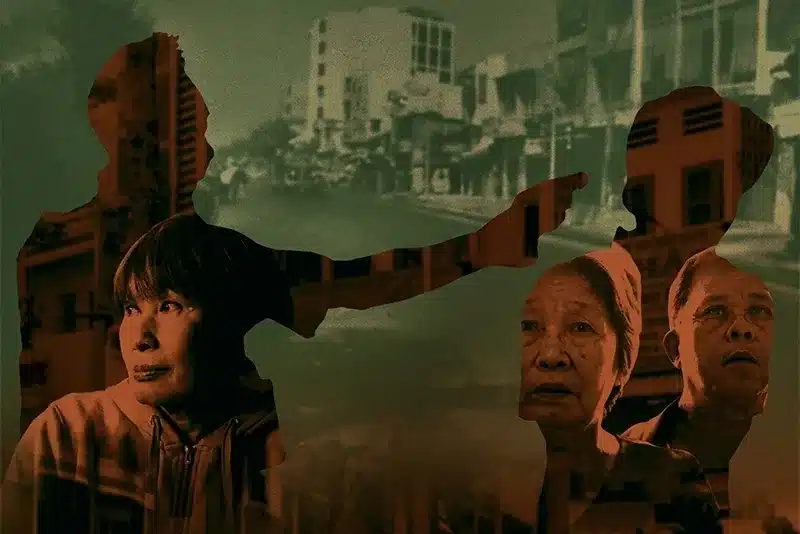
Nguyen lets the photograph speak. Adams’ image is cut into pieces, and each piece is given a voice. A face speaks. A hand seems to answer. Even the street is given a voice. At times, it works. The image stops feeling so fixed.
It also becomes too much. The first-person voiceovers are sometimes insistent, especially near the end. There are moments when Saigon Story explains the photograph more than it needs to. It works better when the families carry that weight themselves.
Vinh complicates the film. As mentioned, he appears beside Loan in the photograph, and later emerges through Mrs. Hafer’s memories as a man who brought violence home. The war around him still matters. The discomfort remains. He is damaged by war and continues to cause damage to others.
Mrs. Hafer’s scene is painful in a different way. She remembers her husband’s last day and says that his final question was whether she had ever really loved him. Nguyen leaves the moment almost plain. The question is small, almost ordinary.
The children and survivors give the film its gentlest moments. They want to know what happened. They want names, places, maybe a little clarity. That is already a lot. Saigon Story feels alive in that unfinished work. Adams’ photograph still has its terrible force. Nguyen trains his camera on the lives that had to continue after this brief but lasting moment.