
“Making records isn’t for the faint of heart,” said songwriter Salim Nourallah. If anyone would know, it’s him. Nourallah has at least five records of different sorts coming out this year (and that doesn’t include his music from 2025), starting with his ninth solo album, Nourallah, which came out as a surprise release on New Year’s Day. Follow-up Close As a Star will hit Bandcamp in May, a shocking new Nourallah Brothers album, Calling Manila, arrives in August; the solo album Constellation gets a vinyl reissue in November; and the Disappearing Act’s Proof of Existence is due out this year, too. PopMatters caught up with him this spring to make sense of everything going on.
“It’s just all been building up,” he says of the deluge. “Everything that’s happening in my solo land is the result of moving slowly but then finally happening.”
Nourallah has been developing since 2018; its oldest song was written that year while the singer’s mother was dying. The album arrived out of the blue on New Year’s Day, an exciting way to begin a new period.
“In the world at large, there have been so many negative things happening,” Salim Nourallah said of his decision to release the record that way. “Especially right around New Year’s, it felt particularly brutal. I’d been waiting nine months for the record. I’d been waiting seven years to release these songs. I’m no longer in a place where I’m climbing a ladder. I’m happy where I’m at, I’m making music for myself. I’m grateful that the people who do care are there. Why would I wait to set up a release that will get me more hits or likes?
“New Year’s Day felt like the perfect way to start the year,” he continues. “It was beautiful because it was unexpected for the people who are closest to me. So much love coming my way. It was my contribution to all of this — that is ultimately my contribution. I’m speaking through the music better than by posting a million posts about this or that, or about things I’m upset about. I just thought: Here’s my record. That’s my contribution.”
Salim Nourallah’s contribution isn’t simply releasing catchy music (though he does do that). On his self-titled release, recorded mostly with regular collaborator Billy Harvey, he digs into heavy topics, addressing some big questions, making it his most existential record yet. The writing took place over a long time, but ended up highlighting where Nourallah is now.
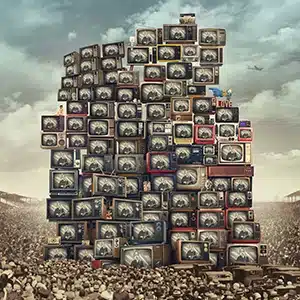
“The album art informed so much of what songs to put on this record,” he explained. “The Nourallah album was informed by the crowd of loved ones at the bottom of the mountain of TVs – my young parents, my daughter being held by her godmother, [and friends who have died]. There are living friends and loved ones in there, too. It felt like the songs that had a slightly bigger scope. ‘Judgment Day’ in particular feels perfect when I look at the surrealistic image – I’m happy with the way they line up together.
“It was those core songs and the album art that Jeff [Caudill] made that began to lead me toward the final destination. It was excruciatingly slow. I do not move quickly. I wrestled with album titles for almost a year to arrive laughably at the most simple, obvious title. Every title I came up with was so distracting to the art. I was so happy the day I realized that using my last name, because it means ‘light of god’ was the perfect title in my estimation.”
It fits because god appears throughout the record, and Salim Nourallah mentions the Bible, the Koran, the Pope, and more. One song’s titled “I’m in Love with a Nihilist”. He talks about these beliefs, not with answers, but with questions.
“That’s absolutely where I’m at,” he said of the questioning. “As the years roll on for all of us, I’ve firmly arrived: I do believe this is all not accidental, but it’s sort of embracing, trying to embrace the now, which is now gone, and whatever time we have left, making the most of it, and accepting that we don’t know anything, and that’s okay. It’s okay not to know, and it’s okay to be afraid or just to accept it.”
Nourallah doesn’t have definitive answers; he does have a sensitivity to both the seeking and the dangers of certainty.
“I’m always interested in what other people think as long as it’s not someone telling me they absolutely know what this is all about and that I should accept that, too,” he continued. “Going back to my childhood: my mother was Christian, my father was Muslim. Neither one was super aggressive about it. Even back then, I was questioning all of the dogmas, people killing and hurting other people.
“When I was a child, my father talked about it all the time – political dinners and rallies I went to. It’s always been something that’s been on my mind and my background. Ultimately, I’ve arrived at all the hippie things: peace and love. The record: This is me asking questions, asking them to you, the listeners, and other people. I’m not coming out of the gate with an agenda other than ‘How about we be kind, enjoy our lives, and be okay with not having all the answers?'”
“Born with a Broken Heart” addresses the problem directly, including the line, “All these people pointing fingers if you’re not on their religion’s team.” Salim Nourallah describes that lyric as “one of the most specific moments I say something I stand by.”
“I do think it’s absolutely wrong, it doesn’t matter what your faith is, to point at the other and say they’re less than or they don’t have a right to live or they can be killed because they’re not of your faith. That’s something that I’m adamant about, and I spoke up in the middle of that song.”
It’s part of an issue he’s been considering for years: “The dehumanizing of the other, which human beings have done forever to commit atrocious deeds. The minute you demonize the other, you’re giving yourself a weapon to use against them if we could just try to stop that madness. Just because someone doesn’t believe what you believe does not make them less than or mean they don’t have a right to live. It goes both ways, every way.”
Close As a Star, in contrast, feels much lighter. Lyrically, it feels more of a piece with Salim Nourallah’s previous work. “It’s not an un-heavy album,” Nourallah explained, “but it moves away from bigger picture to songs that have to do with, not relationships, but more of the dance or the struggle between people in relationships with each other. A lot of it was written in solitude, feeling distance. It’s much different than Nourallah because the words are not at all in the same kind of realm.”
That sense of isolation comes through on most of the tracks. “Sick of Being Lonely” sums it up nicely, but other cuts explore the loneliness that can arise within a relationship. It’s hard to consider this one the “lighter” record of the two, when it’s simply the more immediate and grounded, at least in a sense.
Fortunately, Nourallah has broken through isolation in a surprising way recently. He’s reconnected with his brother, Faris Nourallah, and they’re making music again. Nearly 20 years ago, Salim felt like this collaboration was impossible, and not much had changed.
“We’d have never thought there would be a Nourallah Brothers vinyl [reissue] release last year,” he said. “That was a miracle, and that completely came out of reconnecting with Faris. This new Nourallah Brothers, Calling Manila, is another miracle record. If you’d have said, ‘You guys are going to make another record, and that’s going to come out next year, I’d have bet anything that that wasn’t happening.'”
It’s not just that the brothers are working together; it’s that they’re doing something very unusual in the process. “It’s one of the weirdest ways to make a record that anyone has done,” Salim Nourallah said. “It came out of my sifting through all this music that my brother had left behind.”
New technology, like that used for Peter Jackson’s work on the Beatles’ Get Back, allows musicians to separate the tracks on previous recordings. Nourallah had a batch of Faris’ songs to work with. For one example, he removed the backing track from Faris’s “Italian Fantasy” and replaced it with a string quartet.
“I don’t even know what this is,” Nourallah said. “It could not have happened without this new technology of separating tracks. That is not what he recorded 20-plus years ago. He didn’t write a new song. He’s in Manila, he’s quit, he’s still not playing music.”
Faris’ songs include “Get out of the USA” (“a Beach Boys/Beatles romp, which literally tells the tale of Faris leaving the United States for Manila” and “Better Son” (“My father used to say, ‘I could find better sons that you in Mexico;” Faris turned something “hurtful” into a song). These cuts get new life and public release after decades.
While Faris isn’t writing or playing now, he has contributed to the new recordings.
Salim Nourallah explained, “My songs on the album are collaborations from a world away, talking back and forth, riffing, me doing it, him contributing production ideas, some voice memo background vocals, and things like that. It’s a completely unorthodox way to make a record.
“What I loved having is how much I missed my brother as a creative foil, and also just his left field ideas … that’s what he brought to the Nourallah Brothers record. He brought all these ideas, like ‘Let’s put a theremin on this,’ and I did everything he wanted, even when I didn’t agree, and he was 95% spot on. I haven’t had the force to push or disagree. I loved it. It’s been so much fun.”
Nourallah tells one story of the example of that fun: “While we were doing press for Nourallah Brothers, the vinyl release, we were having such a good time, at the end of one interview, he said his attorney Alphonse Alphonso was going to cease and desist and dissolve the NBs as a joke. We laughed about it on the phone. Then we started working on a song – ‘Alphonse Alphonso’.”
The fun doesn’t mean it’s been simple, and it took some smart production to make everything work out. “The thing I’m most pleased about is that from a production standpoint, it slots in right after Nourallah Brothers,” he said. “This does not sound like it happened 25 years ago. We had to keep the production quaint. It wasn’t like suddenly we’re making this modern rock album that’s hi-fi, or Coldplay. There are so many things that I’m thrilled about, but the fact that I can put it on right after the record that we made so long ago and it sounds like we picked up right where we left off makes me really happy.”
That happiness extends to the relationship. “Things have never been better between us. We talk almost daily. We’re having so much fun. We feel like we’re sitting on a record that might be the best thing we’ve ever done. Everything we do – picking artwork, singles. In some ways, better that he’s there, I’m here … the distance has actually worked for us. It’s just been miraculous for me. I would never have imagined that we could have entered a creative space again together in such an unorthodox way and be thriving.”
That collaboration might be the most startling work Salim Nourallah is doing right now, but it’s not the only surprising or unorthodox music he’s putting out. The Disappearing Act has recorded a new album, and it’s one Nourallah never thought would happen, which takes some explaining.
“The Disappearing Act started 17 or 18 years ago,” he said. “I have a friend, Bob Blumenfeld, I’ve known since first grade in El Paso. When this all began, Bob came in. He plays guitar in these unconventional tunings. Way back then, I called him a savant. It was my initial impression because it was almost childlike, but brilliant. He would play these instrumentals. They were very evocative to me – I started sharing top lines, words, and vocal melodies. The very first time — he didn’t even know what I was doing — I plugged in a mic in the control room and was mumbling lyrics over his noodlings and said, ‘Hey, I’m hearing song songs.’ He was like, ‘Okay, cool.’
“The first two albums, when I was still engineering, I would be triggered by Bob’s guitar things. I’d end up writing words and vocal melodies. They’d have to be chopped up; it was very unorthodox; he’d only play a figure for so long, and he wasn’t thinking I needed three times as long for a vocal. We’d construct songs that way, then have other people come in. It’s a totally different trip than anything I would ever do on my own.
“It had run its course after the second record. I wasn’t engineering anymore. Then, he pulled John Dufilho [of the Deathray Davies, Nourallah’s solo band, and more] into the mix. They started working on the backing tracks, and just like the first couple of records, as soon as I heard what they were doing, I heard words, melodies, and ideas that I wouldn’t have come up with on my own. They were generated through the music. It was another gift to me because I didn’t think we’d ever make a third album. It was born out of John and Bob collaborating and giving me these tracks, which inspired me to write over them. We’ve just continued with this new chemistry, been incredibly productive, and have the new album, Proof of Existence, finished and coming out this year. I put the new one and the last one on vinyl.”
All of which means that Salim Nourallah has hit an unusual peak of activity. Besides the new music, he adds, “I’m on this tear, on this mission to reissue all of my old solo album CDs on vinyl for the first time. Snowing in My Heart came out in November of last year. Constellation — I’m hoping to put out in December. It just needs to be pressed.”
The process, as he said, “isn’t for the faint of heart.” Nourallah also notes that the process is “expensive” and “easy to screw up”. To pull it off, he’s lucky to work with the people he does.
“I have one of the best mastering engineers in the country, and many people agree: Dave McNair. I have an incredible team – Jeff Caudill, who’s doing all this incredible artwork. Just looking at the Nourallah Brothers vinyl alone, you’ll see just how important Jeff’s role is. Dave is obsessed with audio. He’s cutting lacquers. I think he has two lathes in his home. This guy is next-level good. Having these people around me has gotten me inspired. It takes time and it takes money. You still have to be ready to wait.”
That’s how he does it, but the bigger question remains: why? “Everything seems so short attention span,” Salim Nourallah said. “Our attention spans are evaporating. Our devices and phones have done immeasurable damage to that. Real books, a book that you actually hold in your hand and read, and albums are two very important things to me that ask you to stop, to stop scrolling, to pay attention to more than 30 seconds, and have an experience with them. I cannot get excited about releasing these into the void again. I want something that someone can hold, look at photos, and be pulled into this world.
“Albums to me, when they’re really working, are inviting you into this little miniature world,” he continues. “I’ve shifted all of my focus to it; it’s become an obsession. I’m planning on producing five records this year. That’s going to cost me a considerable amount of money, and I’ll be lucky to make back some of it. I will, but it’s not about that anymore. I want to be contributing something back that’s not furthering this short-attention, clicks, five seconds here or there, 30 seconds if you’re lucky, world that we live in. It just feels like more noise pollution.”
Nourallah feels the same way about what he listens to as he does about what he creates. “I had a realization a few years ago with the Beatles. I don’t want to listen to the Beatles on Spotify. I want to listen to their records. It’s so much more pleasing to me. I think it’s important. It makes me happy. I want to make a thing, and the things I want to make are records. I’m so grateful they’ve come back, and we can make records. I would be lost if all there was was releasing your record on Spotify. I don’t want that. I’m not interested in that.”
That doesn’t mean Salim Nourallah completely resists streaming options. As he talked about a few years ago, he’s still following David Lowery’s lead by producing a physical product for his current fans and then releasing material on platforms like Spotify and Apple Music. “This is the model I’m going to stick to,” he said.
The approach has plenty of upsides, offering ways to connect with longtime fans and meet new ones. “I love the fact that people all over the world can hear the music,” Nourallah added. “There’s someone in Spain listening to the Nourallah Brothers right now. I never got into this for the money, and most musicians didn’t. Are you going to kill it because you’re not getting enough money? Money wasn’t the thing I ever cared about.”
As the records churn out this year, the process is an indication of Nourallah settling into a new place in his career.
“I’m truly independent at this point,” he said. “I’m the label, I’m the one funding the records and dealing with the manufacturing. There are lots of artists in the world, and the ones that have people helping them, that’s incredible. But I’m at a point in my life where it’s all coming from me. I’ve had to figure out how not to be a complete dinosaur and navigate all these changing, shifting things. My own label – I never wanted to get into that – I’d gladly give that up. But it’s also been wonderful. I love putting the records in the mailers, seeing people’s names, and writing notes. That brings me joy. That’s incredible to me. I’m enjoying all these things from it that I never thought I would enjoy, like having to fulfill orders. I actually don’t want someone else doing that for me.”
It’s hard to imagine that Salim Nourallah’s life isn’t completely full — he even gives the interview on a break from recording another band in his studio. Even so, or maybe because of that fullness, he sounds like a man at peace, laughing as his dog Klaus joins the conversation near its end. Nourallah has one last thought that encapsulates where he is at this moment.
“I feel very fortunate and privileged to continue to make music and make records and to do whatever I want to do. Who gets to do that?”