
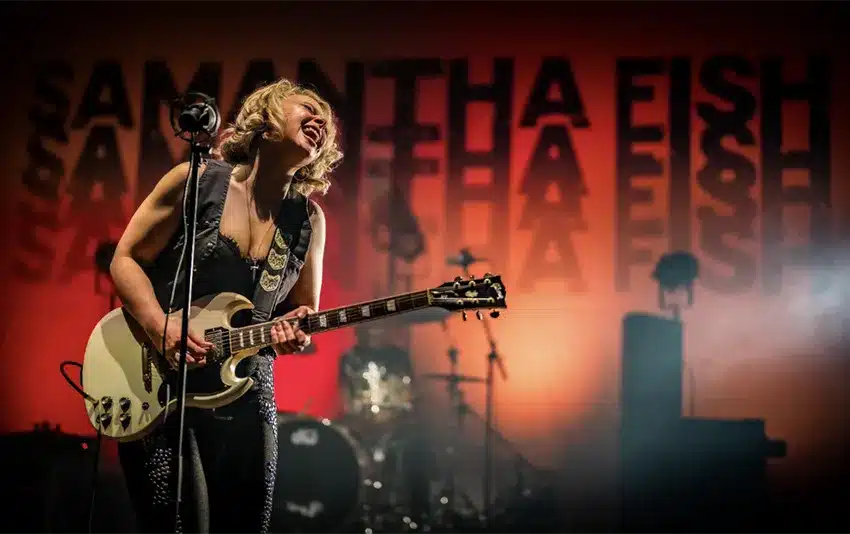

There was a time when live albums felt dangerous. Not polished. Not corrected by committee. Dangerous.
You could hear the room breathing. You could hear amplifiers misbehaving and drummers pushing a little too hard. Sometimes the singer missed a note. Sometimes the singer found one nobody knew existed until that exact second. A live record was proof that flesh-and-blood human beings had gathered in one place and tried to summon something bigger than themselves.
In 2026, with synthetic voices multiplying like fruit flies in a laboratory jar and AI-generated songs arriving by the truckload, Samantha Fish decided it might be the right moment to release a live album that leaves the seams showing. “A lot of my fans have been asking for a live record for such a long time,” Fish says. “The thing that I like about live records is it’s no frills. Everything’s just as it is. We didn’t go back into the studio and recut and overdub or anything.”
That matters to her. “Here we are out here putting our mistakes on a record,” she says with a laugh. “That’s maybe kind of refreshing.”
The album, Paper Doll Live, captures Fish doing what she does better than almost anybody currently wandering the American roots-and-blues highway: taking a stage and turning it into a weather system. Recorded at the historic Bijou Theatre in Knoxville, Tennessee, the record bottles the force of a Samantha Fish concert without sanding off the rough edges that give it life. The Bijou, with its old-world atmosphere and velvet-shadow history, proved the right place for such an undertaking.
“You can just kind of feel the history in the room,” Fish says. “It’s just been there forever and ever and ever.”
The venue itself feels like the kind of theater where ghosts would smoke cigarettes in the balcony and complain about modern country music. Fish clearly appreciated the mood of the place. The logistics worked perfectly—Nashville musicians could easily reach Knoxville, including the legendary McCrary Sisters, whose gospel harmonies add gravity and soul to the performances—but the room itself became part of the sound.
“It ended up being an amazing space to do it,” she says. “The videos look really, really great. It’s just a beautiful old theater.”

Live records have become oddly radical in an era where so much music is assembled atom by atom inside laptops. Fish understands that audiences still crave the imperfect electricity of a genuine performance. Her fans, many of whom travel long distances to see her concerts, wanted a document that reflected the sweat, spontaneity, and communion they experience at her shows.
“Willie Nelson described it as finding your congregation,” Fish says. “I definitely have found that in my fans.” That congregation was built the old-fashioned way: one club, one town, one hard-won believer at a time.
Fish grew up between Kansas City, Kansas, and Kansas City, Missouri, absorbing the region’s musical DNA through late-night jams, smoky clubs, and marathon listening sessions. Before she became a Grammy-nominated artist, she was another hungry guitar player chasing gigs around town, hauling amps into bars and trying to earn enough money to keep the wheels turning.
“The real goal was to go play Knuckleheads,” she says, referring to the famed Kansas City venue that became a proving ground for touring blues and roots acts. “That was definitely the premiere club in Kansas City.”

She played weekly residencies at neighborhood bars, sat in at blues jams, and learned songs like Howlin’ Wolf’s “Killing Floor.” Kansas City, with its deep jazz and blues bloodstream, taught her how musicians communicate in real time — not through algorithms, but through instinct, feel, and repetition.
There is something wonderfully unromantic about how many great musicians begin: not with divine revelation, but because somebody left a guitar lying around the house.
Fish started by stealing her father’s guitars whenever she could.“He and his friends would sit around and play every weekend,” she recalls. “It just looked cool to me.”
The atmosphere mattered as much as the instruments themselves. Her father’s friends played country, bluegrass, and what would now be called Americana, while her dad blasted Guns N’ Roses and taught her open chords and blues scales. Somewhere inside that collision of back-porch picking and hard-rock swagger, Samantha Fish started assembling her musical identity.

Her first guitar was a pink, homemade Stratocaster-style mutt with razor-sharp frets that “hurt to play.” Which may have been appropriate. Blues guitar has never been an instrument for the overly delicate. “It made my fingers tougher,” she says.
She learned obsessively, connecting pentatonic scales to chord shapes, trying to understand not just what worked, but why it worked. Fish still speaks about music as if it were something she is chasing, a mystery she has not entirely solved. “That’s the endless journey of being a musician,” she says. “You’re never quite happy with where it’s at.”
That restless curiosity eventually led her south. Fish now lives in New Orleans, a city she describes almost like a spiritual calling. “There’s inspiration everywhere,” she says. “There’s just something that feels very genuine and authentic in New Orleans.”
Authenticity is a slippery word these days, usually deployed by marketing departments trying to sell pre-ripped blue jeans or whiskey aged for six weeks in suburban warehouses. However, Fish means something simpler and older. She means human connection. Imperfect connection. Real voices in real rooms.
Though she is rooted in blues traditions, Fish rejects the idea that she is some museum-piece preservationist. “My music is rooted in the blues,” she says, “but I also acknowledge I’m not a pure traditional blues artist in any sense.”
Instead, she draws on rock, soul, Delta blues, North Mississippi hill-country grooves, gospel, and hook-heavy songwriting instincts. She speaks reverently about artists like Junior Kimbrough, R.L. Burnside, Skip James, and Charlie Patton, hearing a continuous thread running through generations of American music. “In the blues world, everything is connected,” she says.
That connective tissue—between past and present, audience and performer, analogue humanity and digital isolation—may be exactly what gives Paper Doll Live its resonance.
Because beneath the amplifiers and guitar solos and theater lights, Samantha Fish is really selling something increasingly rare: evidence that people still gather together to feel something real. Sometimes, for a couple of hours inside an old theater, that is enough to drown out the machine noise.
