
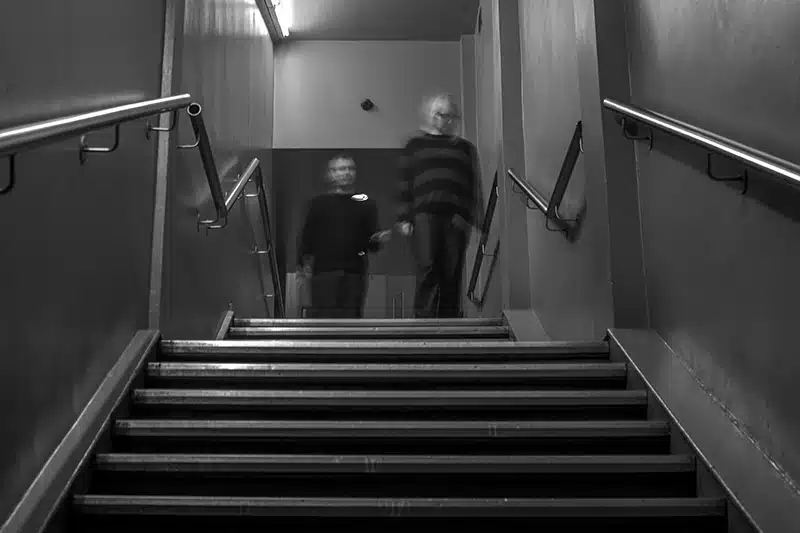

British electronic collective Seefeel reappeared after a 13-year hiatus with two mini-albums in 2024 and now present Sol.hz, their first full-length release since the 2011 self-titled LP. The group’s claim to notoriety is as one of the first guitar-based groups signed to the fabled British electronic label Warp, with their 1995 sophomore album Succour.
Rock listeners may first have encountered them on the 1993 debut Quique, where the band pushed dream pop beyond guitar rock conventions by dismantling structures that Sonic Youth and My Bloody Valentine had just about held in place. Instead, Seefeel built their sound around extended tracks of hypnotically recurring motifs, rewiring traditional instrumentation such as strummed guitars and a full drum kit into something closer to process than performance.
Sol.hz plunges Seefeel’s textural signatures back into the deep end of sonic minimalism. The opening track’s “Brazen Haze” creeps into the headphones, its volume plateauing after 60 seconds, when, for a further three minutes, triangular waveforms of melody float beneath searing white noise. Then the melodies evaporate as the noise intensifies. What stands out is how little change registers as development; rather than progressing, the track continually rebalances the same unstable surface.
My awareness of Seefeel’s guitar-rock lineage conditions me to anticipate a kind of resolution—something akin to “Breathe” by Pink Floyd or Sonic Youth’s “Teenage Riot”, where the abstraction cascades into emotionally propulsive backbeats and cathartic guitar riffing—but that resolution never arrives. Instead, “Everydays” opens with a damp squib of guitar feedback and a dull thud of found percussion, and another glistening electronic texture soon emerges.
The 2011 Seefeel album began with the croaking and wheezing of “Dead Guitars”, an act of sonic taxidermy that already suggested the instrument’s role in their music had been reduced to residue. On Sol.hz, that sense is furthered; any guitar presence is faint, mostly reduced to incidental feedback or indistinct harmonic bleed, such as when feeding subtle overtones into “Everydays”.
Percussion is similarly restrained across the nine relatively brief tracks (generally around four minutes, compared to the more extended forms of yesteryear). When it appears, it often sounds improvised or decayed—like found objects struck rather than a coherent kit. Even more structured rhythmic patterns are fragmented into irregular meters, where organization itself becomes destabilizing rather than grounding.
In that sense, rhythm functions less as structure than interruption. Across Sol.hz, Seefeel are less interested in constructing songs than sustaining a shifting field of texture, where familiar signposts dissolve as quickly as they emerge.
For those unattuned to the Seefeel sound, its branding is apt, even necessary to an appreciation of this music. While it is headphone music, it is not meant to be heard so much as felt. Repeating sonic motifs constructed from synthesized drones and pulses accumulate into something like a synaesthetic haze—less a sequence of tracks than a continuous perceptual environment. After several listens, its intensity becomes cumulative rather than narrative; at times, it demands withdrawal rather than immersion.
In the end, Sol.hz feels less like a continuation of Seefeel’s earlier work than a further thinning of already fragile boundaries. Where rock textures once lingered as traces, they now feel almost entirely dissolved, leaving behind something closer to a continuous sonic field than discrete compositions.
What remains is not melody, rhythm, or progression in any conventional sense, but a sustained state of suspension—sound that refuses to settle into objecthood. This refusal defines the record: its resistance to resolution, its avoidance of catharsis, and its insistence on texture over form. For listeners willing to engage with that instability, Sol.hz offers a disorienting clarity; for others, it may feel like music that perpetually withdraws just as it seems about to reveal itself.