
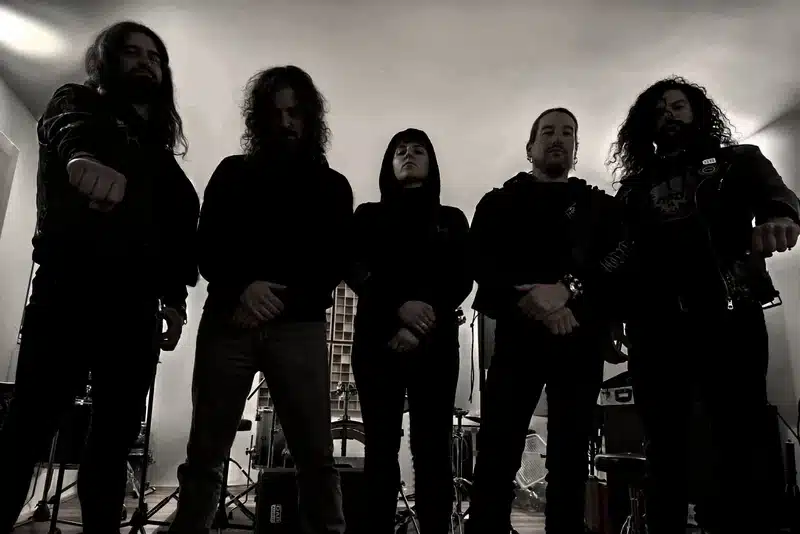

Sépulcre are entranced by death metal’s ritualistic potential. While many acts are rehashing the genre’s mechanics, the Brittany band instead embraces its aesthetics. Their full-length, Cryptic Temple of Otherworldly Abhorrations, is the pinnacle of their effort, a work that still stands firmly on the groundwork laid by Immolation and early Finnish death metal. At the same time, they extend the dissonant guitar tradition and the heavy, mid-tempo weight of death metal toward something more ritualistic.
Sepulcre’s approach to ritualism is multidimensional. Their lead work can morph into different presentations, taking elements from across genres to achieve different effects. The clean guitar parts in “Ominous Path (to the Nightside)” draw an eerie quality that stems from the band’s underlying dissonance, walking a fine line between death/doom and a blackened interpretation. In turn, this leads into more esoteric moments that can tap into the psychedelic. In instances like “…of Otherworldly Abhorrations”, they fully descend into minimalism, as the instrumentation becomes sparser and the melodic lines dissolve into deconstructed contortions of the death metal tradition.
Given the atmospheric tendency, the production is essential. It balances the gritty, old-school death metal sound with the heavier, more atmospheric aspects of death/doom. The result is a record where each instrument retains its extreme character, without the overall sound becoming muddy or messy. Take the vocal approach in the opening track: the reverb is abundant and could easily drown the performance, but it always stays in control, making the result harrowing yet direct.
This ritualistic foundation also feeds back into Sépulcre’s death metal pedigree, pushing their death/doom mechanics toward something more extreme. The infernal, Incantation-derived leads in the second half of “Abyssum Drakon” radiate with a more discordant quality. Similarly, their sense of progression, and especially momentum, draws from Finnish death metal while becoming increasingly more unruly and volatile. What starts in the established territory of Demigod and Adramelech in “Cryptic Temple…” becomes even heavier, and in “Katabasis” can easily shift between the established mid-tempo pacing and a more erratic blastbeat barrage.
Sépulcre understand the difference between reviving a genre and merely reproducing it. Their identity is moulded by ritualism, which they bring to death metal rather than allowing death metal revivalism to define them. It is a subtle difference, but it separates bands that merely repeat a sound from ones that understand it.