
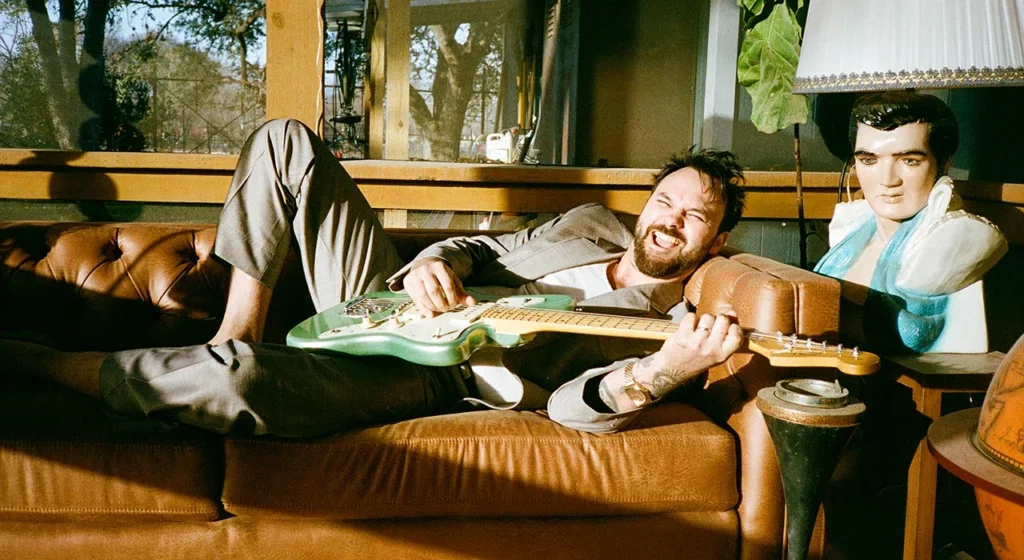
In Austin, Texas, mythology comes cheap. Every street corner carries a ghost, every bar a story, every stage a promise half-kept or half-broken. For Shakey Graves, it wasn’t mythology—it was atmosphere. Something you breathed in without knowing it, something that settled into your bones before you ever thought to call yourself an artist. “The thing about growing up in Austin,” he says, “was that it always felt small. Not like nowhere—but like a small town at heart.”
That feeling—intimate, idiosyncratic, a little off-center—remains embedded in him, even as Austin has ballooned into something sleeker, louder, more self-aware. “At some point, we didn’t even have the ‘Keep Austin Weird’ slogan,” he recalls. “When it showed up, everyone who grew up there was like, ‘What are you talking about? It just is weird.'”
That unselfconscious weirdness became a kind of artistic baseline. Not something cultivated, but something absorbed.
Raised on Storytelling and Improvisation
Shakey Graves was born into a household where art wasn’t an aspiration—it was the daily hustle. His father, David Rose, worked as a set designer and performer; his mother was an actor, director, and playwright. They met in the theater department at the University of Texas, building a life that, to a child, felt both precarious and magical. “We used to joke it was like ‘magic beans income,'” he says. “Somehow we’d eat again through the power of modern dance or whatever.”
It wasn’t stability in the traditional sense, but it was a possibility. Creativity wasn’t an abstract dream—it was a lived reality, however improvised.
That improvisation extended into music. Graves’ parents performed in an experimental project called Moon Coup, blending world rhythms with theatrical movement. The house—and often the backyard—became a rotating stage for the unexpected. At one point, Alejandro Escovedo played at a birthday party there. “I was always around weird shows,” Graves says. “It was just normal.”
First Contact: Chaos and Sound
If music was omnipresent, it wasn’t always foregrounded. “It was background noise for a long time,” Graves admits. “I’m sure I was accidentally in the room for all sorts of crazy stuff.”
His first real jolt came in middle school—a show at La Zona Rosa, where he saw the Bloodhound Gang. He crowd-surfed, got kicked in the head, and showed up late to school the next day. “It’s the most Austin story I could tell you,” he says, laughing.
At home, his listening habits were equally eclectic. His father was a devoted R.E.M. fan; both parents loved Talking Heads. His mother worshipped the Beatles. Somewhere in the mix: Enya and a stack of oddball movie soundtracks. “I had the Predator 2 soundtrack,” he says. “A lot of Alan Silvestri stuff. That’s my background—Bloodhound Gang and Predator 2.”
It wasn’t a curated education. It was a collage.
Learning the Wrong Way—On Purpose
Shakey Graves’ early career unfolded in fits and starts, often in less-than-glamorous settings. In Los Angeles, he booked one of his first gigs through Craigslist—a Chinese restaurant on the Strip. “I basically screamed at people while they ate for 30 minutes,” he says. There were pay-to-play nights at the Viper Room, DIY warehouse shows, house parties—each one a lesson in what not to do, and occasionally, what might work.
Busking never suited him. “I don’t like it at all,” he says plainly. “It felt like I was being pulled away from writing songs.” What he wanted wasn’t passing attention, but presence—an audience willing to stay, to listen, to meet him halfway.
Back in Austin, he found that space at venues like the Hole in the Wall, where he began to refine something closer to a vision. “It’s still one of the most important places in my life,” he says. “A real home field.”
No Rules, Just Process
If there’s a philosophy underpinning Shakey Graves’ work, it’s deceptively simple: there is no right way to make music. “It’s kind of my North Star,” he says.
He traces that realization, in part, to fatherhood. Watching his young daughter engage with the world—more interested in the act of painting than the finished product—shifted something fundamental. “She loves setting up, using the colors, putting the apron on,” he says. “The painting itself? She doesn’t really care.”
There’s wisdom in that, he believes. A reminder that process often matters more than outcome. “You can sit around banging on pots and pans and get just as much satisfaction,” he says, “as someone who’s stuck trying to write the perfect opening line to a song that doesn’t even exist yet.”
For Graves, the studio is less a place of precision than of discovery—a tangle of tape machines, wires, half-understood technology, and sudden clarity. “Some days I don’t know what any of it does,” he says. “And then some days everything lines up, and it’s the best feeling in the world.”
Building Fondness, Etc. from the Ground Up
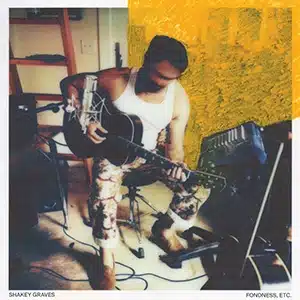
That sense of discovery defines his latest record, Fondness, Etc., a work that resists easy categorization while quietly holding together a series of emotional snapshots. “I didn’t go in thinking I was making a ‘dad record’ or anything,” he says. “It’s more like an archaeological dig.”
Songs emerge in fragments, then reveal themselves over time. The first piece of the puzzle, “When the Love Is New”, arrived before his daughter was born—a kind of tonal anchor that guided what followed. “I just liked the way it sounded,” he says. “It had a certain honesty to it.”
From there, the album unfolded as a series of vignettes—moments within relationships, not necessarily autobiographical but drawn from a shared emotional landscape. Each song is like a little freeze frame,” he says. “Not in any order, just different moments.”
The recording process itself mirrored that ethos. Much of the work was done on analogue equipment—tape machines that, as Graves puts it, are “built like a brick shithouse”. Durable, imperfect, tactile. “As long as you don’t drop them, they’re great,” he says.
Texas, Myth, and Memory
Place still matters. It always has. Like Austin, the vastness of Texas—particularly regions like Big Bend—lingers in Shakey Graves’ imagination. Not as postcard scenery, but as something older, stranger, and more contradictory. “It’s an otherworldly place,” he says. “You look at it, and it seems empty, but it’s full of life you just can’t see.”
That tension—between appearance and reality, myth and lived experience—threads through his work. Texas, in his telling, is both identity and question mark. “It’s a strange place to be from,” he says. “But it’s home.”
Exotica and the Fiction of Sound
One of the more unexpected influences on Fondness, Etc. comes from the mid-century exotica movement, particularly Martin Denny. Graves discovered it later in life and fell deep. “I listened to that stuff for like three years straight,” Graves says. “I thought it was the best music I’d ever heard.”
What intrigued him wasn’t authenticity, but imagination—the idea of creating music about a place that doesn’t quite exist. “It’s like fictional island music,” he says. “People imagining somewhere they’ve never been.”
In a way, that mirrors his relationship to Western and country imagery. “I’m not really a country guy,” he admits. “I’m a city guy in Texas, but that Western thing—it’s in there somewhere.” It emerges not as imitation, but as interpretation—a kind of internal landscape rendered in sound.
The Long Road Forward
For all his success, Graves remains wary of definition. Labels, he suggests, tend to limit more than they clarify. “Good,” he says when asked about confusing listeners. “All the better.”
His ambitions remain deliberately contradictory. “I want everything,” he says. “Obscurity, fame, family, chaos. All of it.” It’s not indecision. It’s appetite.
After nearly two decades under the name Shakey Graves, he’s still pushing against the boundaries of that identity—wondering what it might mean to collaborate more freely, to step outside himself, to explore new forms without expectation.
At the center of it all is the same impulse that shaped him in Austin: curiosity without constraint, creativity without permission. Somewhere between tape hiss and memory, between backyard shows and crowded rooms, Shakey Graves is still digging—still uncovering what was always there, waiting just beneath the surface.