
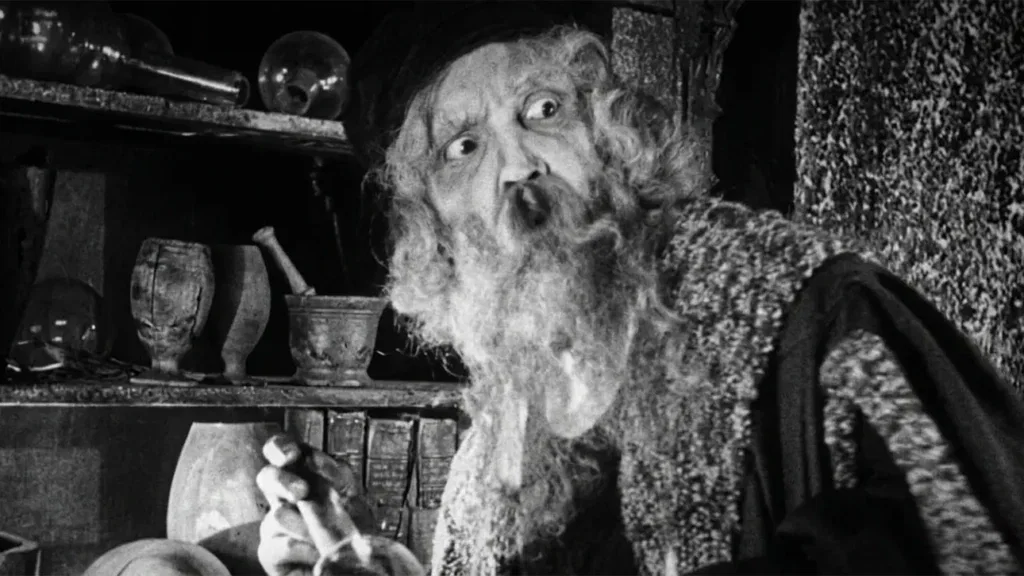

Jan Stanislav Kolár is a pioneering filmmaker in Czech silent films who became an actor primarily during the talkies. Deaf Crocodile’s new Blu-ray package of silent films, The Arrival from the Darkness + St. Wenceslas, will do much to redress his obscurity while introducing fans to previously unknown examples of silent spookiness.
The Arrival from the Darkness (Příchozí z temnot, 1921) presents us with Bohdan (Theodor Pištěk), a dressing-gown-clad bookworm who lives in a grand mansion, surrounded by servants, along with his wife, Dagmar, who wears her blond locks piled high on her head. She’s played by Anny Ondra, a major Czech star known in the West for starring in Alfred Hitchcock’s first talkie, Blackmail (1929), and for marrying boxer Max Schmeling.
The third member of a triangle, later a quadrangle, is a supercilious neighbor with a cape and a curled lip, Richard Bor (Vladimír Majeras). We gather there was a time when his rival family owned the estate, and he had eyes for Dagmar. Her eyes weren’t mutual. Today, Bor shows up with an ancient book as a gift for Bohdan and uses this as an entry to insinuate his unwelcome presence into Dagmar’s life, breathing heavily on her in the garden. Bohdan eventually perceives this and tosses him out, but he’s going to read the book first because he has his priorities.
Discovering a hidden message in the book about a secret room in a nearby Black Tower, Bohdan can’t help investigating. He finds himself walled in with a strange man who appears to be asleep in a chair, or else dead in a remarkable state of preservation. Bohdan finds a note explaining that the man can be revived at the price of injecting a few drops of one’s blood into his vein. So, the man is a kind of zombie crossed with a vampire and a golem.
Awakened, this man introduces himself as Ješek, a medieval ancestor of Bohdan. In an elaborate flashback, the historical relic explains that a grey-bearded alchemist of the Bor family (Majeras in a dual role) gave him a tonic to place him in suspended animation until he was aroused by blood. He felt little compunction to live after his beloved cousin and betrothed, Alena (Ondra again), died of plague. Now that he spots Dagmar, he’s convinced she’s Alena and therefore his by right. Oy.
Since some of its footage hasn’t survived, The Arrival from the Darkness runs only about an hour, yet it tells a coherent story with an explosion, a duel, and a kidnapping, in addition to all the creepiness amid cold castle walls and dark secret passages. Photographer Otto Heller had an illustrious career ahead of him, mainly in British cinema, and it’s no surprise when you see the atmosphere, the visual frames, the use of depth and moody superimpositions. The Berlin studio interiors and real Czech exteriors boast fine production values, and Kolár knows how to show them off. The restoration of this hardly-known title isn’t one of those massive undertakings of shot-yesterday clarity, but it’s always appealing.
Ješek, the unhinged yet semi-sympathetic man out of time, is played with mood swings by another famous Czech star and filmmaker, Karel Lamač, who frequently teamed with Ondra. They were an item for a while and founded a film company. Like Heller, he fled the Nazi occupation and landed in England. Lamač’s directorial efforts include a Dutch horror item, De Spooktrein (1939), and a comic version of The Thief of Bagdad (Die Diebin von Bagdad, 1952), both of which sound intriguing.
The Arrival from the Darkness was made one year after Robert Wiene’s German Expressionist landmark The Cabinet of Dr. Caligari (1920) and shares one or two ideas we won’t reveal. Kolár shot much of his film in Germany and should have had opportunities to see Wiene’s work. He definitely knew the films of Germany’s Paul Wegener, especially the 1915 and 1920 versions of Der Golem. Those films turn on an artificial man created through medieval alchemy who escapes his master’s control.
The Arrival from the Darkness also uses medieval alchemy to create a mysterious man who goes beyond his brief, although it’s a very different story as written and directed by Kolár. Since Czechoslovakia was a new political entity founded on the ashes of WWI in 1918, the idea of an old-school aristocracy whose fragile power is haunted by chaotic avatars of history has its own thematic tingle. This was perhaps the first Czech feature to receive distribution outside its own country, playing in Germany, England, and other countries under the title Redivivus.
The Arrival from the Darkness is scored in an “experimental” modern manner by a trio called Neuvěřitelno, while the five related bonus shorts on the disc receive a traditional piano score by Ben Model. These shorts include a mouth-watering four-minute fragment of another gothic horror item, The Wedding Shirt (Svatební Košile, 1925), co-directed by Josef Kokeisl and actor Theodor Pištěk, whom we’ve just seen as Bohdan. The fragment is all shadows and lighting, with one man peering balefully through a window and another rising from a coffin while a pre-Raphaelite woman looks frantic.
The other shorts are comedies from Kolár, who went into film archival work and reconstructed his own films decades later. Polykarp’s Winter Adventure (Polykarpovo zimní dobrodružství, 1917) is all outdoor snow scenes starring a top-hatted dandy. The Oriental Languages Teacher (Učitel orientálních jazyků, 1918) is co-directed by its female star, Olga Rautenkranzová, the first Czech woman director. She plays a daughter who fools her daddy so she can marry her sweetie. The Lady with the Small Foot (Dáma s malou nožkou, 1919) is a rather frantic detective spoof with a brief role for Anny Ondra. The Torn Photograph (Roztržené foto, 1921) follows a club of drunken bachelors; its opening sequence is hilarious.
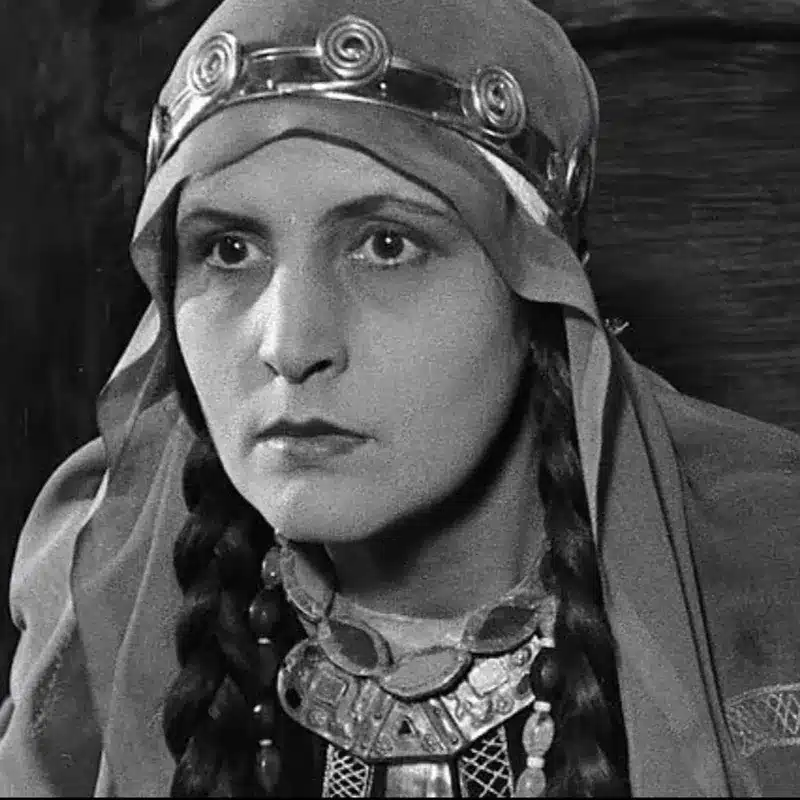
Disc 2 is devoted to St. Wenceslas (Svatý václav, 1930), a monumental undertaking that became the most expensive Czech film to date, and its most expensive disaster. The project was conceived to celebrate the thousandth anniversary of the death of the title figure, who holds national and religious importance in Bohemian culture, and the result is one of those historical epics that might have been designed to illustrate the term “lavish”.
The prologue explains that Wenceslas’s grandparents converted from paganism to Christianity. Grandmother Ludmila is played by Vera Baranovskaya, most famous for iconic roles as proletarian mothers in Vsevolod Pudovkin‘s films, and she still radiates strength of character in St. Wenceslas. Her son marries a brassy pagan huntress, Drahomíra (Dagny Servaes), another powerful woman who looks like a Valkyrie out of Fritz Lang’s Die Nibelungen (1924).
Her sons are the “priestly” Wenceslas (Zdeněk Štěpánek, a monument of Czech film) and the jealous, scheming Boluslav (Jan W. Speerger, yet another major star). It’s no spoiler to reveal that the canonization of Wenceslas derives partly from the legend of allegedly being murdered by Boluslav, Cain-and-Abel fashion. Old Testament resonance combines with the New as the fatal event is presented in Christlike mannerisms, complete with a last supper and forbearing victim who seems to know all in advance, such that death becomes the seal of his greatness.
Kolár masses hundreds of extras swarming across plains and battling in forests for a film that never looks like less than a million bucks (or, rather, four million crowns). Outdoor scenes are massive, and so are indoor sets. Contemporary critics found St. Wenceslas dull, and it became something of a political hot potato that ended Kolár’s directorial career, but all that falls away as the modern viewer sees a great-looking film that comments on power, greed, and the way those who seek a peaceful path seem doomed.
Eastern Europe has a corner on lively historical films, a fact I’d always traced to the vigorous handheld aesthetic taught in Soviet film schools, but here’s Kolár well ahead of that curve. This may be a questionable assertion, but even as a box-office disaster, St. Wenceslas appears to have influenced Sergei Eisenstein‘s similarly iconic and hagiographic Alexander Nevsky (1938), and therefore his two-part Ivan the Terrible (1945 and 1958), and therefore Andrei Tarkovsky’s medieval epic Andrei Rublev (1966). That’s no bad legacy.
St. Wenceslas receives the kind of shot-yesterday restoration that makes its imagery all the more vivid. Both this and The Arrival from the Darkness come with commentaries by Czech film expert Irena Kovarova and historian Peter Hames, who discuss the historical background. They point out that although people have assumed St. Wenceslas flopped as a silent film released after the advent of sound, in fact most Czech theatres were still showing silents at the time. A sound film might have been less visually dynamic, so it’s just as well that Kolár was hammering the last nail in the silent industry’s coffin.
More facts about Kolár’s career can be found in historian Jan-Christopher Horak’s liner notes, while critic Walter Chaw suggests that the literary-dream angle of The Arrival from the Darkness may have been inspired by Edgar Allan Poe’s 1845 poem “The Raven” with its “quaint and curious volume of forgotten lore.”
Another bonus film on Disc 1 is Bohumil Veselý’s How We Used To Make Movies (Jak se u nás kdysi filmovalo, 1954), a fascinating compilation of behind-the-scenes footage from several Czech silents, including both Kolár features and some of his shorts. Finally, scholar Stephen Broomer provides a witty, thoughtful visual essay on Kolár’s importance and style.
A limited-edition box has been released on Deaf Crocodile’s website and is reportedly low in stock. According to Amazon, a standard edition is scheduled for October 2026. Let this be the beginning of a fruitful Western awareness of early Czech cinema and its hidden masterpieces.