

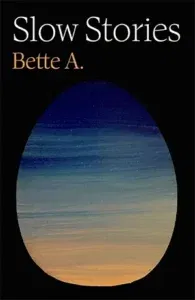
In Bette A.’s collection Slow Stories, “Guided” stands out. It takes place in Amsterdam, or at least a place called Amsterdam. Most of the other stories are set in nameless villages on mountain tops or at the edge of deserts. In these villages life that goes on as it has for centuries is interrupted by something – a man carrying a large rock on his back for no apparent reason appears in the market; an aluminum box is taken to be a god, a child is born clutching a stone in her hand, a house grows endless, mysterious rooms until it is so big it threatens to take over the town.
Characters tend to be nameless, only identified as the large one, the small one, or the girl. Even the named character, Ramses, is better known as the man who refused to go to war; Elvira is the one living in the mysterious, growing house. They are defined by what goes on around them rather than by any intrinsic personality or psychology.
A lot happens in these stories in the way that a lot happens in a Frank O’Hara poem; the characters do this, and then they do that. The tales are far from plotless, but character and plot seem beside the point in Slow Stories. The point – whatever it may be – is a mystery, both in the sense that it is sometimes hard to discern and that mysteriousness itself is one of the goals of Bette A.’s book.
So when, in “The Other Village”, the little girl wanders away from her village on the side of an unnamed mountain, discovers another village, and then everyone in her own village, including her father, denies that the second village exists, we are not surprised. Mysterious houses, boxes, and stones are part of Slow Stories‘ conjured world.
It seems possible that this particular mystery will unfold because the girl grows up to become the town librarian and returns to the second village. The possibility that she will explore this mystery of the existing-non-existent village is raised, but only briefly.
On one of her treks to visit the other village, the librarian is followed by her younger sister. She takes her sister to the goat-herder’s shelter just outside the new village’s walls. They could go in and learn about these new people, this alternative society. However, even though the librarian holds back, it turns out she only ever goes as far as that goat herd’s shelter to watch the lights come on every evening, to wait for the goat herder to appear at the gate, and begin the trek towards his shelter. There, on the brink of knowledge, the librarian leaves; the mystery remains intact.
However, “Guided” is after something more concrete than mystery. It is an old-fashioned science fiction story depicting a world in which, after a series of plagues reminiscent of the 2020-2022 COVID epidemic, the mainstream of world societies has chosen a computer implant that not only keeps their populations safe from disease, but also robs them of memory and emotion. “It is 2152 and everyone was finally happy.”
These “Guide” implants have evolved from familiar technology used to track health data, such as steps, sleep quality, and heart rate. It was a short leap from tracking health data to recommending healthy behaviors that included not just exercise but also techniques to avoid stress, such as what to say to avoid arguments.
It was another short step from recommending such behaviors to inducing them through electro-chemical infusions. That pesky source of anxiety, memory, is dulled. Now virtually everyone is “guided” so that strong emotions are not possible. Anger and depression no longer exist, but neither does bliss. A simple, gentle happiness reigns. Without emotions or memory, we lose art, personal expression, and virtually all culture.
In this way, the allegorical tales in Slow Stories come to make sense: the mystery at the heart of these stories is not an absence of meaning; it is the meaning. What goes on in that village? How are we to relate to that aluminum box? How are we to live with the monsters that surround the village? It is the questions, not the answers, that are important.
Perhaps this is why Bette A.’s work has been paired with Brian Eno‘s music. Slow Stories has been released in a special edition featuring original Eno recordings accompanying some of the stories, along with original artwork. While her fiction is built around basic narrative traditions, with strong elements of folk-tale and allegory, and even the science fiction of “Guided” relying on familiar genre tropes that pit utopias against dystopias in a technological future, Eno’s music does away with the tropes and traditions of musical genres to get at pure mood, creating atmosphere without relying on rhythm, melody, harmony or form.
Of course, prose is a different art form from music. Eno achieves by doing without; Bette A. works towards pure mood and atmosphere by working with. That they are on the same aesthetic page can be heard as Bette A. reads along to the accompaniment of Eno’s sounds. Her voice is as soft and as close to monotony as his music. Indeed, it becomes another instrument in his ensemble, and the two combine to form a kind of high-concept ASMR experience.
How a reader responds to Slow Stories is analogous to one’s reaction to ambient music. For most people, the conventions of both music and narrative serve a purpose, and engaging with those conventions even while pushing beyond them is the point of art.
Fans of ambient music find the loss of rhythm, melody, and form exciting. Perhaps the same will be true for literature: fans who find the absence of character development, specific setting, and narrative progression interesting. If all that wrapped in mysteries that are designed not to be solved seems intriguing, Slow Stories may be right for you.