

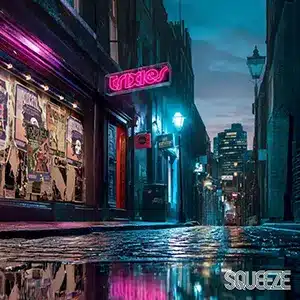
One could easily argue that Squeeze, like Electric Light Orchestra and XTC, are the godfathers of Britpop. Anthems “Tempted” and “Up the Junction” served as commentaries on working-class English life: merry, giddy and wrapped in bellowing riffs. Since day one, the band have been co-fronted by guitarists Chris Difford and Glenn Tilbrook, songwriters who pride themselves on an intelligent outlook and cleanly executed backing. Trixies, the group’s latest album, is in fact the duo’s debut, a rock opera they penned as teenagers.
“Hell on Earth”, a gospel work punctuated by piano strokes, sets the scene about a den of iniquity; a hive where dancers go about their trade. Paul McCartney-esque ditty “The Place We Call Mars” features an exciting guitar hook that recalls Rory Gallagher’s strident chordplay. The rousing “Hell on Earth” pays homage to the eponymous destination, embellished by an exhilarating instrumental bridge.
What’s evident from these recordings is that Squeeze‘s Difford and Tilbrook had their raison d’être mapped out from the beginning, and what was recorded in 2026 could just as easily have come out in 1974. As it happens, the vocals on “The Dancer” sound more mournful than they would have by a younger artist because the passage of time has weathered Difford and Tilbrook.
Beach Boys ode “Good Riddance” proves the outfit know how to sound young and bountiful, backed by orchestral flourishes and Colin Mouldingian bass parts. “Savage women with tongues like razors,” Tilbrook chants, in the tone a Homeric scholar might use reading The Iliad in public. Vocal loops and guitars soak “The Jaguars”, much as Graham Gouldman and 10cc delivered on Deceptive Bends. Sultriness etches the tune, an emotion matched by the shuffling drums. Difford purportedly wrote the lyrics to Trixies aged 19, so his knowledge about night culture likely stemmed from books and cinema. No matter: the world of Trixies is immersive, three-dimensional and tangible.
Riff-stomper “Anything But Me” ends with a cabalistic piano solo, re-creating the vibe from the decade from which the original demos were furnished. Space number “It’s Over” is coated with airy keyboards, complete with a vocal style similar to the angular, acute scats David Bowie used throughout The Next Day. Interestingly, the bass guitar sounds like something Radiohead mainstay Colin Greenwood would produce, proving Squeeze are as eager to learn from their successors as they are to teach them. Given the writers’ youth, the plot becomes convoluted and, arguably, too cryptic for a pop album, yet Trixies can be listened to as a bunch of disparate tunes; much of it excellent.
While there’s no way of telling if this is Squeeze‘s farewell-to-arms, it would make an impressive curtain call if Difford & Tilbrook hang up their instruments. Together, they have provided a catalogue that stands up with the best of Britpop, and Trixies proves that they were always destined to be formidable artists. As a vocalist, Difford hasn’t sounded so confident in years; the trepidatious man from Spot the Difference is nowhere to be heard. Squeeze, as a blues group, go full Peter Green era Fleetwood Mac on “Don’t Go Out in the Dark”, reverb drenching the listeners.
Although the term “rock opera” might remind people of the propulsive, pretentious efforts (like Quadrophenia), Trixies keeps the focus on radio-friendly runtimes. None of the tunes goes beyond four minutes, even though the band pack enough ideas into them to pad them out. Difford & Tilbrook end with the crowd-pleasing “Trixies (Part Two)”, a soaring chorus, punchy harmonies, and scattered saxophone solos. Squeeze were ambitious, although never at the expense of fun. The best compliment I can award Trixies is that it is imaginative, impressive, and most importantly, fun.