
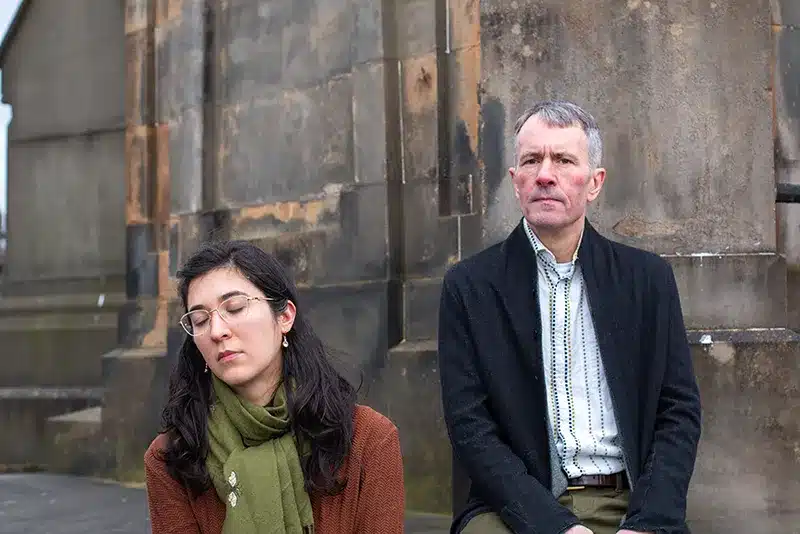

Stephanie Lamprea’s talent defies not only categorization but also any fixed type of collaboration. On her debut album, Quaking Aspen (2022), the Colombian-American soprano matched her voice up against spoken word performances. On 14 Recitations (2023), she daringly interpreted Georges Aperghis’ ambitious song cycle as one singular, astonishing voice. On her latest album, Ecstatic Visions, Lamprea teams up with acclaimed composer and musician Alistair MacDonald, resulting in a stunning, unique matching of the human voice with innovative electronics.
Sources texts from 12th-century mystic Hildegard von Bingen and proto-feminist poet Juana Inés de la Cruz to AI-generated narratives, and according to the album’s press notes, “places historical visionaries and modern technology side by side as sacred oracles.” The notes continue: “The album’s program is a curated exploration of feminine vocality, technology, and creation myths.”
The pairing of Lamprea and MacDonald is a thing of genius. Lamprea’s soaring voice is extremely well-suited to the idiosyncrasies of avant-garde classical music, and MacDonald’s electronics are versatile enough to accompany the seemingly infinite stylistic shades of Lamprea’s vocal palette. The result is a deeply atmospheric, flawlessly executed record that pairs the mythical with the modern.
Ecstatic Visions consists of five compositions by Angelica Negron, Wende Bartley, Eric Chasalow, Robert Laidlow, and MacDonald himself. Negron’s “Letras Para Cantar” opens the album with a multi-part triumph that is perhaps the least experimental performance here, but the most emotionally potent. The complex arrangements of electronics and multiple tracks of Lamprea’s voice are gentle and elegant, while also mysterious and otherworldly. The melding of technology and the echoes of early choral music can sometimes come off as clunky and forced, but in the hands of Lamprea and MacDonald, the juxtaposition is interpreted with perfection.
MacDonald’s multi-part title track introduces a variety of techniques, including field recordings, spoken word, and the great bell of Glasgow Cathedral. The writings of Hildegard von Bingen are featured in the final section, “Hoc Verbum Effabricavit”, once again expanding different stylistic and historical contexts.
On Wende Bartley’s “Ellipsis”, the three phases of the moon (waxing, full, waning) are mapped, in association with three archetypes of woman (virgin, mother, and crone). Lamprea takes full advantage of her unusual and thrilling vocal gymnastics as MacDonald provides the perfect atmosphere of mystery and dread. Eric Chasalow’s contribution, “The Fury of Beautiful Bones”, provides an unsettling backdrop for Anne Sexton’s raw poetry. MacDonald’s bleeps and bloops are in a particularly wild mood as they careen around Lamprea’s voice.
Closing the record is Robert Laidlow’s “Post-Singularity Songs”, described in the press notes as “a monodrama featuring a creation myth co-authored with ChatGPT”. Laidlow’s writing is combined with the poetry of Emily Dickinson and John Donne and is arranged so that modernity is placed front and center, commenting on technology and humanity like an opera by Laurie Anderson.
I’ve described Stephanie Lamprea in previous writings as a “fearless genius performer”, and that is still the case here. Her performances are both passionate and a technical marvel. Working alongside the deeply imaginative and endlessly creative Alistair MacDonald, they’ve created a musical universe that is constantly engaging and deeply satisfying.