
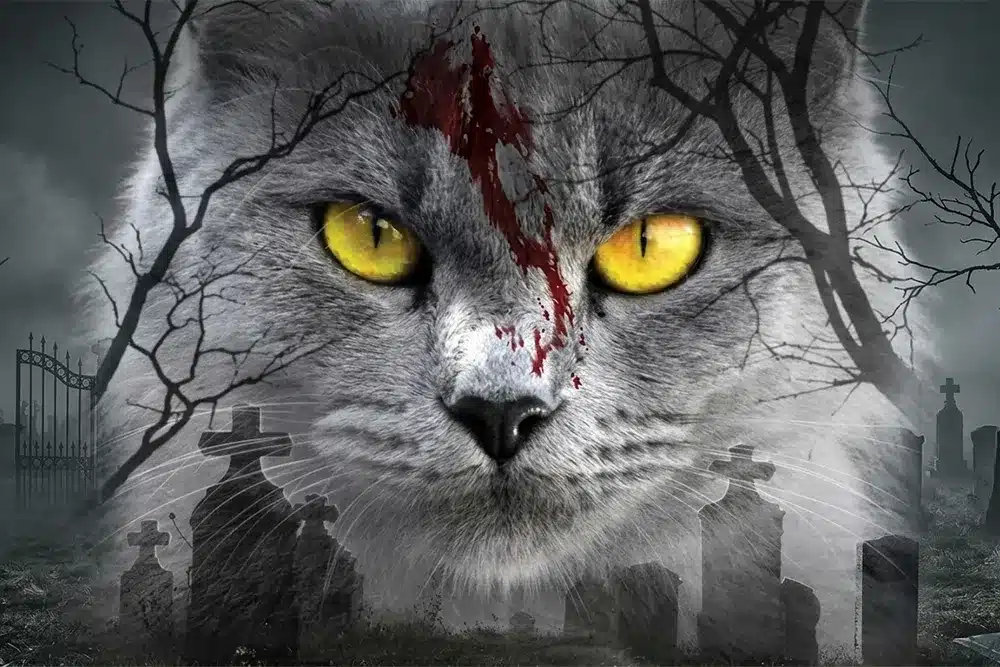
If Stephen King had stopped publishing after 1983’s Pet Sematary, his reputation would be even greater than it stands today. That’s not because the quality of his work fell off dramatically, though the less said about 2001’s Dreamcatcher, the better. At a minimum, It (1986), The Green Mile (1996), Under the Dome (2009), and 11/22/63 (2011) are spectacularly vivid reads.
On Writing: A Memoir of the Craft (2000) is a concise and affecting guide to the how but also the why of writing. Stephen King published enough memorable works from 1983 onward that any five-year stretch would constitute on its own a bibliography most writers would be jealous of.
What happened was that after Pet Sematary, King became less associated with the genre that made his reputation: horror. His omnivorous appetite for styles of story, particularly fantasy and science fiction, was well represented in his early output. His omnivorous appetite for styles of story, particularly fantasy and science fiction, was well represented in his early output. However, the elemental terror in those landmark early works of horror makes them seem of a piece.
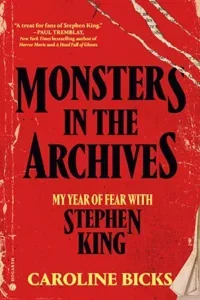
In Caroline Bicks’ Monsters in the Archives: My Year of Fear with Stephen King, she reckons with what makes this set of books besides Pet Sematary – the novels Carrie (1974), ‘Salem’s Lot (1975), The Shining (1977), and the short story collection Night Shift (1978)—such a specific, cohesive, and unsettling stretch of American literature.
An academic by training, Bicks specializes in Shakespeare and has several works on the Bard to her name, e.g., Cognition and Girlhood in Shakespeare’s World (2021). As such, she frames Monsters in the Archives as a literary researcher ready to leverage her training in deep text analysis. Yet her book also has a personal component, given her attachment to King’s work from an early age. You know what she means: that quivery, excited, frightening feeling that comes from reading stories like ‘The Boogeyman’ too young.
The introduction explains how the book’s genesis came from a moment of “kismet” in 2017 when she was hired as the first Stephen E. King Chair in Literature at the University of Maine in Orono. After convincing King to speak to her students about writing, she secured access to his personal archives and spent a six-month sabbatical poring over the manuscripts whose finished product spread spiny-tentacled nightmares across the world. She explains Monsters in the Archives as being about a “grown-up English professor facing her childhood fears and getting to know the man whose monsters helped unleash them.”
Monsters in the Archives is a curious, fascinating document. It is almost as much about fandom and the roots of terror as it is about King’s work. Using a winningly self-deprecating tone, Bicks narrates her journey through these scrawled pages with wide-eyed wonder. Poring over drafts and correspondence, she acts as a literary detective, eagerly yet closely parsing the evolution and shaping of these stories to determine why they are effective and where they originated from.
Throughout the book, Bicks does not present as an august chair of literature. She comes across as a keen-eyed student and ardent researcher who has spent much of her professional life limning the work of one long-dead artist and is thrilled to have direct access to one still living. This creates some surprising connections as she studies King’s vampires, telekinetic children, ghosts, and pustulent corpses that refuse to stay dead.
In her email exchanges with Stephen King, Caroline Bicks chases down one theory of why he changed this line or that. Already predisposed to things Shakespeare, she is thrilled to find a magazine piece King wrote about The Shining, describing his intention to write the book “in the form of a five-act Shakespearean tragedy, with scenes instead of chapters.”
Following that thread, she discovers in an early draft, later cut, where Dick Hallorann (the Overlook Hotel chef who helps Danny and Wendy escape Jack’s murderous rampage) thinks to himself, “when shall we three meet again,” quoting from the Witches’ opening monologue in Macbeth. In one of the semi-comical deflating moments that Bicks sprinkles through her investigative chronicle, though, King tells her she is both right and wrong. He was thinking of Shakespeare, but specifically, Hamlet: “Jack never decides to leave.”
Undergirding Monsters in the Archives is not only her literary expertise but her personal attachment to Stephen King’s early work. Many readers of a certain age will feel a ping of recognition as she describes the nightfrights spawned by encountering these stories at an impressionable time. She also movingly illustrates how King’s 1970s work built on anxieties both immediate (as an underpaid schoolteacher needing a new source of income for his family) and more deeply buried.
The section on Pet Sematary, a seemingly goofy ghost story about resurrected pets that turns into an existentially devastating examination of mortality, is particularly insightful about what lies beneath the eeriness and jump scares. Pet Sematary was written in 1979, but he didn’t publish it until 1983, in part because it felt even too dark for him. Responding to one of her many queries about inspiration, King tells Bicks that he believes horror stories like his “exist because we sometimes need to create unreal monsters and bogies to stand in for all the things we fear in our real lives.”
Her book is somewhat less successful when Bicks’ sleuthing leads her to make inferences that may not be fully supported. Finding a mention of King being punched by a counter-protestor while taking part in an anti-Vietnam War rally, she makes an unconvincing attempt to connect that to elements of youthful fury in his work. She would have found more substantive proof of King’s anti-establishment views at this time by expanding the scope to include novels written under the pseudonym Richard Bachman, like The Long Walk (1979) and The Running Man (1982), both of which are powered by a near-revolutionary fury.
Still, Monsters in the Archives makes a good argument for the potency of this stretch of Stephen King’s work. Studied together, these books become a cohesive set despite their range of subject matter and scares, crucial both in establishing King in American literature and re-centering horror in the public imagination. It’s not unlike David Bowie’s astounding run from his song “Space Oddity” (1969) and album Diamond Dogs (1974); he would reinvent himself time and again later on, but those five years said everything you needed to know about him as an artist.
While Bicks is unable to come up with a unified theory of Stephen King’s works, this is probably for the best. At one point in her otherwise quite thoughtful analysis of the grounded small-town atmospherics of ‘Salem’s Lot (a small town slowly turns into a coven of vampires), Bicks asks King to explain a metaphor about Maine’s rockiness. He brushes her back in good-natured fashion: “Eviscerating a metaphor is like explaining the punchline of a joke: much of the savor is lost.”
Part of the joy of Monsters in the Archives is that Caroline Bicks appreciates when to stop and let the work be the work.