
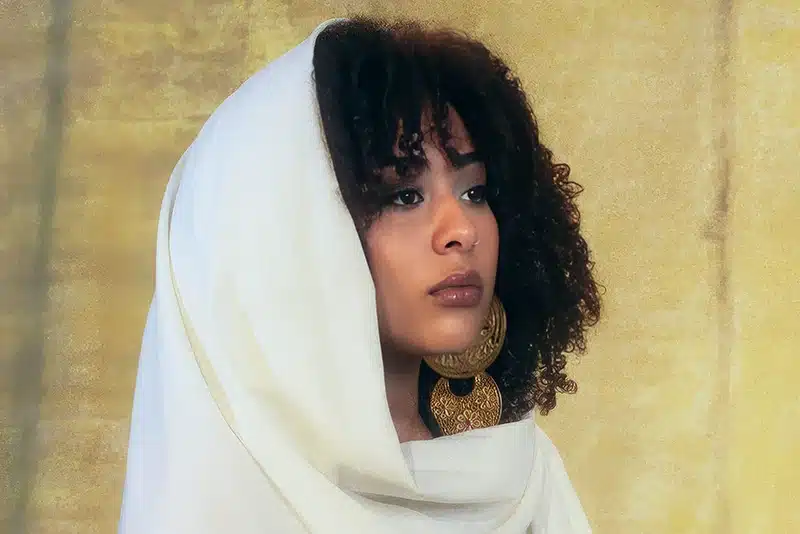

I’ve lost track of how many times I’ve listened to ABA, the new album by singer-songwriter and oud player Sulaf. I mean this as a compliment. The arrangements on ABA are heartbreakingly gorgeous, and Sulaf’s voice is consistently poignant at the forefront of each one. They tell true and deeply personal stories. This balance of substance and beauty makes listening to ABA an enchanting experience every time. Even though it’s a fairly compact album (ten tracks, four of which are intro or outro tracks), it’s easy to sit back and keep soaking in its sonic and affective layers, finding new resonance with each repetition.
ABA is named for Sulaf‘s great-grandfather, a Sufi poet whose compositions she sings throughout. To her, he is both family and culture-bearer, a symbol of heritage and roots that are not narrow but instead intertwined at all levels with love and kindness. Tied to her devotion to him and their shared history, though, is another weighty narrative that makes the need to connect to traditions and the past all the more significant.
In 2022, Sulaf left Sudan for a short artists’ residency in Paris. Before she could return, civil war broke out between the two main Sudanese military factions; it is still ongoing. She became an exile, stuck abroad with only a few meaningful belongings, among them her oud and some of her great-grandfather’s poems. She talks about this briefly on the first introductory track, her voice echoing: “No one foresaw all this separation.”
Quickly, Sulaf ties the shock and sorrow of her situation to her great-grandfather’s work. “Bitti Alhitali” opens with a recording of Aba from a cassette about his daughter’s leaving home upon her marriage; it plays amid the sounds of cicadas, barely audible folk singers and instruments, and languid synths, producer Maxime Kosinetz’s (Imarhan, Tinariwen, Bon Voyage Organisation, Oracle Sisters) way of framing the recording as cherished memory. Sulaf sings over luscious yet sparing instrumentation, her voice as sweet and limber as ever. The introduction to the track “Shogi Ana” directly addresses Aba. Says Sulaf: “I wanted to write about me / I wrote about you instead.” She thus lays bare the forces that drive this work.
“Shogi Ana” feels like a hard-won triumph, its balladic form putting some of Sulaf’s most powerfully emotional delivery on display. Each remaining track offers a different emotional space for Sulaf to fill. “Marhab Ya Alrasool” backs her soft melismas with spiraling electronic beats. Her gentle introduction to “Sameen” grounds the celebration therein. In “Naada”, her voice and oud both take center stage, gently swaying, slowly building, and eventually rising on the power of Kosinetz’s generous synth work. The final song, “Allah Ya Allah”, is a song of praise and hope, completing a satisfying arc even as the future remains ever out of reach and shrouded in unknowns.
Sulaf has been featured in some powerful performances with other artists over the last few years; on this year’s Tinariwen release Hoggar, she was one of the most intriguing guest voices. It’s not surprising, then, that ABA is such a stunning record. Even more striking than the album’s aesthetic appeal is the vulnerability of what Sulaf shares with us here. This album is utterly timely in a world marked by increasing numbers of people forced into a refugee lifestyle. At the same time, it’s timeless in its themes of ancestrality. This is an album of sincere pathos and musical virtuosity, a groundbreaking debut for a young and very promising artist.