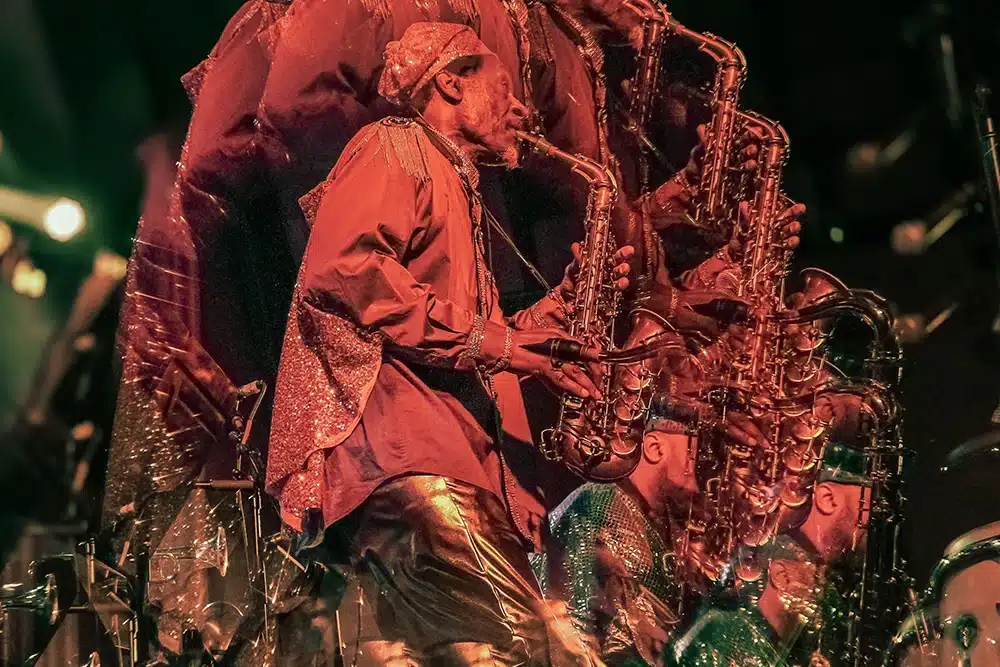
Cosmic jazz’s Sun Ra Arkestra have become one of the most enduring groups, thanks to their unique blend of dynamic musicianship and spiritually uplifting music.
It’s a late winter Saturday night here in San Francisco’s Mission district on 28 February, yet it’s starting to feel like springtime thanks to the week’s pleasantly warmer weather. The mood of the US is uneasy, though, due to the government having just launched a war on Iran. Thus, it feels particularly timely to have the Sun Ra Arkestra back in town to deliver musical services for the soul at the Chapel. The cosmic jazz outfit has become one of the most enduring groups in music history, thanks to their unique blend of dynamic musicianship and spiritually uplifting material.
The group’s legendary founder, Sun Ra, came up through the big band jazz scene before leading an innovative, forward-thinking evolution of the genre, beginning in the late 1950s, on classic albums like 1957’s Supersonic Jazz, 1958’s Jazz in Silhouette, and 1962’s The Futuristic Sounds of Sun Ra. Upbeat jams with song titles like “Medicine for a Nightmare” and “Space Jazz Reverie” hinted at Sun Ra’s desire to use music to give listeners a spiritual boost beyond Earthly blues. He would lead the group in a more avant-garde direction in the years to follow, but the foundation for the Arkestra’s current sound still traces back to those early years.
Various versions of the Sun Ra Arkestra have now been touring and recording for nearly three-quarters of a century, which seems impossible at first glance, considering that Sun Ra died in 1993 at age 79. Yet the music of Sun Ra’s prolific repertoire seems to have taken on a life of its own, much like the Grateful Dead’s music has continued to thrive since Jerry Garcia’s death in 1995. Saxophonist Marshall Allen had led the group since the mid-1990s, continuing to tour through his 90s before stepping back from national touring in 2023 at age 99. Allen remains active with the Arkestra back east, though, and led the group in the recording of 2024’s stellar release, Lights on a Satellite.
In the new PBS documentary Sun Ra: Do the Impossible (which premiered just a week before the Arkestra’s two-night stand at the Chapel), filmmaker Christine Turner does a superb job of distilling the essence of the cutting-edge tone science and visionary spirituality that continues to power the group’s performances in the 21st century. A signature moment comes from a 1969 anecdote in which Sun Ra was one of a handful of artists and celebrities asked by Esquire to offer helpful hints for astronaut Neil Armstrong (as he was about to become the first man to walk on the moon). Billed in the article as “the space age jazz poet”, Sun Ra offered a poem that touched on how going to the moon had long been deemed impossible:
“Reality has touched against myth / Humanity can move to achieve the impossible / Because when you’ve achieved the impossible, the others / Come together to be with their brother, the first impossible / Borrowed from the rim of the myth / Happy Space Age to You.”
Photo: Lisa Miller
The Chapel seems packed to capacity when the Sun Ra Arkestra hits the stage around 9.00 pm, opening with a tease on “Door of the Cosmos” from saxophonist and current band leader Knoel Scott. Regular touring vocalist Tara Middleton is absent from the ensemble, resulting in a more instrumental show. It’s a little something different from recent tours, but a focus on the group’s stellar chops makes for a delightful experience in its own right.
“Man, this world’s in trouble… The only thing that’s gonna get things straight is the love of the creator,” Scott tells the audience early on. “If I told you I was from outer space, you wouldn’t believe me, would you?” he asks rhetorically. Sun Ra claimed to be from Saturn, and who knows how many members of the Arkestra and other impactful groups might actually be starseeds whose souls came to Earth to try to help save this wayward planet with music that conjures a more spiritual view of life, the universe, and everything.
A clear highlight of the show occurs when Scott indicates that the group will feature their secret weapon, which turns out to be another horn player who leads a sensational jam on the vibrant “Opus in Springtime” (recorded on 1990’s Mayan Temples). It’s an upbeat tune powered by a walking bass line, crisp piano, and dynamic polyrhythmic percussion, creating a groovy foundation for hot solos from the horns, the guitarist, and the cellist.
Another peak moment occurs as Scott leads a timely and intensely powerful rendition of “Nuclear War”, one of Sun Ra’s great late-era compositions from the 1980s. It’s a straightforward song with a simple yet deep message, as Scott delivers the pithy spoken word lyrics: “Nuclear war, they’re talking about nuclear war… It’s a motherfucker, don’t you know… If they push that button, your ass got to go!” The anti-war classic about the insanity of nuclear armageddon suddenly takes on an extra zeitgeist factor here in 2026, making for one of the evening’s most cathartic moments as Scott and bandmates deliver the catchy refrain repeatedly.
Photo: Lisa Miller
“Face the Music” is a different kind of gem, a swinging tune with Scott singing “You gotta face the music, listen to the cosmos song,” as various Sun Ra Arkestra members harmonize behind him. In a 1989 interview, Sun Ra described the song as being about how “Music is considered as the truth, really… So I’m saying face the music, because that’s what this planet has to do now. They’ve got to adjust themselves to another way of thinking and being…” As the Arkestra jams out, Scott exits the stage to walk up what little there is of the crowded aisle while still playing his sax, second line style.
“Springtime in Chicago” brings the energy down into a contemplative ballad dating back to 1957’s Supersonic Jazz, featuring delicate piano to further honor spring’s onset. Another old school deep cut that really stands out is a high-energy romp through “Unmask the Batman”, which mashes up the theme from the Batman television show of the 1960s with a jazzy R&B jam. It’s a dazzling performance featuring boogie-woogie piano, tight horns, and groovy percussion for a super fun retro dance-party jam as Scott sings the vocals.
Long-time trumpet player Michael Ray leads the way with his endearing vocals on “Feels Like a Holiday”, a vintage repertoire number recorded again on 2024’s Lights on a Satellite. The big band swing tune with hot sax solos has an upbeat vibe that could remind some listeners of the Mos Eisley Cantina band in 1977’s Star Wars, as the Arkestra generates a festive vibe.
“Playing with the Arkestra involves a lot of sacrifice, but it’s for the greater good. You know what we need to find now is ‘Fate in a Pleasant Mood’. You can change your destiny,” Scott explains before the group launches into the title track from 1960’s Fate in a Pleasant Mood. It’s a performance that grows more exploratory as Scott and the Arkestra weave in teases of “Space Is the Place” and “Outer Spaceways Incorporated”. Scott implores listeners to join up with “Outer Spaceways Incorporated”, as the song is also mashed up with the familiar melodies of “We Travel the Spaceways”.
Photo: Lisa Miller
“Come and sign up. There’s a world beyond your wildest dreams, and we’ll wait for you. This world is not my home; it’s way past the stars. I know I’m a member of an angel race; my home is somewhere out there. One way or round trip?” Scott asks as Sun Ra Arkestra play. The audience chimes in on the song’s melody, as is tradition when singing the group offstage. The planet is indeed in trouble, but San Francisco has been blessed tonight by the uplifting tone science of the Sun Ra Arkestra.
Sunday, 1 March
Twenty-four hours later, the tone scientists of the Sun Ra Arkestra are back at the Chapel for the conclusion of the two-night run. Valencia Street isn’t quite as happening as it was on Saturday night, but the Chapel is still the hot spot for local music mavens. Much of the set list will remain the same, a changeup from tours where the group will mix it up on back-to-back nights. There’s still variation in the delivery and some of the arrangements and teases, however, as the Arkestra remain ever improv-oriented.
“Face the Music” is utilized early on to get the audience in the groove and listening to “the cosmos song”. There’s also a little more room in the aisle, which allows for a bit more dance space. Knoel Scott sings of “sunrise in outer space” and “love everlasting” as the group dabbles in the melodic ambiance of “Love in Outer Space”, a Sun Ra standard recorded on multiple albums, such as 1965’s Secrets of the Sun and 1970’s The Night of the Purple Moon.
“Look behind the moon, they’ll be landing soon. I’ve seen them, you don’t have to believe me,” Scott says at one point, alluding to extraterrestrial visitors. “Opus in Springtime” is featured again, this time for another vibrant jam led by the “secret weapon” sax player. Meanwhile, “Springtime in Chicago” seems to provide a much-needed breather for most of the Sun Ra Arkestra, with the pianist taking the lead. He looks like he could be a distant ET relative of Sun Ra, with his wide sunglasses that impart an alien vibe.
Photo: Lisa Miller
Scott presents a quirkier intro to “Nuclear War”, asking “Whatchu you gonna do without your ass!?” The allusion soon becomes clear when the oddball intro leads to the classic refrain, “Nuclear war / It’s a motherfucker / If they push that button / Your ass got to go!” It’s a fitting song to repeat given current events in the Middle East, though this version is more concise. It gives way to a wild free-jazz jam, with the “secret weapon” sax going off on an extended solo that recalls John Coltrane‘s “sheets of sound” approach. The jam also includes another second-line foray, with multiple members of the Arkestra heading down the aisle and around the audience in New Orleans style before returning to the stage.
The depth of Sun Ra’s vintage repertoire shines again on “Enlightenment”, an enduring classic that first appeared as an instrumental in the 1950s before evolving to include some spiritually oriented lyrics. The song benefits here at the Chapel with Scott’s vocals as he sings, “The enlightenment of tomorrow has no plans of sorrow…” He soon extends another invitation as the Arkestra heads back towards the stars for an “Outer Spaceways Incorporated/We Travel the Spaceways” mash-up: “We’d like to invite you / We hereby present ourselves as members of the Astro Nation / If you find Earth boring, sign up for Outer Spaceways Incorporated.”
Scott mentions how Sun Ra had “some of the greatest musicians that ever walked the Earth”, citing John Gilmour, Marshall Allen, June Tyson and Pat Patrick, while adding that he never announced any of them. The Sun Ra Arkestra keep the space jam going as Scott again speaks of otherworldly origins: “This world is not my home, my home is somewhere out there, amongst the clouds and stars, way past Mars.” The vocal melody from “We Travel the Spaceways” serves as the night’s outro once again, conjuring some festive audience participation.
Photo: Lisa Miller
It’s been another uplifting performance that gives the audience a window into a higher dimension of sound and spirit, where enlightenment awaits out in the spaceways. The weekend’s performances bring to mind a deep quote from Sun Ra, featured toward the end of the Sun Ra: Do the Impossible documentary:
“I’m really striving to do something about humanity. I feel that musicians can actually achieve this, and music is the vast thing that can do this… can stimulate people to seek to reach out to be their impossible self, the self they might have left behind, or that they didn’t have the courage to be.”
In this sense, Sun Ra continues to endure as one of the most inspiring musicians of the 20th century, with a message that encourages us to expand our vision of what is possible, both in our own lives and for society. Sun Ra Arkestra, meanwhile, performs a noble service in keeping this vision alive here in the turbulent 21st century, where the message of a greater alternative destiny for humanity remains sorely needed.