
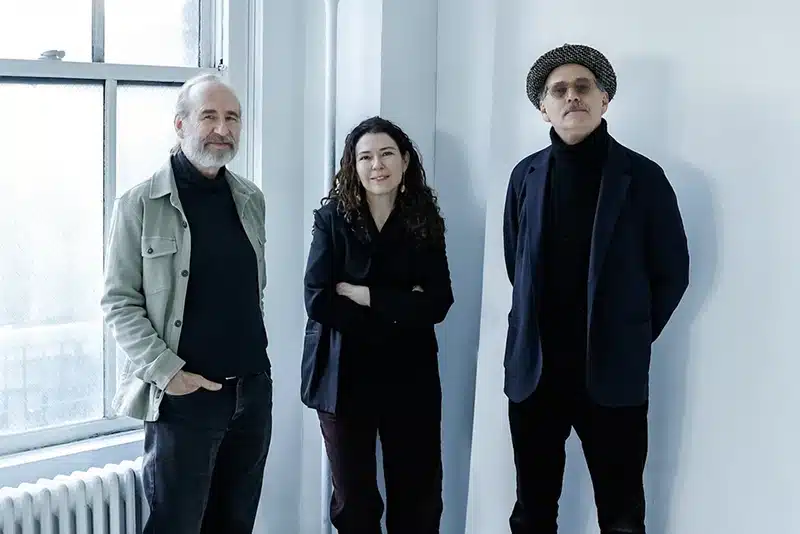
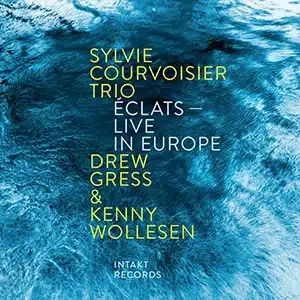
The Swiss-American pianist Sylvie Courvoisier has been recording improvised music for over 30 years, and her band featuring bassist Drew Gress and drummer Kenny Wolleson goes back a dozen years. The trio has just released Éclats, a live recording made during a 2025 European tour.
Courvoirsier made a terrific album last year in a duet with guitarist Mary Halvorson, Bone Bells — their third. It is playful and majestic in turn. The duo’s 2021 Searching for the Disappeared Hour was one of my favorite recordings of that year. Courvoisier’s playing is an ideal blend of tonal beauty, freedom from the standard jazz systems, and classical discipline.
With Halvoron, she often plays precise, composed unisons that suggest a dancing form of chamber jazz, even as the pair is likely to launch into thin air a moment later. Courvoisier and Halvoson are likely to evoke classic piano/guitar duets like the pairing of Bill Evans and Jim Hall, as well as ECM recording sessions. (Coursoirier recorded for ECM in 2002, releasing Abaton with violinist Mark Feldman and cellist Erik Friedlander, an album with compositions and free improvisations.)
The trio are no less disciplined, but they also know how to groove and make their playfulness a delight that relates to the more romping side of jazz history.
The longest track on Éclats, “Imprint Double”, gets right into a thumping backbeat, with Gress’ bass and Sylvie Courvoisier’s rumbling left hand getting lowdown while Wolleson shuffles. It’s about as “greasy” a trio that also leans to the abstract can get, and it is hard to resist. The title says the track is “double”, so it’s no surprise when the song shifts into a mysterious, composed prism of sound that sets up Gress to play a hip, bluesy solo. A section of solo piano gets craggy and finally invites the trio into a free section that moves toward a romping swing, marrying Cecil Taylor-ish piano to a train groove. In essence, this is what the trio does best: marrying abstraction to a playful sense of momentum, swung, grooved, or otherwise.
“Free Hoops” is another great example of abstraction and joy joining forces. The trio opens with a precisely written and played line of playful melody, free of confining chords, only to burst into a sunshine-y section of harmony that could be from a pop song… kind of. In the centre of the performance, the trio lurch and converse, eventually heading back to the sweet-sour beginning.
Similarly, “Lulu’s Dance” uses a delicious, cycling unison between bass and Sylvie Courvoisier’s left hand to draw your ears into an insistent waltz feeling, only to empty the sonic space and develop into an impressionistic set of musical musings. You can be certain that the “dance” element will return, both because of the song title and because this is how the trio tends to operate. It likes the groove as much as it likes freedom.
The opening song on Éclats goes in and out of traditional four-on-the-floor swing, so the title “Éclats for Ornette” is no surprise. Courvoisier plays every way you can, alternating plucking and rubbing strings inside her piano with swinging right-hand licks. She rumbles raggedly as the band drives things ahead — Gress and Wolleson sounding vintage like Garrison and Elvin Jones (the Coltrane quartet) or Chambers and Philly Joe Jones (the Miles Davis Quintet). “Just Twisted” swings even harder, with the piano playing figures that lurch like Thelonious Monk — or rather like the Monk-ish figures from Eric Dolphy’s classic Monk tribute “Hat and Beard”. This is not chamber jazz.
There is gentler music here as well. “Requiem d’un songe” uses a lovely arpeggiated bass ostinato to underpin a set of piano musings. A third of the way through, the rhythm section plays speedy swing with a hip, written bass line. Playful hijinks bubble up but inevitably return us to the ballad feeling. “South Side Rules” is a free ballad with a tempo that breathes in and out, rich in texture.
Éclats is perhaps at its best when it simply lets the trio play on its own clear and propulsive terms. I love “Downward Dog”, where a jagged opening from Sylvie Courvoisier’s piano develops into a stop-start written theme. The band takes off from there in an up-tempo conversation that is animated and fun. A Gress bass solo sets up a clear bass line over which the piano experiments, stressing a variety of interesting rhythmic choices. Courvoisier plays jabbing chords, fast and hypnotic runs that repeat with tiny variations, and two-handed figures that shift the melody back and forth. On this solo, the leader often sounds like Charles Mingus‘ last and most experimental pianist, Don Pullen. Wolleson’s drum solo is also an album standout.
The word that captures the Sylvie Courvoisier Trio best is “balance”. The challenge of jazz as we head into the second quarter of the new century is how it will reconcile competing influences. Halfway through its history, the music had shed lots of structure — harmonic rules, 4/4 swing as a rule, the “head, solos, head” arrangement for performances, even the requirement of pre-determined composition itself — and the question became, how will great musicians balance the available extremes? Courvoisier, Gress, and Wolleson answer the call with graceful balance.
This group use many carefully composed themes, but they are presented as mutable fragments that can be used, reused, moved around, or not necessarily repeated. Rather than being formal melodies of 12 or 32 or some other set of measures that marry a “tune” to a set of chord changes that will become the obstacle course for any improvisation, Sylvie Courvoisier uses melodic themes that establish mood or motif only. The music is mostly “tonal” but is hardly afraid of dissonance. The trio “swing” both traditionally and in other ways, using complex rhythms yet capable of some groove as well.
In their balance, the Sylvie Courvoisier Trio reach back too. The obvious comparison is to the trios led by pianist Bill Evans, which pioneered the technique of giving piano, bass, and drums more equal claims to center stage. Courvoirsier is similarly lyrical and percussive, in balance (that word again). This ensemble also nod to Evans by lending the sound of European classical music some weight. It is not easy to pin down, but Courvoisier can base her playing in the blues while giving equal weight to harmonies from modern classical music.
Among the other reasons to check out Éclats is simply hearing a band develop over time. Sylvie Courvoisier has had many long-lasting partnerships (including playing with John Zorn, Ned Rothenberg, and Nate Wooley, among others), but the trio has lasted 13 years and has legs. Groups that stay together and develop are key to the development of this music, and the Sylie Courvoisier Trio are going places.