
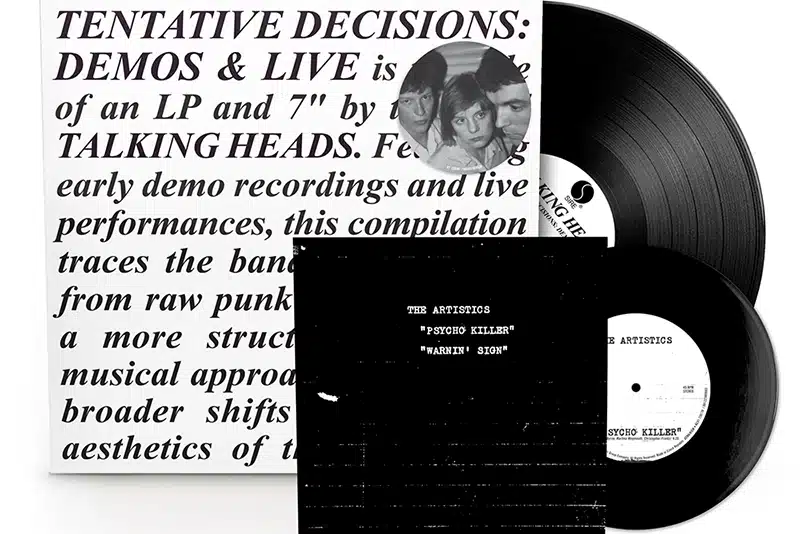
A new Talking Heads compilation acts like a scrapbook, looking at the nascent band’s early years as a trio before they exploded onto the New York scene and around the world. This three-CD collection is compiled from several sources recorded when the group consisted of David Byrne, Chris Frantz, and Tina Weymouth, before their debut album, Talking Heads: 1977. The recordings, live and in studios, show the young band right after it left the Rhode Island School of Design and arrived in downtown Manhattan like a promising thoroughbred taking its first runs on coltish legs.
The songs here—well-known to Talking Heads fans—are not as fully realized as their subsequent album versions, but the band’s great talent as songwriters and players is already evident. A shorter vinyl version is also being released.
Byrne and Frantz met as freshmen at the Rhode Island School of Design and formed a short-lived group called the Artistics (represented on an accompanying 45 with early versions of “Psychokiller” and “Warning Sign” recorded in Frantz’s apartment in 1974). Eventually, they added Weymouth (Frantz’s then-girlfriend and now wife), who taught herself bass and was auditioned three times by Byrne before he accepted her as a bandmate.
The trio moved to New York City to pursue their rock ‘n’ roll dreams, debuting in 1975 as the warm-up band for the Ramones at CBGB, developing an enthusiastic following amid the downtown experimental music scene that would eventually be called New Wave.
The collection starts with some early demos, including some recorded by a friend of the band. Then it goes on to an album’s worth of higher-quality demos laid down at CBS/Columbia Studios in September 1975, but which did not land them a contract. The set also includes a live recording at Max’s Kansas City in lower Manhattan just prior to their being signed to Sire Records, and a January 1977 gig in Syracuse just before Jerry Harrison joined the band.
Though Talking Heads would become multi-textured and expand its sound and personnel, here it is a stripped-down power trio with an already distinctive set of songs. Frantz’s steady, driving drum playing lays down a joyous, rock-solid foundation, embellished by Weymouth’s powerful and melodic bass lines. The songs’ arrangements are precise and creative, topped by the quirky lyrics and Byrne’s distinctive off-kilter vocals.
While many of the songs gathered here eventually ended up on their first album, some never made it onto their albums, and a few appeared on their 1978 sophomore release, More Songs About Buildings and Food, which saw the quartet team up with electronics wizard Brian Eno and transform into a much more complex soundscape. These early versions of “With Our Love” and “Stay Hungry” from More Songs are here in prototype form; more propulsive than their later versions, which were thoroughly reimagined with Eno’s synthesized studio treatments.
For longtime fans, these familiar old friends of songs can still surprise when they reveal lost verses or elements. The Columbia studio version of “Stay Hungry”, for example, goes in a different direction, with a funkier gallop that sounds like some other band doing a cover. The next cut, the 1976 “Tentative Decisions”, presents fans with a wholly new (though actually old) version that has a kick-ass swagger that shows the band was hot before it was cool.
“Warning Sign” here similarly comes in way more cooking than the album version’s buttoned-up, tense energy. Talking Heads sound like a fiery bar band playing to get the joint jumping. In fact, the entire group of CBS studio demos show the band as infectious rockers. Byrne’s signature offbeat delivery and unusual lyrics are a bit less forward in the explosion of energy that jumps from these recordings.
The song “(Love Goes to a) Building on Fire” was Talking Heads’ first single, released before their debut album, but not released on an album for years. This CBS studio version begins with an angular, somewhat spare arrangement, then gets the jam band treatment, building to a mighty crescendo.
“No Compassion” has a unique structure, flipping between two contrasting sections, but here it races more, riding along a sinewy bass line. This rawer version rushes by so that the provocative lyrics (“They say compassion is a virtue / But I don’t have the time”) don’t have the space to grab you by the collar as they do on the studio album, where they are a much more defining part of the song.
Ten songs are from a set at the late lamented club Max’s Kansas City. The show was on 9 October 1976—about a year before the release of their iconic fluorescent-red-and-green album. The recording is pretty good for what is essentially a warbly bootleg, and unfortunately includes snarky comments from would-be hipsters in the club who are near the mikes. The live set again shows what an exceptional bar band they were. The band exponentially expanded their sound with each album, but this is a reminder of why the core band quickly caused excitement.
The Max’s Kansas City set includes “Pablo Picasso”, a song by Jerry Harrison’s previous band, The Modern Lovers. The only other cover is Al Green’s “Take Me to the River”, which was a hit for the band years later. While the song replaces the band’s forward motion shown elsewhere with a gritty, slow funk, it was slowed down even more for their eventual Eno-produced version. Played here at the Lower Manhattan Ocean Club in August 1976, the song is powered by muscular drumset work from Frantz and a sexy grind from Weymouth’s bass and Byrne’s fuzz-toned guitar.
For longtime Talking Heads fans, this set is a fascinating mix of grainy reproductions of familiar songs—like watching old home movies—along with hints of paths not taken. Much of the collection can provoke fans’ nostalgia even if they weren’t there at the time. What is made plain is that this beloved band, even at its most elemental, was destined for much more than late-night sets at downtown dive bars.