

Film is sex searching for the sun as a partner. So says Teo Hernández in Three Drops of Mezcal in a Glass of Champagne (Trois gouttes de mezcal dans une coupe de champagne, 1983), a 16-minute short that’s part of the Museum of Modern Art’s retrospective on the films of Hernández and his colleagues.
According to MoMA’s notes, Hernández was an avant-garde experimentalist who worked with a Super 8 millimeter camera. Born in Mexico, he traveled the world for years before settling in Paris in 1975. He shot more than 150 films, often with the help of such friends and lovers as filmmaker Gaël Badaud and Michel Nedjar, his heir. Hernández died of AIDS-related conditions in 1992, leaving behind a body of work that is much more than casually knocked-out items. They are often intensely detailed, meticulously practice-heavy epics. The museum is scheduling about 19 of his films, as well as some films signed by Nedjar, the composer who billed himself as Jakobois, or a collective.
Teo Hernández’s early films were largely static exercises in campy dress-ups that evoke spiritual and mythological rituals and therefore bear some comparison to the work of Kenneth Anger, Maya Deren, and other better-known avant-gardists. Hernández came to realize that the act of holding and swinging the camera, of moving around and zooming the image in and out, of relentlessly blurring the subject into abstract shapes and forms of color and light, was a liberating act of ritual and ecstasy. As films, the results can be compared to Jackson Pollock’s documentation of the swing of his arms with paint. Watching the results can induce a similar headspace in the viewer.
Teo Hernández’s Brain-Rewiring Cinema
Hernández likes the city streets. He likes Christ imagery, such as drinking wine from a grail or a crystal goblet, breaking large loaves of bread, looking pensive, and being bearded. These images and ideas recur across several of his films. Beyond this surface content, Hernández loves dizzying motion and frantic montage, so that the stylistic subject is the eye-blink barrage and the constant, blurry shifts of the same visual motifs, repeated endlessly.
The results can be daunting, especially since many films are feature-length. His constant, repetitive, kinetic gestures can induce drowsiness; the viewer’s eye blinks, perhaps mimicking the visuals. At the same time, the results can be ineffably beautiful and trance-inducing. They should perhaps be watched while hyped on caffeine, unless they function for some as a substitute for caffeine.
He shoots silent, obviously, but affixes sounds from somewhere, including old recordings of Spanish melodramatic songs or basic repetitive sounds such as ocean waves or indistinct street babble. A favorite subject is handsome men, sometimes with nudity, both celebratory and mundane. For equal opportunity, he throws in a few young women, too.
Three Drops of Mezcal in a Glass of Champagne is the only film in MoMA’s showcase with narration, and it could be called a manifesto. The first half of the footage shows what appears to be a kind of black skyscraper against a cloudy sky, but it could be a trick with some object on a mirror, a lovely device Hernández shows off in one of the other films. The filmmaker’s voice says the nature of cinema is “a drop of sperm, a drop of ocean, a drop of dream” delivered in time. Magic and dreams aren’t separate; both are projected onto a screen of reality. Emotions are pushed outside the self. Teo Hernández enters barefoot and empty-handed. All this sounds marvelous in French.
Then the filmmaker’s hand holds photos of his father over a landscape of Paris far below. The final photo is of his father’s coffin being lowered into the ground. Now the images start their typical flying and flashing amid a series of statements, e.g. “There is a body in this mirror, there is a mirror in this body, there is a mirror in this coffin, there is a film in this mirror, there is a country in this film, there is a hole in this country, there is a country in this hole, there is a hole in this film, there is a hole in this mirror. Screen coffin, body country, photo public, mirror coffin, body screen, photo hole, public country, coffin public.”
By this point, we’re seeing the filmmaker aim his camera at us, presumably into a mirror for endless reflexivity on reflections, or reflections on reflexivity.
Teo Hernández’s Short Films of Travel and Transcendence
The Voyage to Mexico (Le Voyage au Mexique, 1990) is 30 minutes of “tourist shots”, broadly speaking: churches, buildings, streets, vendors, people, and a bullfight in the last minute, all in attention-deficit style with swishes and zooms, scored by public noises. Souvenirs-Florence (1981-82) does the same for that Italian city. Some may say Hernandez concentrates excessively on good bits of nude statues, wittily comparing them with too-brief glimpses of people nearby. Nuestra Señora de París (1981-82) gives Notre Dame a radical treatment, with special attention to stained glass and gargoyles, and an almost industrially raucous soundtrack, like a mix of chants and video game battle effects.
Personal flashback: When I visited German relatives at 12, my dad let me use the 8mm for a few minutes, so I shot my debut footage. I reasoned that I only needed to point the camera at a thing long enough to register what it was, not stand there staring at it, and I wanted to cram in everything I saw. I shot a few frantic minutes, edited in-camera, of everything outside and inside a stately home we visited, including my uncle-in-law’s mom looking up at me from a chair as I entered her living room and dashed out again. When the film was developed and shown at home, in the middle of my dad’s more regular footage, it was suddenly this dizzy montage of random shots on the run that I rather liked, but that made my parents laugh. So I think I get it.
The silent Pas de Ciel (1987, 27m) uses wild flash-zooms and spins as dancer Bernardo Montet performs free modern calisthenics, lying on windy ground against the sky. He begins fully clothed and ends in something that looks like a form-fitting Speedo. I’d have told Teo Hernández, man to man, that sometimes your subject for rapt contemplation is simply the beautiful physicality in front of you, not in how you shoot and edit it, but that was, after all, his bag. The Afro-French Montet is famous, among other things, for choreographing Claire Denis’ Beau Travail (1999).
The rapturous Tables d’hiver (1978-79), which means “tables of winter” or “winter tables”, is shot slowly to capture the sun passing across rooms. The rooms seem static while Hernández and his two friends flash across like subliminal ghosts, the evanescent participants in this solid world. Even when sitting for a while at food on the carpeted floor, they are sped. As the filmmaker shows himself nude several times, he reveals his qualifications for the swinging of heavy equipment that he wielded with openly metaphorical intent. The source for his ideas on cinema as sex as well as ritual, both culminating in ecstatic visions, becomes self-evident.
While the first half of Tables d’hiver is more documentary, the second half is performative and involves play with costume fabrics and ritualized gestures with candles. Later comes play with objects on a mirror reflecting the sky. At the end, Hernández showers and dresses before the final shot brings us to normal speed as he poses at a window on the stairs. The music has a whistling quality, accompanied by a woman singing in Arabic who may be the Egyptian singer and actress, Umm Kulthum.
A veritable brain-rewirer is the totally silent 43 minutes of Mesures de miel et de lait sauvage (1984), which I translate as “measures of honey and wild milk” or perhaps “wild measures of honey and milk”. The first movement, as it were, comprises an infinity of closeups of found objects, pictures, signs, patterns, photos, labels, celebrity pics, lots of fruit and vegetables, lots of shoes, lots of random items found strewn as public trash, plus shots of living people, all glimpsed briefly and edited using a technique that makes them appear almost to morph into each other. Everything has equal validity: a child’s face, a playing card, a candy wrapper. Or it could be evidence of humanity, our sustenance, and detritus.
The images aren’t quite arranged randomly, but according to visual rhymes of shape, association, or implicit comment. For example, shots of women from a Playboy magazine are followed by a Tampax box, the unreal image contrasted with physicality by metonymy. Several images of Marlene Dietrich signal Hernández’s recurrent fascination with her, and at one point, he shows her in television clips of Orson Welles’ Touch of Evil (1958) with French subtitles.
Amid occasional shots of the photographer and his camera, we suddenly get a section of beach footage that reads like a cutting-room-floor snippet. Talk about everything is everything. Talk about the universe in a grain of sand. Talk about attention deficit. Talk about life already on fast forward.
The Body of the Passion
A quartet of four feature-length epics comprises The Body of the Passion. The first two titles, Cristo (1977) and Cristaux (1978), are rhyming puns.
At just over an hour, Cristo has many participants and a strong focus on visual motifs: an old-fashioned key, plates of reddish food, palm fronds, netting, fish, bread, a goblet, nails, pieces of silver, and men staring into their own space. As women sing German opera or sentimental Spanish ballads, we see people make poses and gestures as though enacting paintings, moving so slowly that it would seem slow even at double speed.
Towards the end, idyllic images of naked men at an Edenic swimming hole are scored to an unidentified African-American woman singing spirituals of freedom. Another woman sings Bob Dylan’s “Mr. Tambourine Man” over images of men walking and reclining on white cloth laid out like a cross on the grass. Another woman sings Dino Olivieri and Nino Rastelli’s “J’attendrait” during carousel footage of a white-painted man.
The 85-minute Cristaux, a pun on crystals and the Spanish word for Christ, is set to a spacey ambient track, like reverberations in a cave. Male torsos and faces: Teo Hernández, Gaël Badaud, Michel Nedjar. First, a man holds a crystal sphere and stares into it, looks into its bee-vision multiple reflections, lies on the floor to stare at and caress it, and licks it, all surrounded by darkness.
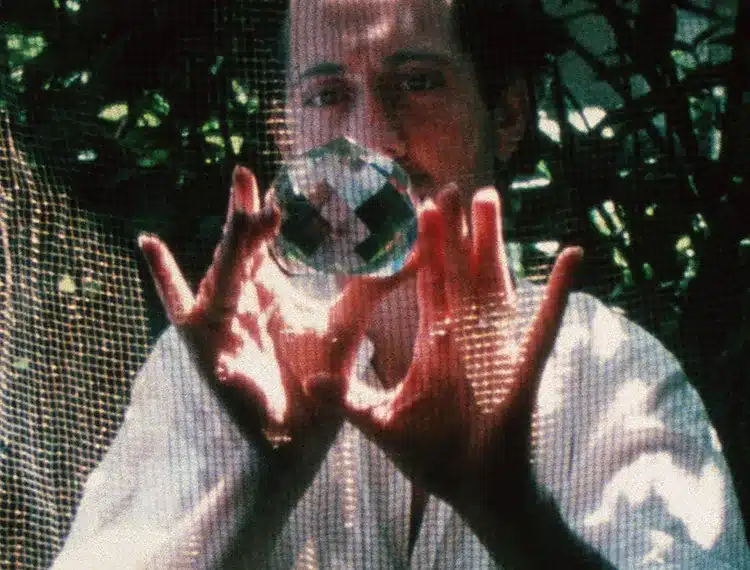
Then Hernández starts projecting images of their bodies onto the screen; we see red food or something resembling the brain, gut, or mouth, while another man’s hands caress or interact with the bodies and projections from behind. Hands and shadows of hands, highly oral imagery of eating and drinking, plus many shots of eyes amid posing and voguing.
Then comes much business with handling dead fish and bread as Christian symbols, plus many of the other objects used as material in Cristo. Red and blue filters dominate, later green when the camera starts rotating clockwise. A few old Spanish songs are heard now and then. Finally, we’re outside in a green, sunlit garden, playing with the sphere and netting. In the final minutes, the languor gives way to hyper-kinetic montage. No nudity or sex, but highly sensuous and totally homo, bro.
MoMA’s notes quote Hernández describing Cristaux as the story of “a masculine Adam and Eve…The crystal sphere is the apple, the forbidden fruit, knowledge, awareness, the true problem at the heart of the biblical story.” The crystal facets could just as easily be seen as symbolic of an endlessly rewatchable non-narrative film for the patient and adventurous.
Lacrima Christi (1979-80) runs over a whopping two hours and has many elements mentioned in the previous entries: dizzy, blurry spinning, feet walking, a farmers’ market, a cemetery (probably Père Lachaise), crystal goblets, oral gestures, and the caressing of a colorful orange dress by both a woman and a bearded man. What makes this film especially effective is the soundtrack of natural effects, protracted endlessly, if disjunctively — water, chatter, insects.
In a dramatic twist at 90 minutes, the screen goes dark while we hear what sounds like sawing, mumbling, and a radio between stations; then cloudy skies pass; then it’s back to hands, nets, and an epic of red wine swirling in glasses. The subject is less religious imagery than motion itself, or rather, the sense that motion is itself spiritual.
The silent Graal (1980) is an ode to kinetic camera and flash editing in which jump cuts look like skipped frames. Two men share a red goblet, or grail, beneath what appear to be white cherry blossoms. One wears a red robe with a serpent belt. Then he spends minutes whirling his cape while the camera looks up at him and spins. They spend decades waving two cups (one blue) at the dark clouds. At 40 minutes, a man is seen waving a camera and a round mirror. At last, the bearded man reclines on rocks by a roaring sea, then waves his cups again. One hour of this, with superimpositions.
While the goal is spiritual intoxication and transcendence, films like this can seem as though they’re not necessarily for “watching” as for merely seeing or for catalyzing your own visions. Again, they might be ambient background projections on a wall, like Andy Warhol’s Empire (1965).
Maya Takes the Veil, Lifts the Veil
If I had to choose one film to represent the beauty and challenge of the Teo Hernández project and its aesthetic, I would pick what feels like a wholly successful 103 minutes called Maya (1978-79), scored initially with something that sounds like a cimbalom or multiple sitars.
Aside from its incidental reference to ancient peoples, the word “Maya” denotes the illusion of reality, often symbolized by a veil. The veil is the delusion of the everyday world that must be torn aside to experience transcendent reality, and its symbolism explains the many veils and nets used throughout these films. It even explains Teo Hernández’s obsession with Marlene Dietrich, often seen iconically in a veil. Earlier, Hernández had made a camp meditation on Salome, known for her seven veils.
In Maya, the camera moves so rapidly that we don’t know what we see except for a second of slowed-down forest now and then. Eventually, we make out a young woman (Parvaneh Navai) lying in a veil like Sleeping Beauty. Sometimes she walks around. What we see is mostly shapes and colors moving, not things we identify, then snow and occasional flowers.

At 30 minutes, music and image switch to roaring water, then the woman lounges on the wet rocks, gazing raptly into tidal pools like Narcissus at his reflection. She holds up a dead bird, then what appears to be a serpent bracelet, as the camera spins around her and she twirls. She climbs a giant rock. She stands like a druid priestess or gothic heroine.
The credits come at 1:06. She walks barefoot along the coast, her dress with a breastplate like silver feathers. At 1:15, flames of fire erupt for five or six minutes with flute drones, then watery reflections, and mostly her blissful face at many blurry cuts per second. Challenging and soothing, soporific and nervous, this kind of thing probably rewires your brain.
This listing is only a portion of the titles showing at MoMA through May 26, 2026. Since the program constitutes the first Hernández-centered retrospective in the US, many will be thrilled, dazzled, and confused when experiencing this filmmaker’s intensely concentrated, liberated, collaborative, and personal output. It feels like life as work and work as art, something to which Teo Hernández devoted most of his time and attention. The results are the overflowing evidence of a vision left behind as he continued his transcendent journey.