
Even if his work is less recognized than that of other Japanese masters, like Akira Kurosawa and Yasujirō Ozu, Keisuke Kinoshita was probably one of the most prolific directors in the country’s history. Starting his career as a photographer, he slowly climbed the ladder at the legendary Shochiku Kamata Studios (home to filmmakers like Mikio Naruse), where he specialized in the art of diversity. Throughout his illustrious career, he experimented with genres ranging from the epic to the family drama. Yet his most famous movies, at least in terms of his artistic legacy, are those that deal with Japanese traditionalism.
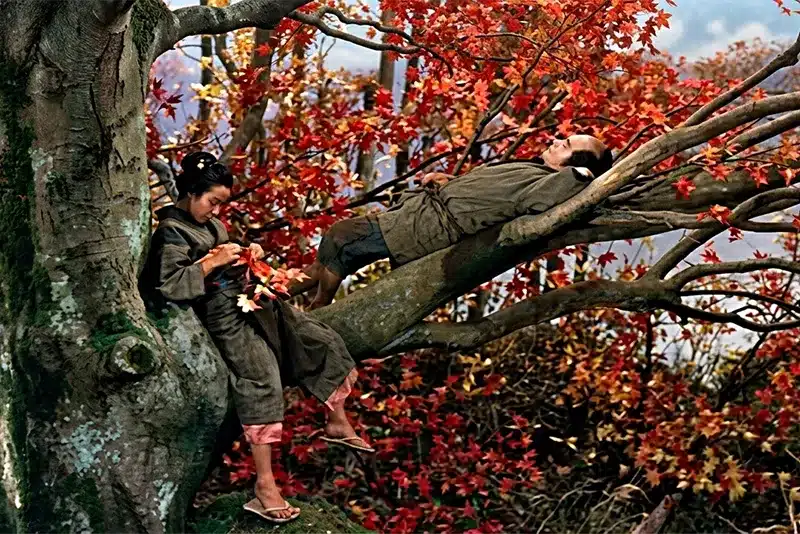
In The Ballad of Narayama, one of his most experimental films from Japan in the 1950s, Kinoshita took a Japanese book (itself inspired by a traditional tale) and turned it into an artificial spectacle that combined kabuki theater with bittersweet storytelling akin to folk. The director was a master of the jidaigeki genre, which primarily featured period pieces set during the Edo period of his country’s history.
The story in The Ballad of Narayama centers on the practice of ubasute, which was practiced in Japan during times of extreme poverty and famine and involved carrying an elderly relative to the top of a mountain, where they would eventually die of starvation, dehydration, or both. While the practice itself has never been confirmed as being customary, it served as the basis for endless legends and tales, which shaped the way in which we think of Japan as a country ultimately concerned with utmost efficiency and the distribution of goods so that the young will always have a future ahead of them.
It could be said that this practice, in a way, inspired the works of Ozu, which have been characterized by a melancholy often associated with the way the elderly are left to their own devices, unable to keep up with modern times. However, in The Ballad of Narayama, Kinoshita presents us with a reality that’s even cruder precisely because everything around it is so artificial. The film was shot completely in studios (the sets, which range from huts to elaborate landscapes, are a true thing of beauty) and tells the story of the elderly Orin (played by Kinuyo Tanaka), a matriarch who comes to terms with the fact that her moment has arrived to travel to Mount Narayama in order to help her family survive a disastrous period of famine.
Strong, to the point where her endurance is painful to watch, the elderly woman convinces her son, Tatsuhei (Teiji Takahashi), that he is better off living his life with his new wife, Tama (Yuko Mochizuki), and in a series of tragic, but touching, scenes, she proves her unworthiness of remaining with them. A harrowing scene even has her smash her own teeth in order to eat less, and allows the young to have more. This comes as a pleasing turn of events for her cruel grandson, Kesakichi (Danko Ichikawa), who pokes fun at her misfortunes with his pregnant girlfriend, Matsu (Keiko Ogasawara). A crueler take on how the young forsake the old has rarely been put onscreen.
What remains thoroughly engaging and makes The Ballad of Narayama such a pleasure to watch is its stylized direction, which takes full advantage of the bittersweet magic of the sets, allowing us to imagine Orin finding a happy ending when she arrives at the ominous mountain. Of course, the film here defies our conventions as a Western audience and forces us to see beyond the limited scope of what we’ve come to think we know about Japanese culture.
Is her happiness perhaps completely related to giving her family a healthier future? While there is true horror in the dreamlike fantasia presented to us by the director, we can’t help but be haunted by the film’s endless feeling of fulfillment.
Why should Kinoshita present us with the reality we wish were true? Since the conventions of the narrative make it harder for us to simply give in to the storytelling, we are often left with long moments to reflect on what’s happening onscreen. Certainly, this must have a different effect on people accustomed to kabuki performances, who are undoubtedly transfixed by the power of the sung lines and the story’s ultimate emotional punch; as such, the movie can’t help but feel both universal and very distant.
The Criterion Collection has released The Ballad of Narayama on DVD with a new transfer that highlights the film’s Technicolor wonders. Sadly, this is one occasion where bonus features would have made the experience richer for newbies to the genre, and on this rare occasion, the boutique house has left much to be desired. Extras are limited to a couple of theatrical trailers and a booklet with essays. Ideally, though, those inspired by the film will undoubtedly seek to learn more about its genre and, especially, its maverick director.