
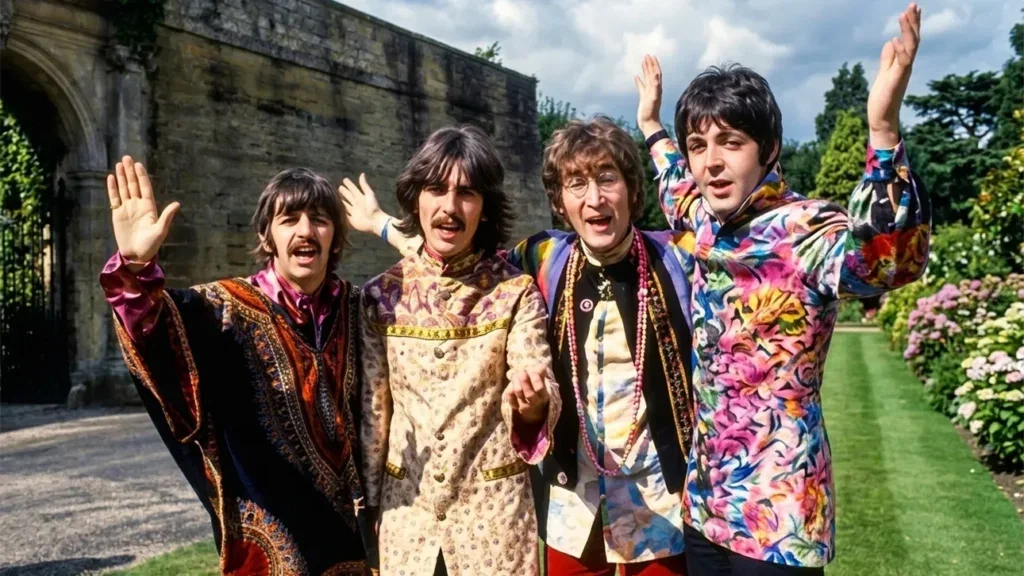
Many rock fans are familiar with the Beatles’ universally reviled television movie, Magical Mystery Tour, but how the Beatles managed to make it and get it aired in December 1967 is relatively unknown. The story of how Magical Mystery Tour came to be is one of tragedy, hubris, and the price of extreme fame.
The disaster that became Magical Mystery Tour begins with triumph. Sgt Pepper’s Lonely Hearts Club Band was famously Paul McCartney’s idea, conceived on a flight from Kenya to London in 1966. Mal Evans, the band’s roadie, asked McCartney to pass the “salt and pepper”, which McCartney misheard as “Sgt. Pepper”.
McCartney’s inspiration led the Beatles to spend an unprecedented amount of time and resources constructing what was heralded as the first pop’s first “concept album”. Minus a few outliers, critics overwhelmingly lauded Sgt Pepper’s Lonely Hearts Club Band. Called the best album ever made, Sgt. Pepper’s Lonely Hearts Club Band was compared to other cultural milestones, on a par with the 1963 assassination of President John F. Kennedy. The album spent an astonishing 27 weeks at the top of the UK albums chart and 15 consecutive weeks at No. 1 on the US Billboard album chart.
With the near-universal acclaim that followed Sgt. Pepper’s Lonely Hearts Club Band, it was widely assumed that the Beatles could do no wrong. That assumption was proven wrong when their made-for-television film Magical Mystery Tour became the Beatles’ biggest (and arguably, only) failure.
The Half-Formed Concept and Abstract Script
Near the end of the Summer of Love, in August 1967, the Beatles’ manager, Brian Epstein, died from an accidental prescription drug overdose. Epstein’s death marked a major turning point for the band. Without him, the man who had transformed their image and helped make them global superstars, the Fab Four were leaderless.
No doubt overconfident in his abilities, Paul McCartney sought to fill the void by suggesting they make another movie. McCartney had been making experimental films with his handheld camera and, inspired by Ken Kesey’s Merry Pranksters, convinced himself and his bandmates that their next project should be an avant-garde film featuring themselves and a “magical” mystery tour.
As children, the kids who would become the Beatles were exposed to traditional British “mystery trips”, which offered thrilling “destination unknown” experiences, typically featuring coach travel, a 4-star hotel, and surprise excursions to places like the Lake District, Yorkshire Dales, or coastal towns. These packages often include dinner, bed, and breakfast. The “mystery” was the destination, which was revealed only shortly before or during the journey. The idea for Magical Mystery Tour was that such a trip would be undertaken, but made “magical” because the bus held the biggest and most beloved act in the world.
The Beatles began filming Magical Mystery Tour in September 1967. Their entourage included an eclectic cast of characters, such as Jessie Robins (as Ringo’s “Aunt Jessie), the Bonzo Dog Doo-Dah Band (who performed their song “Death Cab for Cutie”), Victor Spinetti (as an Army Sergeant), and Scottish surrealist and poet Ivor Cutler, who played “Buster Bloodvessel”, the bus conductor.
Problems that would have been obvious to everyone except the Beatles soon emerged: the “magical” part of the trip couldn’t overcome scheduling conflicts, union problems, low morale, and, as would later prove significant, no script. The Beatles spent five days driving through the English countryside, ad libbing whatever came into their heads. Perhaps the biggest barrier to success was that none of the Beatles had any inkling of how to make a movie.
Whereas one might expect a movie script to include elements such as scene headings, character names, dialogue, and parentheticals, the “script” for Magical Mystery Tour consisted of a hand-drawn circle surrounded by a haphazard collection of ideas, sketches, and scenarios. These included the notes “get a coach”, “song (Fool on the Hill?)”, “strip club”, “fat woman”, “dreams”, and the word “lunch” in all caps. Including lunch in this script must have been especially important to the Beatles, as scenes in which John serves spaghetti with a shovel and the entire entourage ordering fish and chips were filmed.
The Beatles collected ten hours of film. Incomprehensible scenes also include the Beatles dressed as wizards in a laboratory, George and John applauding at a strip show, and a ballroom-dancing sequence to “Your Mother Should Know”.
A likely contributor to Magical Mystery Tour’s absurdity is that the primary filmmakers were taking lots of drugs while making it. By 1967, the Beatles (especially John and George) were ingesting LSD like it was candy. Combining the psychedelic with mountains of marijuana and an unlimited budget was a disaster in the making.
As has been exhaustively explored, the Beatles wrote many odes to their fondness for drugs. The title track to Magical Mystery Tour’s title song is just one of them. The lyrics, “Roll up! Roll up for the mystery tour!” were confirmed by Paul McCartney himself to be referencing the construction of a joint.
To the casual viewer, it becomes apparent that Magical Mystery Tour must have required copious amounts of acid. Watching George Harrison sit cross-legged in a cloud of smoke while lip-syncing “Blue Jay Way” isn’t remotely interesting unless one is tripping. As if the message wasn’t clear that hard drugs were needed to understand this sequence, the filmmakers decided to employ artificial fog, prismatic, fly-eye lens refractions, and color filters.
The Magical Mystery Tour Movie Airs, Briefly
Only the Beatles could have commanded the airtime to broadcast anything as terrible as Magical Mystery Tour. December 26, 1967, Boxing Day, was a Tuesday. It was assumed most Brits would be home following Christmas Day to watch the Fab Four’s latest masterpiece. The quirky comedy/pop musical aired only once, on BBC One at 8:35 p.m. Part of the problem was that color television sets had been available to the public for only six months, and few Brits owned one. This meant the pastel colors, which one could really only appreciate if profoundly stoned, went largely unseen.
The fallout was immediate. Reviews for Magical Mystery Tour bordered on ridicule. Critics were scathing, deriding the film as “rubbish”, “an incoherent, amateurish flop”, “sloppy”, “unfocused”, and, worst of all for such a vibrant band, “boring”. Derided mercilessly, Paul McCartney quickly issued an apology on the David Frost show. He told Frost, “We don’t say it was a good film. It was our first attempt. If we goofed, then we goofed. It was a challenge, and it didn’t come off. We’ll know better next time.” The American network NBC canceled plans to rebroadcast the movie.
If there is a saving grace to Magical Mystery Tour, it is the music. Six performances in the film include “Magical Mystery Tour,” “Your Mother Should Know”, “I Am the Walrus”, “The Fool on the Hill”, “Flying”, and “Blue Jay Way”. The 1967 album contains some of the Fab Four’s best work. In addition to the tracks featured in the film, Magical Mystery Tour includes “Hello Goodbye”, “Penny Lane”, and “Strawberry Fields Forever”. The album hit #1 on the US Billboard 200 chart on January 6, 1968, and stayed there for eight weeks.
In interviews today, Paul McCartney defends Magical Mystery Tour, claiming that acclaimed directors like Steven Spielberg have praised it. In 2012, a full box set of Magical Mystery Tour was re-released by Apple and EMI with digital restoration. The release includes interviews with surviving Beatles Paul McCartney and Ringo Starr, and previously unseen footage.
Unfortunately, even with the extras, Magical Mystery Tour is still awful. Contemporary reviews fail to reflect McCartney’s enthusiasm, with phrases like “…impossible to watch,” and “…a big, nasty, boring mistake.” Unlike everything else the Beatles did, Magical Mystery Tour will forever be seen as the failure it is, never to resurrect itself, even as an “it’s so bad it’s good” movie.
References
Asiain, A. “Paul McCartney’s film script to «Magical Mystery Tour»”. X. 26 April 2023.
The Beatles – Blue Jay Way | Magical Mystery Tour (1967). Vídeo Dailymotion. Dailymotion. 26 December 2024.
Behr, A. “Magical Mystery Tour: a rare Beatles flop – but it paved the way for Monty Python”. The Conversation. 22 December 2017.
Coffman, T. “The Beatles movie that greatly influenced Steven Spielberg”. Far Out. 8 October 2023.
Freiman, S. “Magical Mystery Tour: Some ‘Mysteries’ Solved”. Culture Sonar. 26 February 2025.
Goodman, W. “The Beatles’ ‘Sgt. Pepper’s’ Turns 50: Is It The Best Album Ever?” Billboard. 26 May 2017.
Jones, J. “Paul McCartney’s Conceptual Drawings for the Abbey Road Cover and Magical Mystery Tour Film.” Open Culture. 14 February 2014.
Lennon, J., & McCartney, P. (n.d.). Magical Mystery Tour (TV Movie 1967). IMDb.
Maplethorpe, D. “Cocaine, weed, heroin and LSD: It was drugs that ultimately split up The Beatles”. Far Out. 27 March 2026.
Miles, B. Paul McCartney: Many Years from Now. H. Holt. 1997.
Rosen, C. The Billboard Book of Number One Albums: The Inside Story Behind Pop Music’s Blockbuster Records. Billboard Books. 1996.
Shotton, P., & Schaffner, N. John Lennon in My Life. Stein and Day. 1983.