
If we were to flick through a dictionary from Steven Soderbergh’s bookshelf, might the word “predictable” be mysteriously missing? After all, it’s not a word we associate with the American filmmaker, who has been credited as the innovator of the modern indie film, even though he has paradoxically found a way to work within the commercial machine. So where does his latest, The Christophers, sit on this scale?
His movement between genres is light-footed, and the films are jabs we don’t see coming. There’s the slow, meditative sci-fi drama Solaris (2002) perched between the box-office crime-caper hit Ocean’s Eleven (2001) and its sequel, Ocean’s Twelve (2004). Or there are eight eclectic films, from 2006’s experimental neo-noir The Good German to 2012’s stripper comedy-drama Magic Mike.
There comes a point, though, when the unpredictable becomes predictable. After last year’s ghost story Presence (2025) and spy thriller Black Bag (2025), the comedy crime drama about a cantankerous painter, The Christophers (2025), is as predictable as it is not. Herein lies the pleasure of encountering Soderbergh’s cinema: we expect it, but what’s coming cannot be anticipated.
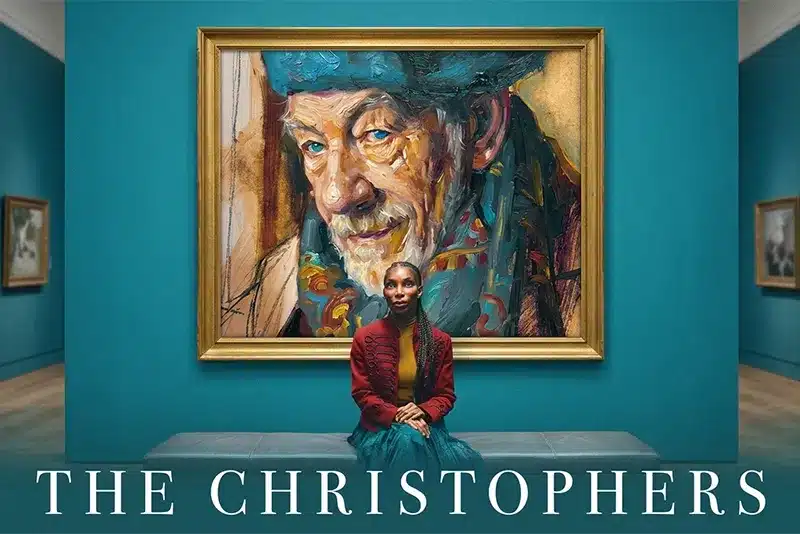
In The Christophers, Ian McKellen plays the weary and reclusive painter Julian Sklar, who’s only remembered for “The Christophers”, two portrait series he painted of a young man decades ago. Julian’s disgruntled children, Barnaby (James Corden) and Sallie (Jessica Gunning), are preoccupied with the rumored third series, which Sklar began but never completed.
Expected to fetch millions at auction, they approach struggling painting conservator and blogger Lori Butler (Michaela Coel), who runs The Lucky Red Lantern Chinese street food stall. It’s a far cry from her ambition to be a painter. Barnaby and Sallie propose that she forges the third series, and offer to split whatever the paintings fetch three ways.
It’s no coincidence that Sallie has sought out Lori, as the pair studied together in college. She knows Lori can mimic any style and, as an added caveat, she’s studied her father’s work closely. This makes her the ideal choice, but first, Lori must get close to the reclusive painter. It just so happens that Julian’s looking for a new assistant and, under Barnaby and Sallie’s instruction, Lori secures the position, setting in motion the devious plot of a profitable posthumous discovery for her co-conspirators.
There’s a coyness to the way that Soderbergh introduces Julian. With a clichéd look, sat in his beret, scarf, and coat, Soderbergh emphasizes the allure of the creative genius by momentarily concealing him behind the cinematography’s abstract framing. When one considers the minor, celebrated output that elevated his standing in the art world, his stylized introduction can be read cynically. After all, Lori does not appear awestruck, but the camera frames him as a figure that should inspire deference.
It may be a sly shot about the fickle nature of admiration, and the impulsive and nauseating way people will fawn over anyone in proximity to celebrity. Beyond this cynical interpretation, the little-by-little reveal mimics the formation of a painting itself, as the layers and details of color are committed to the canvas and the painter’s vision takes shape, only here, the paintbrushes and paint are transposed for the camera and the edit.
Soderbergh has fostered a reputation for infusing his films with visual energy, sometimes subtle, other times not. He is comfortable with his audience being aware of the filmmaker’s guiding hand, which immerses us in the film’s artifice. For example, Ocean’s Eleven uses a step-printing technique, resulting in a slower film rate. Soderbergh complements this disorientating off-kilter effect with the pace of the edit and the music. This reminds us how pliable the form and its techniques are.
The Christophers is flat when it needs to be, but what’s interesting is how Soderbergh visually lifts the film off its canvas. This energy is not derived from an experimental use of cinematography but rather orchestrated by the playful dance of the performances, writing, and staging, which flexes its acerbic wit.
McKellen and Coel are a sheer delight. The chemistry between the pair crackles. A good amount of their interaction is a duel, but the leads transform it so that it resembles a dance, or two classical musicians performing a duet. Yes, their sparring can be intense, but their interactions are filled with gentler and more compassionate passages.
The Christophers is, after all, about legacy, compassion, and the gifts we give each other. The film is an ode to human connection, and while we misunderstand each other and struggle to get along, the most important relationships can grow out of what seems like arid earth, as Julian and Lori’s do.
It’s striking how McKellen and Coel occupy the frame. While McKellen acts with his whole body, Coel acts with her eyes. His performance is looser and more emotional, whereas hers is more of a physical and internalized performance.
Nowadays, it appears Julian talks more than he paints, from recording personalized Cameo messages to delivering lengthy soliloquies to Lori. This provokes sadness because it’s as though he were performing on stage, and she is the only person in the gallery.
Julian’s labyrinthine and self-indulgent dialogue is easy to become lost in. McKellen’s seasoned voice is seductive, and with a musical-like quality, we are torn between listening to the words or allowing ourselves to become lost in its rhythm. The words reveal a man trying to distract himself from a truth he’d rather avoid. His words betray the loneliness, insecurity, and fear of a man yet to reckon with who he is and his place in the world.
We see a stark contrast between him and Lori. Unlike Julian’s lack of brevity, Lori’s perceptions are considered and to the point. In one scene, her eloquent, observant, and insightful critique of The Christophers introduces the idea that the artist might not be the person best placed to understand their work. Instead, an objective perspective less susceptible to self-indulgence is needed. Julian’s labyrinthine soliloquies may therefore be a metaphor for the artist’s struggle not to become lost in either their work or their ego.
Coel has a serpent-like, deceitful, and untrustworthy presence. Throughout, the question is about where Lori’s loyalties lie. Are they with the siblings, Julian, or herself? Soderbergh and screenwriter Ed Solomon sit back and observe how the time Lori spends with Julian undermines her original duplicitous intentions, as well as how Julian’s cantankerous and sometimes cruel nature shifts Lori’s intentions.
In this way, The Christophers is a keen exploration of human nature. At the heart of Coel’s performance, despite this visceral, serpent-like presence and doubts about whether we should give her our trust and sympathy, is Lori’s ability to invite hope and a search for purity in her damaged, scarred soul.
The question of sympathy is not of interest to either Soderbergh or Solomon. Regardless of whether we sympathize or empathize with Julian, Lori, and the siblings, they are nonetheless interesting. Soderbergh and Solomon understand that interest carries a greater currency than sympathy or empathy, fostering a nuance that makes their characters that much richer.
Julian and Lori are not one or the other. Lori is duplicitous, and Julian has a cruel nature, but both are wounded creatures, scarred by life experiences. Barnaby and Sallie, on the other hand, come across as generally unsympathetic, given the direction the story takes. One can sense that, somewhere in their relationship with their father, a sympathy lies dormant, but here they are useful foils for the two leads.
The Christophers is an impressive film with a thoughtful soul. One of its triumphs is its depiction of Julian’s tumultuous journey to find a break in the storm that has emotionally held him prisoner for these past decades. Themes and ideas are delicately introduced, and if there’s a sense that one can lose their way, The Christophers advocates for hope, not despair.
The story explores how the most frustrating chapters in our lives can lead to unexpected, meaningful events. The story never disavows the displeasure of life’s challenges, which it views through the lens of two painters—one whose career petered out, and the other whose career never got started. If life has a wicked sense of irony, The Christophers paints a cinematic picture of it through the resiliency of those important relationships that help navigate the stormy human temperament.