

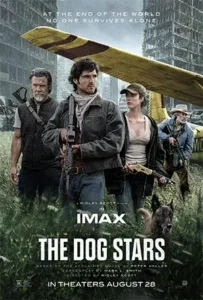
Set in a post-apocalyptic world, Ridley Scott’s new film The Dog Stars is a scathing indictment of modern America and a meditation on grief and letting go. Hig and his dog Jasper, in a remarkable example of canine acting, stare at the stars that Hig has given his own names.
A mechanic and one of the few people who have survived a global pandemic, Jacob Elordi’s Hig has lost almost everything. Now he spends his nights guarding the perimeter of the armed compound he shares with Bangley, played by Josh Brolin, against violent feral gangs foraging the land as they try to survive.
The Dog Stars opens with Hig working on his vintage 1956 Cessna 182 and then flying into Denver, now all but deserted, to get supplies. The urban wasteland is also dangerous, and Hig puts on a bulletproof vest and carries a military rifle, which soon comes in handy. What is left of society has collapsed into barbarism and anarchy that leaves Hig, a handy, hardworking, and decent everyman capable of doing what is necessary, but he is not quite right for all the things he has to do.
He is also grieving those he lost, and flying over the mountains and valleys of what is conveyed as Colorado, but is played convincingly by Italy’s rugged Cansiglio region, where most of the film was shot, is his therapy. He cuts the motor and shows the Cessna’s famous airworthiness as he glides noiselessly with his faithful dog at his side. Much of the story takes place in the cockpit, with wonderful aerial photography and shots of the stillness and beauty of the American wilderness.
This scene might represent America before the “American Dream” came to fruition. The airplane is used to symbolize, at once, the know-how and the free-spiritedness that drove that dream, or at least, the parts of it that Hig still clings to. His partner Bangley holds to the most extreme version of American ideology; he represents the quintessential rugged individualist. A Marine veteran, skilled in weaponry, he mans a lookout tower wearing night-vision binoculars and carrying a sniper rifle, and ruthlessly “puts down” interlopers whom he calls “maggots”.
Drifting in the Cessna, which, along with Jasper, is an important co-star, Hig hears a garbled radio message from a place called Grand Junction, which inspires his hope that this place could be a relief from the present reality. The mysterious radio messages heighten the tension between him and Bangley, who thinks they represent a dangerous fantasy.
We meet another group of survivors when Hig stops in an idyllic valley and is met by bearded or flower-dress-clad adults and a crowd of excited children—a shocking contrast to the desolation of the city and the austerity of Bangley’s fire base. Miscalled, intentionally and contemptuously, Mormons by Bangley, this is a colony of Mennonites who appear to be thriving, though they appreciate the soft drinks that Hig brings them.
Manitoba, where I grew up, is one of many places where the Mennonites fled from religious persecution in the 19th and early 20th centuries. As expert farmers, they were welcomed by the Canadian government to open up and exploit the vast grain-growing areas in the west, where they prosper to this day. Indeed, Mennonite culture has shaped some of Canada’s best literature, including works by Miriam Toews and Sandra Birdsell, to name just two.
Growing up, many of my friends were Mennonite. Working as a school bus driver, I had a summer assignment to drive a group of Mennonites from their rural billets into the city to attend a week-long international Mennonite conference. When I arrived at the host pastor’s farmhouse the first morning, I was invited into the family kitchen and served breakfast. At the end of the week, they presented me with an embroidered wall hanging embossed with “Guatemala”, which is another of the places that welcomed their diaspora when they were in need of shelter.
Hig has had a similar experience with this communal, pacifist, Christian sect, despite Bangley warning that they may be “contagious”. Othering is a primitive survival technique that Bangley embraces and that Hig intuitively rejects. In The Dog Stars, the Mennonites represent a third way, an alternative strand of the American Dream DNA, suggesting that long-term survival requires cooperation more than weapon skills.
Eventually, the draw of the ghostly radio broadcast becomes too alluring for Hig, and he decides to try to fly there, leaving Bangley resolutely behind. On the way, he is forced to crash-land on the property of another determined survivalist, Pops, played by Guy Pearce, who has set up an armed camp of his own with his daughter. Cima, played by Margaret Qualley, senses a kindred spirit in Hig, and they win over the suspicious Pops.
After Hig has repaired the plane, in a significant sequence, the three work to clear trees away so Hig can take off, evoking a traditional American frontier scene. Here are determined homesteaders taking on the wilderness with the aid of a donkey, in a small but worthy role. We learn that Cima is also processing deep grief, and later the young couple bonds staring at Hig’s re-named stars, suggesting that since the old world is gone, he can make new choices.
The script by Mark L. Smith from the novel by Peter Heller is lean, with short, sharp dialogue exposing the contrasting worldviews of the characters. They never narrate; the film shows rather than tells. The excellent main cast is augmented by Allison Janney and Benedict Wong, with a scene-stealing cameo by Ewen Bremner. The mostly wordless flight scenes are painted by a luminous Americana film score by Harry Gregson-Williams, with guitars, fiddles, and dobroes along with subtle but rich orchestra sections.
A welcome departure for Ridley Scott, slow and contemplative, The Dog Stars is a nuanced bit of social commentary reminiscent of films like Robert Altman’s Nashville. Tagged as a “survivalist” film, it has been criticized for its lack of action and dreamy pace. In fact, the film is masterfully constructed. I have omitted shocking plot turns that build a tight, tense story arc and that support the film’s theme to avoid any spoilers.
The Dog Stars‘ marketing, showing tough-looking dudes holding military weapons, may not be attracting the audience the film deserves. Elegant, with visual and musical beauty and a thoughtful, philosophical core, the film lands in the middle of today’s polarized political atmosphere right on schedule.