

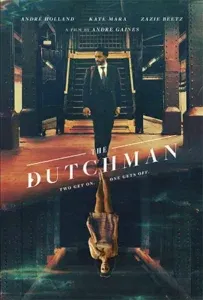
Listening to The Dutchman’s opening narration, it’s as if the voice of Dr. Amiri, played by Stephen McKinley Henderson, reaches out across the void. It’s what we might imagine God’s voice to sound like. He threads the words with a rhythm that emphasizes their significance. The sound of the clock, whose ticktocks boom, and the elongated musical rhythms that seem to stretch out time, give Henderson’s voice a spiritual presence. This is neither a false nor romantic impression.
“You are immersed now in the modern myth… but you are alone. It is a peculiar sensation, this double consciousness; this sense of always looking at yourself through the eyes of others. You ever feel your twoness? An American… a black man. Two souls; two thoughts; two unreconciled strivings. Two warring ideals in one dark body. You’re lost, Clay… but we can find you.”
As the story unfolds, Amiri appears in various guises. He’s Amiri Baraka, the original author of the 1964 one-act play Dutchman, which the film is based on, as well as a God-like being, dueling with the devil over Clay (André Holland), the main character’s fate. If Clay is immersed in the modern myth, then Amiri’s voice is like the irresistible call of the Sirens, luring us into the film’s disconcerting reality.
André Gaines’ adaptation of Baraka’s play, which I’ve neither seen nor read, is liberated from its claustrophobic setting of the New York City subway. The psychological thriller centers on the encounter between Clay, a political advisor to Warren Enright (Aldis Hodge), an up-and-coming Harlem politician, and Lula (Kate Mara), a mysterious stranger on the subway.
The story begins with a hostile therapy session between Clay and his wife, Kaya (Zazie Beatz). Her affair and his longstanding distance have placed their marriage on a precipice. When the session ends, they have a brief conversation about that night’s fundraiser in the corridor of Dr. Amiri’s building. Behind the snide, accusatory comments, Clay awkwardly reveals that he wants to open up to her; he just doesn’t know how. Kaya leaves, telling him not to bother coming to the fundraiser if he’s going to be like this.
When he walks back into the room to gather his things, he finds the doctor is waiting for him. Amiri wants to give him something, but first he asks Clay, “What do you struggle with the most? Conformity and expectation? Identity and assimilation? Anger or restraint? Vulnerability and violence?” He explains to Clay that understanding these struggles can lead to freedom.
He hands Clay a copy of the play Dutchman, which he says came to him during one of the darkest periods of his own life. Amiri tells Clay that we can find pieces of ourselves in literature that can help us heal. He then asks him, “Do you see yourself on that train, Clay? Trapped between who you really are and who you must be?” This sets in motion a meta-narrative to see if Clay’s fate can be different from that of his namesake in the play, who is murdered by Lula.
Gaines’ first feature is filled with playful, inventive energy. It reveals a director interested in utilising film as both art and narrative. One might even say that Gaines is imbuing the film itself with a twoness. The director, however, is careful not to forget his audience, for whom he creates space to enter the film. From the beginning, we can get a foothold in the story because this twoness Amiri describes is a common experience.
It’s no coincidence that before Amiri’s voiceover, a commonly used quote by the Swiss psychoanalyst C.G. Jung appears onscreen: “Who looks outside, dreams; who looks inside, awakens.” It’s an early sign of how on the nose Gaines intends The Dutchman to be.
Indeed, Gaines impresses upon the audience this concept of twoness, and in an early scene, Clay admits the burden of balancing competing expectations of his blackness. He tells Kaya that to some of his colleagues and people in the community, he’s too black, and to others, he’s not black enough.
All of us reckon with balancing the internal and external, perhaps especially our feelings of worth, and so, this allows us to identify with Clay. While the play and the film are written about the black experience and black masculinity, the human experience broadens this intent and creates even greater relatability.
André Holland plays Clay perfectly as the straight-cut political advisor who nervously watches every step, every word, and syllable to satisfy whatever expectations anyone watching might have. Holland skillfully conveys details about Clay in the way that the character physically carries himself and drifts in and out of his own mind. He stifles his anger the best he can, sometimes projecting it on Kaya and even Lula, afraid to look inside and confront himself. A fire inside of him clearly burns — the repressed rage and honesty that needs to be freed to trigger his metamorphosis and awakening.
Kate Mara is delightful as Lula, who, with her exaggerated mannerisms and expressions, becomes devil or poltergeist-like. She crawls under our skin, simultaneously sexually alluring and odious. Then, there’s her unnerving smile and the way she speaks in riddles, reminding Clay time and again that she lies. Yet, one thing she doesn’t lie about or cannot, is her intentions to be an agent of chaos and torment. Lula might be one of the more interesting incarnations of the devil cinema has seen in quite some time.
Throughout The Dutchman, Gaines ratchets up the tension of a man trapped in a circumstance not of his choosing. The suspense becomes viscerally oppressive for the audience, who feel the intensity of Clay’s situation. Is there anything he can do or say to end this nightmare? It doesn’t appear so. Instead, we’re forced to watch a cat playing with the mouse it has caught. Only, it can feel like we’re the mouse.
The Dutchman works over its audience’s minds with its playfulness, and in Gaines’ hands, entertains a series of themes and ideas. The shapeshifting Amiri is intriguing through his many guises, and what these symbolize. One interpretation is that Gaines uses the meta-narrative to frame the storyteller as a God-like figure, which then devolves into a reflection on how God’s Will must yield to humanity’s free will. The Dutchman humbles both God and the devil by empowering its human characters, yet it refuses to disavow the significance of fate, embodied in human form.
Gaines presents The Dutchman as a psychologically driven story, yet it is filled with religious connotations. The apple that Lula slices on the subway car and offers Clay recalls the story of the serpent tempting Adam and Eve with the forbidden fruit in the Garden of Eden. In this case, Lula is the serpent and the apple, who wants to fuck Clay to ensnare him deeper in her trap. Lula is also Clay’s confrontation with Satan in the desert, who tries to tempt him. Only in The Dutchman, the arid desert is transposed to New York City and its seething underbelly.
For some audiences, The Dutchman will be too self-conscious and too on the nose. It does, however, have its subtler moments. The religious connotations hide behind the Jungian and the crisis of black masculinity. Other moments, however, like the posters on the subway cars that read “Break the Cycle”, are less discreet.
The Dutchman is a heady mix of emotion, suspense, and ideas that feels like we’re dragged down a surreal rabbit hole. It has a strange, haunting presence that, when the film ends, we feel we’ve experienced a fever dream.
- Thriller ‘The White Rabbit’ Ensnares Viewers in Hitchcockian Fashion
- Psychological Thriller ‘Saltburn’ Is a Feast for Depraved Eyes
- Select Juliette Binoche on Her Starring Role in Romance Thriller ‘Both Sides of the Blade’ Juliette Binoche on Her Starring Role in Romance Thriller ‘Both Sides of the Blade’