
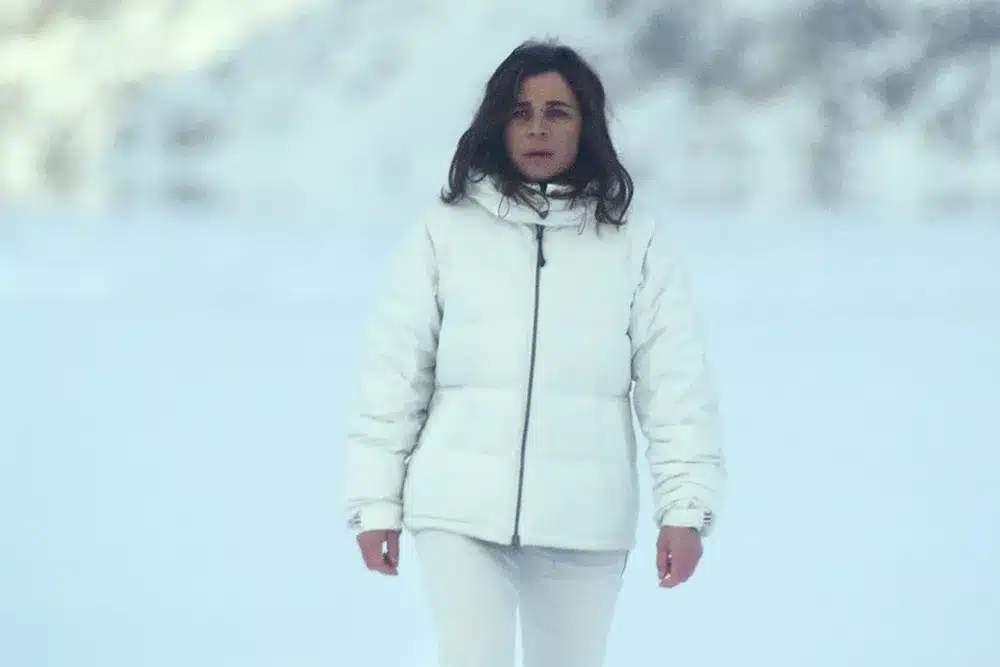

The piano-led orchestration at the beginning of director Sébastien Betbeder’s The Incredible Snow Woman (L’Incroyable Femme des Neiges) accompanies the introduction of an unknown woman in the vast and white wilderness of Greenland’s Baffin Bay. It’s necessary to note the piano because without the music, what are we to make of what we’re seeing?
The gentle melody by Ensemble O, who provide the film’s original music, conveys a sadness and something akin to its opposite — the warmth of this woman being spiritually at peace in isolation. It’s as if she’s content to be wrapped in its embrace. If the scene feels simple and calm, the messiness of the character’s life is quickly laid bare.
Coline Morel (Blanche Gardin) is the titular character, a researcher and polar expert, who acts as an occasional narrator. This works for the film’s narrative, given that she is trying to get her research findings down on paper and tell a little of her life story.
After opening in Baffin Bay, The Incredible Snow Woman retraces Coline’s steps, beginning with an unannounced return to her home village in the French Jura mountains. Awoken during the night by noises from downstairs, her brother Basile (Philippe Katerine) mistakes her for an intruder and hits her on the head. He can be forgiven, because it has been some years since either he or Lolo (Bastien Bouillon) has seen their sister. Then, there’s the awkward encounters with her first love, Christophe (Laurent Papot), his wife Sophie (Clémentine Baert), and their teenage son, Enzo (Ferdinand Redouloux).
From reducing Christophe’s class of young children to tears during a talk about her Polar experiences, to being dragged out of his home and arrested by the police, Coline leaves behind a trail of chaos. It’s hardly surprising the Polar Institute dismissed her, and Sacha, her boyfriend of 18 years, has dumped her for someone he can talk to and who is “sweeter” and more “considerate”.
Stories are built on a pressing need. As David Mamet said, it’s a question of “What does the protagonist want?” In Coline’s case, she struggles to share the reason for her return. This is complicated when she reaches a personal low and declares that she will no longer speak until she finds the strength to say what she has to say. Basile is more sympathetic than Lolo, and when the three of them hike up to their father’s cabin, Coline mysteriously vanishes.
Think of Ernest Hemingway hosting poolside boxing exhibitions at his home, Benjamin Franklin’s naked “air baths”, or Ludwig van Beethoven meticulously counting 60 beans for his cup of coffee. Impressive people are prone to behavior that sets them apart from others, and The Incredible Snow Woman’s protagonist is no different.
Coline is molded from the dysfunctional and melodramatic, which contrasts with the fearless adventurer who has crossed Greenland from east to west, undertaken solo expeditions to the North Pole and Antarctica, camped on an ice floe, and single-handedly wrestled a bear. What’s interesting, however, is how she comes across as more quirky than dysfunctional. This might stem from a touching moment when Basile, to Coline’s surprise, reveals that he has followed her adventures.
Bound by unconditional love, Basile’s affection for Coline encourages the audience to perceive her as simply unusual. It’s in this moment that cinema reminds us that it possesses a big heart, or rather, cinema exposes our better natures. After all, cinema is often kinder to outsider characters than real life is; in the day-to-day, we find reasons to ostracize and objectify them for our amusement. The Incredible Snow Woman takes in the dysfunctional and quirky Coline, who might never have fully grown up, and compassionately embraces her.
Stories like The Incredible Snow Woman reveal the duality of vulnerability and strength. Despite her confidence, like the souls of the most committed outsiders or provocative and rebellious personalities, she is in pain. It’s about the tension our nature forges with the extroverted part of our personality that wants to belong. From early on, Coline is a character struggling with herself as much as with other people, and yet the lightness of the film’s opening scene runs throughout.
Betbeder nurtures its humorous spirit, never funnier than when Christophe lets Coline loose in front of his class. Then, there’s the moment when he and his wife return home to find that an intoxicated Coline and their son have been hitting it off like best friends — missing the part where they sat sharing a cigarette, with Coline pouring her heart out about Sacha.
Under Betbeder’s direction, the humor is neither lazy nor superficial. Instead, it develops character and even emotionally transports us inside the moment. For example, when she talks to the children, her overuse of academic language becomes a blur as we adopt their confused points of view. There’s also a black, uncomfortable humor that expresses Coline’s incompatibility with the community, an idea that undergoes its own transformation.
When Coline mysteriously vanishes, her brothers sound the alarm, but the search mounted by rescuers is in vain. It’s here that we return to The Incredible Snow Woman‘s opening scene in Baffin Bay to continue the story linearly. Ole (Ole Eliassen) and Martika (Martin Jensen), two native Inuit, discover Coline in the snow — her face is covered in ice, and we’re unsure if she’s even alive. Provided shelter in one of Greenland’s last hunting villages, she’s cared for by the Inuit community.
The next time we see Coline, she’s at her laptop typing up her research findings and life story, with a cigarette drooping from her lips. She appears lighter and happier than she did back home in the Jura mountains. Transformed, her eyes are different, and her smile beams with a genuine affection for her surroundings.
It’s here that Gardin’s performance and the film’s philosophical musings burst forth. The Incredible Snow Woman is difficult to discuss in detail without giving too much away. It’s the critic’s responsibility to try to protect the mystery of the film’s emotional story while offering insight. So, let us say that Betbeder’s drama is a reflection on belonging, identity, and how the time spent searching for something can leave us with little time to enjoy the fruits of our labor. Perhaps life is less about pleasure, and instead, the toil of creating the best version of ourselves, that even if completed, leaves us with regret.
The Incredible Snow Woman is a deceptively simple, heartwarming, and inviting work that invites viewers to smile and laugh, but it also communicates on a deeper philosophical level. Strikingly, The Incredible Snow Woman is not dependent on big sweeping narrative gestures. Instead, less is more, where things are felt as much as they are spoken.
Betbeder is cognizant of certain moments that should remain private, leaving his characters with parts of themselves not meant to be shared. This doesn’t deny the story but enriches it. The Incredible Snow Woman is an emotionally stirring journey about the search for serenity, grounded in the quirky vision of its director, making for a genuine delight.