

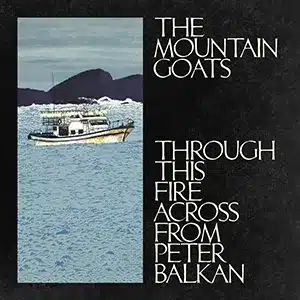
For longtime fans of the Mountain Goats, an epic, Broadway-coded album featuring Lin-Manuel Miranda was not on our bucket list. The Mountain Goats’ 23rd studio album, 2025’s Through This Fire Across from Peter Balkan, is an unexpected yet profound step in the band’s sonic evolution. The tale of a shipwreck, told through the eyes of the deserted, languishing crew, adopts the boisterous form of a musical, serving as a confoundingly optimistic foil to the narrators’ bleak circumstances. Lead singer John Darnielle’s measured vocals find their perfect counterpart in Manuel’s harmonies, while Matt Douglas’ jazz-fueled instrumentals round out the soundscape against the heartbeat of Jon Wurster’s drums.
Through This Fire Across from Peter Balkan is an enchanting, symphonic masterpiece, lifetimes removed from the band’s early work. The Mountain Goats’ humble beginnings trace back to 1991, during Darnielle’s tenure as a nurse at a psychiatric hospital. Equipped with only his Panasonic boombox, he began recording grainy, stripped-down tracks, pairing his trademark shrill voice with the poetic depth that would become the band’s earliest signature.
Listeners who felt misunderstood and alienated by the mainstream music scene found a home in the Mountain Goats. Darnielle’s lyrics have, at one time or another, given representation to nearly every stage of the human condition. While he treats his lyrical storytelling as a work of fiction, he hasn’t shied away from drawing inspiration from his past, connecting reflections on his abusive childhood and heavy drug use to the universal tribulations of humanity.
A recent, brilliant GQ profile by Grayson Haver Currin pinpoints what makes Darnielle so exceptional: He strongly, fervently believes in his convictions, but is equally willing to let them go. This complexity lends itself not only to the passion in Darnielle’s words but also to his proclivity for expansion. After surviving his near-fatal descent into hard drugs, Darnielle retreated to prayer, vegetarianism, and, eventually, long-distance running. He can exist in one space without betraying the other.
Gradually, Darnielle built up his team of musicians. His fine-tuned vocals became an instrument in their own regard, softening when needed and, at other times, rising with frenetic urgency. After signing with 4AD, the Mountain Goats abandoned their low-fi production. Each new album became more refined than the prior one, resulting in a vast, genre-bending, and deeply emotive catalogue.
What began as a modest solo project—the name the Mountain Goats formulated to muddle Darnielle’s role as the presumptive protagonist—has had a trajectory unlike anything else in the modern music scene. The pristine ability to continually redefine one’s own art, without erring into the predictable or trite, is one of the Mountain Goats’ greatest strengths. For proof of the band’s evolution, listeners need look no further than the story of Jenny.
The Mountain Goats’ Jenny Arrives on Her Motorcycle
I was 17 when I first saw the Mountain Goats perform in a dim basement in Washington. The entire crowd fit within spitting distance of Darnielle as he launched into the unmistakable opening chords of “Jenny”, a single from the 2002 album All Hail West Texas. Every person in the room sang along, “900 ccs of raw whining power / No outstanding warrants for my arrest / Hi diddly dee, goddamn! / A pirate’s life for me.”
In an album whose cover teases “Fourteen songs about seven people, two houses, a motorcycle, and a locked treatment facility for adolescent boys,” “Jenny” is a singular beacon of hope. All Hail West Texas has an overarching spirit of desolation, both personal and geographic. Each song is built from little but roaring guitar riffs and Darnielle’s sharp, yearning voice.
Nestled amid raw tracks about doomed relationships and stolen youth, “Jenny” introduces a mystical heroine who arrives on a “new Kawaski / All yellow and black”. The narrator joins Jenny on her bike, clinging to her for dear life as she “pointed the headlamp toward the horizon”. Jenny is “sweet and delicious as the warm desert air”, high on a pedestal in one of the album’s few glimpses of unadulterated joy.
Darnielle’s staggering talent as a musician is rivaled by his knack for writing lyrics that are both uncannily specific and impossibly vague. He laces together strings of vivid images, yet leaves enough ambiguity for the listener to fill in the gaps. At the same time, he is adept at carving out patterns, often creating threads in his work by returning to familiar people and places.
“Jenny” gave life to a character who would weave through the Mountain Goats’ canon for over two decades, and the subject of the song is, for the most part, defined more by her absence than by her presence. She exists largely in the memories of Darnielle’s narrators, their longing reawakened through calls and postcards. The magnitude of her void is illustrated in “Night Light”, a track from 2012’s Transcendental Youth; after hearing from Jenny, who is “passing through” Montana, the narrator admits, “Probably never see her again in this life, I guess / Not sure what I’m gonna do”.
More than 20 years after she roared away in her yellow and black Kawasaki, Jenny reappeared as the namesake of Jenny from Thebes, the Mountain Goats’ 2023 sequel to All Hail West Texas. It would be the final album featuring the quartet of Darnielle, Wurster, Douglas, and longtime bassist Peter Hughes, who departed the band in 2024.
Musically, Jenny from Thebes is worlds away from All Hail West Texas. Crescendos and instrumental call-and-response punctuate its lush texture. The orchestra is expertly synchronous. Like every great rock opera, each track is both an individual triumph and a crucial element of a larger, patchwork narrative. On its surface, Jenny from Thebes tells the story of Jenny and the circumstances surrounding her exile. By the end of the album, she is destined for a life on the run, with “Going to Dallas” dropping breadcrumbs about her refuge in Montana.
Yet, the Mountains Goats’ lyrics are rarely as straightforward as they appear. The reintroduction of a pivotal character from the band’s early works cloaks Jenny from Thebes in an air of nostalgia. If All Hail West Texas speaks to the trials of young adulthood, Jenny from Thebes responds from the other side, the angst and longing replaced with complacency and acceptance, thick with allusions to the passage of time. The album’s greatest strength is not its storytelling, but rather its spotlight on the progress of both the narrator and the band itself.
Though the Mountain Goats’ work has always been rife with callbacks, Jenny from Thebes is by far their most intertextual album; references to All Hail West Texas are abundant, with explicit shoutouts to tracks including “Color in Your Cheeks” and “Distant Stations”. Yet it’s the mid-album return of Jenny’s famed motorcycle in “From the Nebraska Plant” that fully encapsulates the metamorphosis of Darnielle’s songwriting, the band, and its listeners.
While “Jenny” sings the praises of its heroine against a backdrop of grinding guitar riffs, the heart of “From the Nebraska Plant” is nestled in Darnielle’s restrained voice, laden with wistful hesitation. The lonesome pulse of the drum, like Jenny, finds its strength not in the carefully timed beats but in the silence between them.
“From the Nebraska Plant” parallels “Jenny”, but its jubilation is replaced by dejection, laying bare that the fleeting relationship between Jenny and the narrator was sacred only in its imperfection. Revisiting it, all these years later, reveals that some pieces of the past don’t fit into the present. As Darnielle sings, “I am strong now, I am strong now / That was all years back / On your custom Kawasaki / Chrome yellow and black”. As for the beloved motorcycle, “It’s somewhere in a wreck yard now / Never see it again on this earth / Let the scavengers proclaim / How much it was worth.
.“Jenny III”, meanwhile, trades in the idyllic descriptors from All Hail West Texas for a harsh recounting of Jenny’s flaws. She is no longer a savior riding confidently into the horizon, but instead, “Jenny was a warrior / Jenny was a thief / Jenny hit the corner clinic begging for relief”. The jazz-heavy track, which muses about Jenny’s escape and what she left behind, ends with her—and her motorcycle—returning for the narrator years after her departure. Unlike in 2002’s song, though, the events are now told in a somber light, and the narrator can “barely make the frame out through my tears”.
The evolution of Jenny mirrors the evolution of Darnielle’s musical prowess. The stylistic choices he once clung to fell by the wayside as his artistry and fanbase grew. Jenny from Thebes is a polished, mature, reflective album, in which Jenny is simply a thread tying together a narrative about things that were once of paramount importance but have lost their spark over time.
The Mountain Goats’ catalogue is about looking in the eyes of the dark places that exist around and within us. Over the past 34 years, Darnielle and his audience have confronted and released the memories that kept them hostage, with Jenny being a prominent example. Jenny from Thebes effectively closed the door on the Mountains Goats’ past, paving the way for Through This Fire Across from Peter Balkan.
Jenny in the Rear-View Mirror
The Mountain Goats’ second consecutive rock opera tells a story more literal and concise than any of their previous albums, with rhythmic and lyrical patterns reappearing throughout the tracks. The songs are gentle without sacrificing their integrity. Themes of resilience, companionship, and surrender can’t help but evoke images of Darnielle adrift in his own sea, forging a way forward without his faithful partner. The first studio recording since Hughes’ departure, Through This Fire Across from Peter Balkan is dedicated to the former bassist, his legacy enduring even in his absence.
The album is less a continuation of the Mountain Goats’ earlier works than a complete revision. “Overture,” the instrumental opening track, doubles as a tangible barrier between the album and all those before it. In “Cold at Night,” Darnielle sings (with support from Miranda), “The first thing you learn is how far you can go with no gas in the tank / And the next thing you learn is how cold it can get at night,” lines that are recycled to close the album in “Broken to Begin With.” Like the marooned crew, Through This Fire Across from Peter Balkan finds the Mountain Goats trapped in a self-referential vacuum, alone but for the echo of their own voices.
Absent from the Mountain Goat’s latest album is the insatiable need to survive, to dig out of even the most harrowing depths, that has been the underbelly of the Mountain Goats’ work. In its place is a sense of resignation, the only comfort lying in the acceptance of one’s fate. “Fishing Boat” evokes this immobility with the lines “Still as the sky on the ocean / Mute as the moon overhead,” while “Your Bandage” offers a more solemn approach: “Be still / Lie at peace / Soon we’ll all be released.”
Contrasting this with previous tracks built around refrains like “Just stay alive”, it’s safe to say Darnielle has unlocked a new era in his artistry. So where, then, does that leave fans—those for whom the solace that eluded them was found only in the imperfection and fury of the Mountain Goats?
The Mountain Goats’ latest releases, while astounding, cannot be fully appreciated without letting go of expectations shaped by what the band once was. Thankfully, if Darnielle has taught us anything, it’s that progress is not an abandonment of the past; progress is the greatest possible outcome of nourishing the infinite space between surviving and thriving. Like Jenny to Darnielle’s narrator, the Mountain Goats’ music has held many fans’ hands through some of life’s greatest trials. Even when that grip loosens, its imprint can never be fully erased.
The third time I listened to Through This Fire Across from Peter Balkan, I was in my old car and battling a mess of stray cords, none of which carried the music to the stereo. So instead, the songs poured out of my phone speaker as I drove, drowned out by the noise of traffic and the sound of the tires on the road passing underfoot. In this less-than-ideal setting, they were suddenly familiar. Beneath the gripping narrative, the shiny guest vocals and the symphonic production, the core of the Mountain Goats’ music remains unchanged; the most unflinching journey yet to the deepest pits of human emotions, trudging fearlessly into the future.
Work Cited
Currin, G. H. “The story John Darnielle lived to tell”. GQ. 12 November 2025