
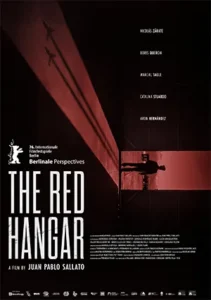
The Red Hangar (Hangar Rojo) narrows its focus to the first day of Chile’s 1973 coup and follows one man through the speed and confusion of institutional collapse. Directed by Juan Pablo Sallato and based on Fernando Villagrán’s autobiographical chronicle published in 2002, Disparen a la bandada (<em>Shoot the Flock</em>), it follows Air Force captain Jorge Silva (Nicolás Zárate), a military officer caught between the habits of discipline and the increasingly visible reality of repression. Rather than trying to summarize the coup as a whole, the film stays close to one officer’s routine as ordinary procedure turns dark.
Jorge Silva is not introduced as a grand historical figure but as a man moving through a day that keeps shrinking around him. Three years earlier, he had saved President Salvador Allende during a failed assassination attempt, and that history now hangs over him as the coup unfolds. What once looked like patriotic service can now mark him as a communist conspirator. Red Hangar exposes the contradiction of a man conditioned by military order, now finding himself within a system that expects obedience, even as that blind faith becomes morally indistinguishable from complicity.
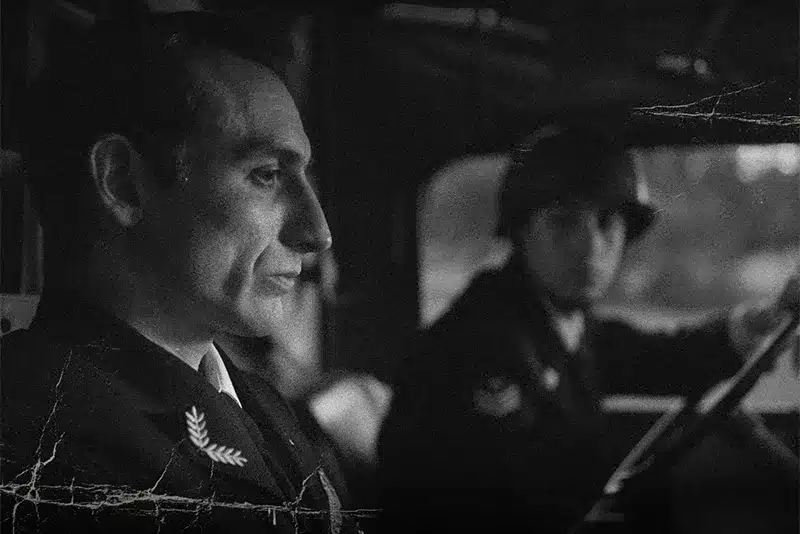
Nicolás Zárate, the film’s clear highlight, plays Silva as a man toughened by military life without reducing him to stiffness. Zárate stays alert to the political pressure surrounding Jorge, and the performance doesn’t depend on outward display. The drama lies in the face of a man trying to stay calm while the institution around him becomes increasingly hostile and unreadable. He is stern without becoming inexpressive. You can feel the stress in his bearing as every order begins to carry a moral cost.
The Red Hangar’s black-and-white photography takes away warmth, giving the military world a harder, more exhausted texture. The camera stays close to the protagonist, often handheld and in tight close-up, with a semi-documentary style that recalls the Dardenne brothers. It moves through corridors, vehicles, offices, and hurried exchanges. That style keeps the film moving and creates a mounting atmosphere of tension on the first day of the coup. People walk quickly, doors keep opening and closing, spaces keep narrowing, and the whole day takes on the nervous rhythm of a tightening trap.
Another form of motion has already shaped Silva’s life. The Red Hangar makes suggestive use of his background as a paratrooper. A paratrooper belongs to a world of freedom in open air, with the rush of feeling unbound when he is in the sky. Now he is in the opposite world: spaces where movement is a matter of compliance. A man whose training once implied openness now spends his most important day moving through institutions of confinement.
The film makes that tension more concrete through one recurring question: What does it feel like to fall from up there? The first time this is asked, it is by Sergeant Hernández (Arón Hernández), who has recently been transferred from the interior to Santiago. Silva drives him home, and the young man talks the whole way. Amid a paranoid military atmosphere, his enthusiasm stands out. He has never jumped, wants to become a paratrooper himself, and sees Silva as a figure to admire. In that first exchange, the question is simple curiosity.
When the question returns later, its context has completely changed. This time it comes from Colonel Jahn (Marcial Tagle), Silva’s longtime enemy and one of the men behind the earlier attempt on Allende’s life. Silva had denounced him for treason, and the fact that Jahn was never really removed from power speaks for itself.
After time in the United States, absorbing the harder anti-communist logic imposed on Latin America during the Cold War, he returns with the coup behind him and revenge in mind. In his mouth, the same question becomes a warning. Hernández asks about the thrill of height; Jahn asks about collapse. What once referred to parachuting now points to the growing sense that Silva himself may be pushed out of whatever place he still believes he holds within the institution, this time with no parachute to soften the fall.
Rosa (Catalina Stuardo), Silva’s wife, brings out something in him that the military world keeps trying to flatten. With her, the tension softens. He speaks to her with tenderness, as though he knows he does not have to carry the full strain of his life in her presence. She understands him without pressing him to explain himself, and their conversations bring a delicacy that seems almost incompatible with his line of work. In a film so full of corridors, orders, and tightening suspicion, their scenes briefly restore a feeling of peace.
When Colonel Jahn, under the guise of casual interest, asks Silva how his wife is doing and whether she is still so taken with strong political opinions, Silva answers with complete seriousness: she is a university history professor; it has nothing to do with politics. There may be no answer more obviously political than that one.
Jahn arrives at the Air Force Academy, where Silva has been kept after saving Allende (instead of being rewarded, he has been pushed aside). Jahn says he needs a large workspace. Silva takes him to an empty hangar, and Jahn accepts it immediately. Only then does he explain what the space is for. Prisoners will be brought there. Interrogations will happen there.
Silva, still thinking like an officer trying to preserve some minimum order, says he will arrange sleeping quarters and bathrooms. Jahn cuts him off at once: a worthless communist deserves a bucket, if that. Then he looks Silva in the eye and names the place himself: the Red Hangar. In a matter of minutes, an empty military space becomes a site for detention and abuse.
The Red Hangar does not distribute complexity equally; it draws a clear line against the regime. It should. The problem is that some of the prisoners are rendered too immaculately, as if their innocence were needed to justify Silva’s choices. It is not. The force of his actions comes from him, not from their purity. It is easy to show mercy to people one already admires or agrees with. Silva risks his life for people the institution expects him to despise.
The Red Hangar reaches that point in its last stretch, when he is ordered to drive prisoners to the National Stadium, and two of them are supposed to be killed on the way. He refuses and carries them there alive instead, saving them, among them Fernando Villagrán, whose book would later inspire the film.
Silva was arrested, tortured in the same military world in which he had served, held for a long time only meters away from the men he had saved, and later driven into exile in London, where he remained until 2024. He died before filming began. That ending places the weight where it belongs: on the integrity of a man who chose disobedience when obedience had already become criminal.