
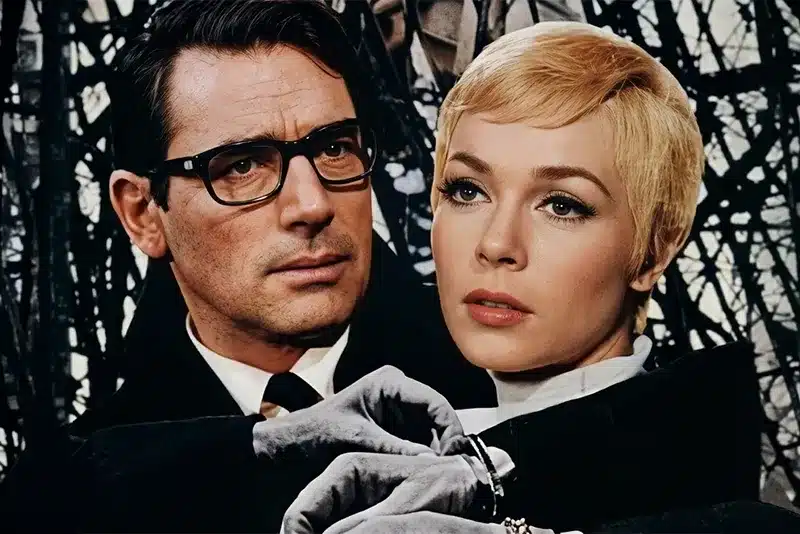
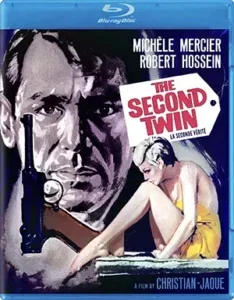
Christian-Jacque’s The Second Twin (1966) is a very 1960s slice of French sleekness packaged like a murder thriller. Well, it kind of is a murder thriller, although it’s mainly a character-driven drama of an adulterous affair between glamorous people. It works either way, as revealed in Kino Lorber’s new Blu-ray.
There are reasons to be confused. The French title, La Seconde vérité means “the second truth”. This makes sense, since much of the film consists of the man’s flashback to what happened, and the latter part gives us the woman’s flashback of the same events. Somewhere along the line, an American distributor must have decided that The Second Twin sounds more like a thriller. Maybe, but it doesn’t sound like this film, which doesn’t even have the first twin.
What The Second Twin does have is a relentlessly chic, flashy style in color and widescreen from the first second. The studio’s credit is presented in red over some kind of knit cloth background, then drops to a pure black screen when we hear gunshots. A rectangular iris opens on shadowy trees at night to the strains of a howling dog. The camera pans to a lighted house in the distance, then pans further to a train thundering past.
Finally, we see the dog still howling beside an outstretched arm in a red sleeve, presented in a Dutch angle. That means tilted, and seemingly half the shots throughout will be tilted in one direction or another.
The credits are presented frantically in red over black-and-white imagery through the windshield of a speeding car, and this is exactly the sort of credit sequence beloved by French thrillers of the era. The Second Twin then drops into the residence of a woman made up to look like Jean Seberg.
She’s Nathalie (Michèle Mercier), a medical student who deejays at a nightclub, although we don’t know that yet. She’s with Pierre Montaud (Robert Hossein), handsomely bespectacled, her married lover and prominent defense attorney, though we don’t know that yet, either. We only know at this point that when the police come knocking to inform her that an ex-boyfriend has been shot, Pierre ducks out.
When the police visit his busy office the next day, he admits he was with Nathalie and that his wife supposedly doesn’t know about the affair, even though everyone else in town does. Then begins the flashback of how they met at the disco and what trouble it is for ultra-busy glamour-pusses to find the time for conducting a decent affair. Come to think of it, the affair unravels so badly that they seem to have broken it off before the night of the murder, so why was he visiting her?
Anyway, since Pierre’s revolver was found at the scene of the crime and he has no alibi, he goes to trial. This event is presented off-screen and off-handedly. All this is only the first part of The Second Twin before it gets its second wind, and even that would be a better title.
As we’ve implied, style is foregrounded in every scene. The photography of Pierre Pettit is forever restless, seemingly handheld, panning and zooming to catch the characters’ multiple entrances and exits from each shot. Did we mention all the tilted angles? Did we mention the color red? Pierre’s law office is a monument to bright red walls, thanks to the design of Jacques Douy.
The editing by Jacques Desagneaux continually flips us about as the narrative drives forward, or rather spins in a vortex. Over it all, the score by Jacques Loussier, who’s also a noted jazz pianist, shifts from lyrical to dissonant to slinky to jazzy to disco go-go.
In charge of all this style is Christian-Jacque, a former art director and prolific French filmmaker who epitomized the postwar “Cinema of Quality” that French New Wave critics dismissed as dull and safe for its focus on literary and historical subjects and unadventurous themes. They especially turned up their critical noses at Christian-Jacque, since his films were so popular. In The Second Twin, he seems energized by the times, as though to say, “I’ll show you ’60s style, baby.”
David Thomson’s The New Biographical Dictionary of Film: Fourth Edition (2003) calls him “an unabashed exponent of ooh-la-la” who makes costume romances “full of curtains, candlesticks, and cleavage.” Georges Sadoul’s Dictionary of Film Makers (1965, translated 1972) cuts him some slack: “Undeniably a complete professional, he has a sense of conviction and often of liberality and has created many interesting films.”
Sadly, not many examples of his liberality are available in Region 1 beyond this and Kino Lorber’s edition of his 1964 Alain Delon swashbuckler The Black Tulip (La Tulipe Noir), which probably has a few candlesticks. We’ll let you know.
The Second Twin is among the many films pairing Mercier and Hossein, who are best known for a series of costumers about a heroine named Angelique. A rather breathless commentary track by film writer Simon Abrams spends a lot of time discussing these films and the actors’ careers, as well as quoting from critical articles on Christian-Jacque, who sounds like someone deserving more exposure on home video.
The Second Twin is one of half a dozen titles produced by the remarkable Agnès Delahaie, also known as Annie Dorfmann. René Clément’s Gervaise (1956) earned her an Oscar nod in the Foreign Film category, and she produced two masterpieces by Robert Bresson: Pickpocket (1959) and The Trial of Joan of Arc (1962), the latter of which remains frustratingly unavailable on video in Region 1.
As a whodunit, The Second Twin is a nifty tease whose resolution might surprise you, unless you pull yourself away from the dazzle long enough to analyze the story. It doesn’t involve a twin. As an ultra-chic romantic entanglement from the era that gave us such lush swooners as Richard Quine’s Strangers When We Meet (1960), Jules Dassin’s Phaedra (1962), and Louis Malle‘s A Very Private Affair (1962), it’s very much up the same widescreen alley. It’s no masterpiece and doesn’t need to be; it’s just enjoyable bourgeois cinema.