
At this writing, media outlets have reported that President Donald J. Trump and the Department of Defense are preparing a $200 billion supplemental request for the conflict in Iran. Perhaps the ceasefire will alter that figure. It’s a convenient coincidence that $200 billion is essentially what Elon Musk, Vivek Ramaswamy, and the Department of Governmental Efficiency (DOGE) claimed to save the American taxpayers.
Observers argue the DOGE figure is inflated. Yet taken at face value, that the government allegedly saved $200 billion in the spring of 2025 and then found a new way to spend $200 billion in the spring of 2026 is the ideal portrayal for how government – regardless of party in power – voraciously gorges on every possible penny.
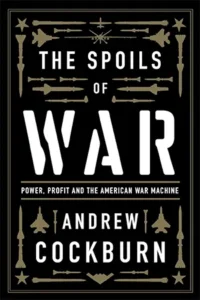
Andrew Cockburn, Washington editor for Harper’s, explains this in his 2021 book The Spoils of War: Power, Profit, and the American War Machine. It is a collection of articles and essays that Cockburn published in Harper’s from 2013 through 2021. Given current events, it’s worth examining this work because Cockburn’s warnings and arguments have been proven, time and time again.
The central point of The Spoils of War is that the Military-Industrial Complex, as Dwight D. Eisenhower labelled it, is, essentially, “alive”. Cockburn writes that the defense contractors, consultants, generals, lobbyists, politicians, and media partnered to create a sprawling organism that has a “built-in self-defense reflex that reacts forcefully whenever a threat to its food supply – our money – hits a particular trigger point. The implications are profound, suggesting that the Military-Industrial Complex is embedded in our society to such a degree that it cannot be dislodged, and also that it could be said to be concerned, exclusively, with self-preservation and expansion, like a giant, malignant virus.”
Cockburn quotes researchers and budget figures that demonstrate that, since the Korean War, any temporary decreases in US military spending never “dipped below where the budget would have been if it had simply grown at 5 percent per year from 1954 on”, with one exception in the 1960s. Since spending never decreased, no so-called “peace dividends” ever went to the American public, even as the Cold War thawed and various adversaries were vanquished.
Some citizens and politicians criticize America’s role as the world’s police force. Think of what Americans could do if they didn’t have to spend so much protecting countries that should protect themselves, they argue. Imagine the riches Americans could shower on education, infrastructure, or the homeless (The call for universal health care is rarely heard in the din in these times.)
Defense contractors Lockheed Martin, Boeing, and Northrop Grumman, however, always have a new need. President Trump created the Space Force in December 2019. The “Magma Force” is probably next up.
“We have to dominate the Earth’s core, Mr. President!” the death sellers shout. “The future frontier is in the middle. Didn’t you watch that Monarch show? Godzilla travels through high-speed tunnels. If we don’t get in there first, the Russians will, and it’ll be game over.”
“Sign us up!” the president will reply. He might use a Sharpie to sign the paperwork, or a Montblanc. Maybe an autopen. Doesn’t matter. The outcome is the same.
Cockburn frequently repeats an old saw from military observers: the Military-Industrial Complex creates weapons that don’t work to meet threats that don’t exist.
There are a few chapters that are particularly timely.
Cockburn’s “Tunnel Vision,” published in Harper’s in 2014, documents leadership’s long-running attempts to kill the effective A-10 Warthog airplane in favor of a more complex, exponentially more expensive, but highly unproven aircraft. The F-35 costs $200 million per plane, while the A-10 costs only $20 million. No matter. The F-35 has been strategically inoculated – in spite of its near historic levels of cost overruns and waste – by supporting hundreds of thousands of jobs in 45 states.
An A-10 was one of the planes that crashed in the Iranian conflict.
In “The Military-Industrial Virus”, published in magazine form in 2019, Cockburn presciently writes that, “A single mine (and Iran has thousands of them) in the Strait of Hormuz, through which a third of the world’s oil transported by sea passes every day, would throw markets into total chaos.” Ahem.
In a 2016 article, Cockburn describes “the new red scare”, where observers overestimate Russian military prowess for increased American spending. Cockburn quotes a retired general who states that “the performance of Russian artillery in Ukraine [in the 2014 taking of Crimea] strongly demonstrates that, over the past two decades, the Russians have gotten a technological jump on us.” He also points out that “The Russians’ T-14 Armata tank is similarly hailed in the defense press as a source of major concern for western armies.”
The hyperbolic accounts of Russian strength juiced military spending here in America, but the truth was revealed in 2022 when President of the Russian Federation Vladimir Putin’s army didn’t have gasoline for tanks. No matter. The hyperbole over Putin’s claim about hypersonic missiles generated buzz in the industry. Breathless claims about hypersonic weaponry still appear in the media today.
To be clear, the Putin examination is an example of how Andrew Cockburn skewers both political parties for their fealty to the machine. In the lead-up and immediately after Russia’s most recent invasion of Ukraine, Putin justified his actions by referencing broken promises about NATO.
In 1990, United States Secretary of State James Baker was among Western officials who promised that NATO would not expand. However, Poland, Hungary, and the Czech Republic joined the group in 1999 during the William Clinton administration. A major component of these developments was arms sales to the new organization members.
Cockburn is also clear that his criticism of the Military-Industrial Complex does not filter down to rank-and-file soldiers. In fact, the greed of the beast shortchanges the fighters on the frontlines. “Our military leadership is driven to pour funds into technologically complex weapons-systems, thereby skimping on troops’ basic needs,” Cockburn writes. “We’re left with a fighting force that needs to rely on loved ones for vital needs such as armor and night-vision goggles, while we throw hundreds of millions of dollars at exotic contraptions,” he points out in another chapter.
Despite spending exponentially more than its adversaries on military readiness, America is somehow the most powerful fighting force in human history while also being woefully behind the times in perpetuity. Cockburn only quotes military experts. He doesn’t reach for more literary references. Still, a “and so it goes” quote would not be out of place.