
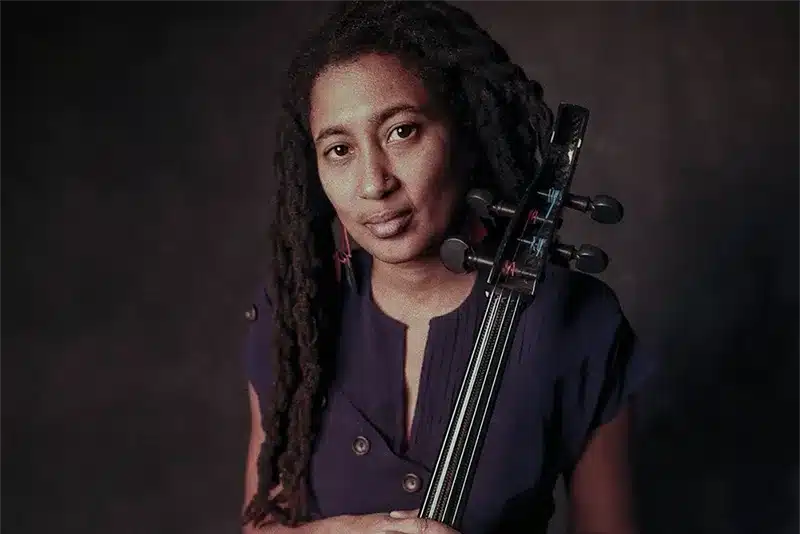

The cello hasn’t been a prominent instrument in jazz. Why? It occupies the beautiful range of the human voice, not unlike the tenor saxophone.
The history is notable but brief. Fred Katz, a classically trained student of Pablo Casals, played a key role in Chico Hamilton’s band and recorded as a leader in the late 1950s. The bassists Oscar Pettiford and Ron Carter both recorded as cellists for a period. In more avant-garde jazz, the cello became an important part of the scene in the hands of musicians such as Abdul Wadud. Wadud played a key role in recordings by Julius Hemphill (Dogod AD, 1972), Arthur Blythe (a great run of albums starting with 1977’s Metamorphosis through three albums on Columbia in the early 1980s), and others. And his own albums By Myself (solo cello, 1977) and I’ve Known Rivers (with flautist James Newton and pianist Anthony Davis, 1984) are astonishing in craft and creativity.
More recently, Erik Friedlander, Hank Roberts, and Tomeka Reid have been further elevating the profile of the cello in improvised music. And Reid’s new Dance! Skip! Hop! uses her excellent quartet to demonstrate how the instrument can lead and bring together a modern jazz ensemble.
This is the fourth album for the quartet over 12 years, a notably stable lifespan for a band in the new century. The result is a fresh recording that sounds like an evening hanging out with cool, insanely talented friends. There is something playful about the record, even when it produces its most sweeping and carefully sculpted performances.
“A(ways) For CC and CeCe” is simultaneously intricate and playful. It opens with drummer Tomas Fujiwara tap-dancing along his toms as if they were the tuned tablas of India, as Mary Halvorson‘s guitar and Jason Roebke’s acoustic bass play a funky syncopated line beneath. The leader is soon improvising along with the drums before the main theme for cello and guitar takes over. Fujiwara’s double-time groove never lets up, and you are soon dancing along with the band.
What Tomeka Reid and her band do so well on this track is a key element of her larger aesthetic. On the one hand, a feeling of dancing is central to this music. It is light on its feet. As the album’s title properly asserts, it hops and skips. Reid’s and Halvorson’s improvisations each occur for a long stretch over a two-chord vamp that would be happily at home in a jam band performance. It is also true that Reid’s hummable composition rides over shifting harmonies and rhythms, culminating in a cool little figure. The direct and the slyly indirect play together well.
The same can be said for funky “Oo long!” with its powerful bass line and backbeat out front and a melody that is more a set of James Brown horn hits than a winding road. Tomeka Reid, for all her avant cred (from the Chicago scene, a member of the Association for the Advancement of Creative Musicians), brings to mind the most gratifying part of that scene. You can dance to Julius Hemphill’s “Dogon AD” even if it challenges your ears a bit, and this track is the same: set over an irregular rhythm, it still gets its groove on.
The longest and seemingly “heaviest” track here is the mournful ballad “Under the Aurora Sky”, but even this performance lifts into thin air. Reid bows the melody over a slow, soulful bass line, with guitarist Mary Halvorson playing a gentle countermelody. After stating it for the second time, the cello, bass, and guitar play a funk lick in octaves to launch the improvisations. This is the finest Halvorson performance on the album: patient and phrased very much like a singer’s line, with flowing logic but pauses for breathing. Tomeka Reid plays her solo arco, using some of the cello’s highest register to reach upward with tremolo drama. Both improvisations are accompanied by atmospheric electronics, and the cello solo also shimmered with designed reverb.
Dance! Skip! Hop! uses some of these electronic gleams — as well as Halvorson’s signature electric guitar sound, with its pedal effects that bend her tones in quirky ways — but it mostly sounds like acoustic string-band music. As you listen to “Silver String Fig Tree”, the aural reference could be folk music or Irish music as easily as jazz.
Roebke’s acoustic bass and Reid’s cello harmonize in pizzicato reverberation as we hear both the pure vibration of the guitar strings and just a glimmer from Halvorson’s amp. Fujiwara plays on a couple of toms for a long stretch, sounding like a hand percussionist or bodhrán virtuoso. At about the 1/3 mark, however, the performance implodes on itself and embraces atmospheric/electronic adventure, only to reform itself as a quiet drum solo for Fujiwara (and then others) over slightly dissonant parallel lines.
Reid chooses to open the record with an utterly winning title track. This string-band feeling is strong here too, with a joyous repeated-note theme that the band brings back behind thrilling cello, guitar, and bass solos. The improvisations then incorporate the theme, creating playful rounds. Halvorson’s solo here is notable. Using her signature modern guitar sounds, she nevertheless sounds almost traditional in how she creates a series of swung single-note phrases with occasional chordal punctuations.
Halvorson is one of the most interesting musicians of recent years. She has achieved critical acclaim and has an immediately recognizable style and sound — arguably the most original approach and guitar sound since Pat Metheny emerged 50 years ago. But she has drawn some (quiet) criticism as well — like other players associated with more avant-garde jazz, she hasn’t often recorded jazz standards or been part of projects where she showed a command of bebop chops. That said, on the album Theirs by the cooperative band Thumbscrew, Halvorson’s swing phrasing and guitar comping were both accomplished and fresh. Some of that range also shows up in her playing with the Tomeda Reid Quartet.
That’s what I love about this album and band, overall. Tomeka Reid, Mary Halvorson, Jason Roebke, and Tomas Fujiwara play and communicate with infectious emotion and a high degree of freedom — jazz virtues. They aren’t recreating the tradition or looking backwards. Still, the music is full of the elements that have always made it fun to hear: a groove, memorable melodies, and collective spirit and conversation. It’s not hard to hear or academic, but it is still part of the vanguard or a living music.