
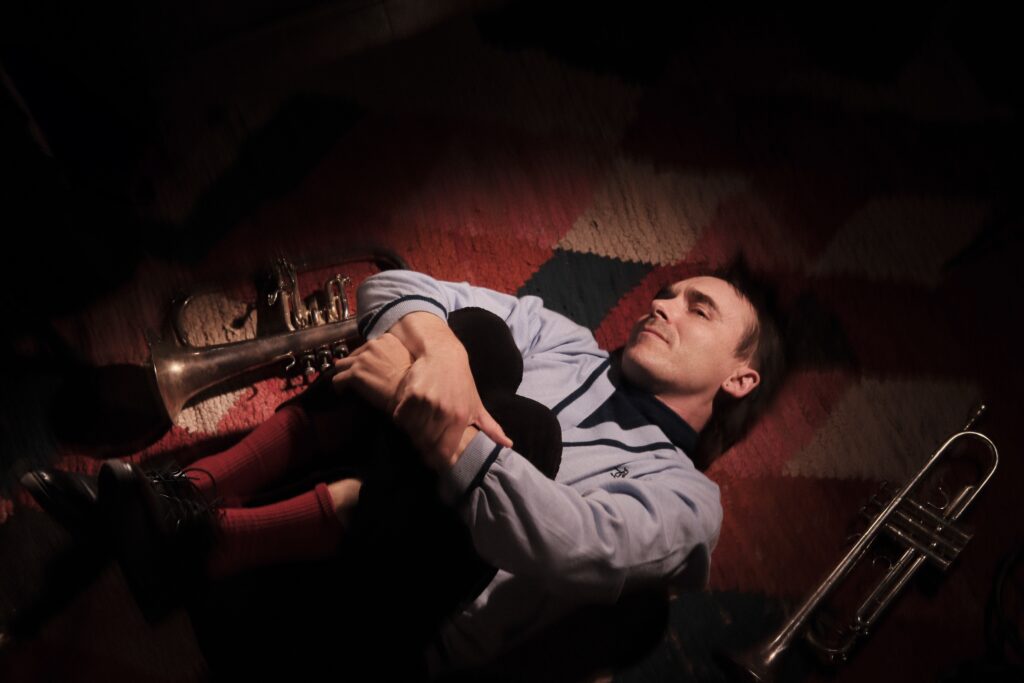
Brooklyn-based songwriter and multi-instrumentalist Alex Toth charts the wild permutations of emotion, both as one half of the indie art-pop duo Rubblebucket and across his solo work under the Tōth moniker. His strongest work turns compassionately toward the unsettled self while balancing a pop sensibility that is both danceable and honest.
Across his Tōth releases—Practice Magic and Seek Professional Help When Necessary (2019) and You and Me and Everything (2021)—Toth continues polishing this mode of musical catharsis, which he has also explored within Rubblebucket’s more kinetic, outward-facing framework. On his latest full-length, And the Voice Said, this instinct fully coheres. Here, it lingers longer, stretches further, and settles more deliberately into form.
Co-producer Caroline Rose leaves an immediate imprint by tightening structures, sharpening arrangements, and pulling Toth back from his instinct to dissolve into abstraction. “Not Broken” opens the record with a tenderhearted bounce more powerful than it first appears, disarming the listener with a subtlety so deft you only later realize you had your guard up at all. It moves with subtle confidence, slipping past scepticism—even that of the hardened rock critic—and proving how susceptible we remain to its charms.
By the song’s close, when a chorus asks us to “open our hearts to the universe,” it should invite an eye roll. Instead, it catches the heart off guard, compassionately cleaving it open, regardless of any instability that might follow. That instability comes into sharper focus on “Spiraling”, one of the album’s most dynamic tracks. Here, Toth’s trumpet playing stretches and fractures artfully, a practice in controlled escalation.
“Thoughts Are Clouds” moves with polyrhythmic curiosity, its mellow chamber-pop arrangement buoyed by a resonant trumpet line that is at once stately and restless. Lyrically, Toth leans into a loosely philosophical framework, drawing not from Ram Dass, a compassionate social worker, or a highly degreed psychologist, but from a harder-won truth he recalls being reiterated in a thick New York accent at a recovery meeting.
That tension between intellect and instinct runs throughout the record, but nowhere does it feel more exposed than on “Easy.” The music video brings that unease into sharp, imaginative focus: Toth appears in an intricate insect costume, complete with articulated, raptorial legs that fold back like pocket knives—a clever and visually striking nod to Franz Kafka’s The Metamorphosis.
The Metamorphosis famously tells the story of Gregor Samsa, who awakes to find himself inexplicably transformed from a man into an insect. Stripped of his familiar human form, Gregor can no longer fulfill the roles his family depends on, breeding rupture, resentment, and devastating isolation. Toth channels that same psychic dislocation, the growing realization that the self you fall asleep as may not be the self that wakes, and that the world offers little sympathy for that instability.
It captures the devastation that estrangement from the self can create, rendering one unable to meet the world’s expectations and forcing one to negotiate the aftermath as best as possible.
The middle stretch of the album—“Ageless Moon”, “Ice Cream”, “Triangle People”, and “Goo”—loosens structurally and widens stylistically. “Goo” features a buoyant indie-pop framework supported by Rose’s detailed production. A brief synthesizer passage delivers a playful, almost retro-futurist texture, reminding us how effective Toth can be when his instincts for melody and arrangement align. “Triangle People” leans further into abstraction, its imagery and textures becoming more viscous and disorienting. These shifts in tone keep the album from stagnating, though they can also make it feel uneasy.
“Ice Cream”, in particular, channels a kind of wide-eyed sincerity reminiscent of Jonathan Richman. Toth doesn’t quite arrive at Richman’s effortless presence, a gap he seems more aware of than we as listeners could ever be, reaching for a childlike openness, a desire to “make songs up” rather than construct them. That looseness occasionally wavers into awkwardness, but just as often, it opens toward moments of disarming warmth.
By the time the record reaches the wistful, soul-wrenching sweetness of its final track, “Light As a Feather”, featuring Caroline Rose, it settles into an ache, a longing to hold together something already slipping apart. The song carries a fragile acceptance, not quite peace, but something close enough to feel like it.
That refusal to resolve ultimately defines And the Voice Said. Toth does not present himself as transformed or healed; instead, he traces the persistence of those internal conflicts. Clarity arrives in flashes, only to give way to doubt or contradiction. The emotional arc doesn’t build so much as it oscillates, between self-assurance and self-questioning, simplicity and complexity, grounding and drift.
Musically, the record pulls from across Toth’s career. The horn arrangements echo the exuberance of his work with Rubblebucket, while the lyrics remain rooted in the self-reflective, diary-like mode of his solo material. Under Rose’s guidance, these parts cohere with greater intention, though not always seamlessly. The album feels lived-in and immediate, even as it occasionally overreaches, stretching beyond what it can fully hold.
Still, And the Voice Said makes space for discomfort, contradiction, and the uneasy coexistence of optimism and despair. It doesn’t resolve those tensions, but it renders them, briefly, more bearable. Tōth doesn’t emerge as a figure of clarity or enlightenment. He remains in process, tuning himself moment by moment toward something akin to alignment. The result is an album that may not fully cohere as one might expect, but it never feels insincere—and for Tōth, that remains the point.